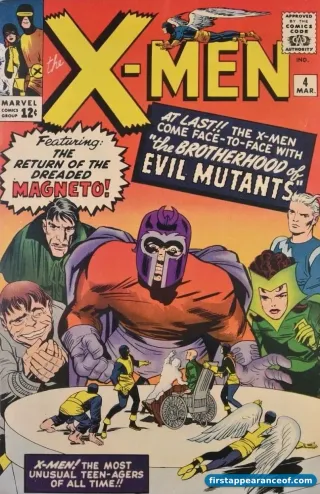
X-Men #4 (1964). Wanda debuts inside as a member of Magneto's Brotherhood.

1st Appearance and 1st Cover

First Appearance of Scarlet Witch

X-Men #4

March 1964 · Marvel · Silver Age

Magneto's daughter (formerly), Quicksilver's twin sister, the Vision's wife, and the Marvel character whose reality-warping powers reshape continuity every decade or so.

Key Issue

Created by Stan Lee · Jack Kirby

By Atomm Updated

The first appearance (1st app) of Scarlet Witch is X-Men #4 (March 1964), created by Stan Lee and Jack Kirby. Wanda Maximoff debuts as a reluctant member of Magneto's Brotherhood of Mutants alongside her twin brother Pietro (Quicksilver). The same issue contains first appearances for the Brotherhood, Quicksilver, Toad, and Mastermind. Wanda defects to the Avengers in The Avengers #16 (May 1965) and has been a long-serving Avengers member since. Her first solo title is Scarlet Witch #1 (January 1994).

Quick Facts

Debut
X-Men #4 (March 1964)
Real name
Wanda Django Maximoff
Creators
Stan Lee (script), Jack Kirby (art)
Publisher
Marvel Comics
First enemy
The X-Men (her initial Brotherhood-aligned opposition)
First ally
Quicksilver (her twin brother), Vision (her long-running romantic partner)
Team affiliations
Avengers (long-serving), Brotherhood of Mutants (origin), Force Works

Firsts Timeline

  1. X-Men #4 cover
    First Appearance First Cover March 1964

    X-Men #4

    By Stan Lee, Jack Kirby

    Wanda Maximoff debuts as a reluctant member of Magneto's Brotherhood of Mutants alongside her brother Pietro (Quicksilver). Same issue: first Brotherhood, first Quicksilver, first Toad, first Mastermind. One of the most consequential multi-debut Silver Age books.

    Read the full breakdown
  2. First Solo Title January 1994

    Scarlet Witch #1 (limited)

    By Dan Abnett, Dario Carrasco Jr.

    Four-issue limited series. The character had been an Avenger for thirty years before getting a dedicated title.

    Read the full breakdown

Creation Story

Wanda Maximoff is Stan Lee and Jack Kirby’s Silver Age Brotherhood of Mutants member. X-Men #4 (March 1964) introduces her with her twin brother Pietro (Quicksilver), Toad, and Mastermind as Magneto’s expanded Brotherhood roster. Wanda’s hex-power framework was distinct from her brother’s speed: she could affect probability, causing things to go wrong for her opponents. Lee and Kirby designed her as ambivalent toward Magneto’s mutant-supremacist ideology, looking for an exit from the Brotherhood from her introduction.

The Avengers #16 (May 1965) moves Wanda and Pietro to the Avengers as part of Captain America’s Kooky Quartet (Cap, Hawkeye, Quicksilver, Scarlet Witch). The Avengers tenure has been Wanda’s primary team affiliation across decades of subsequent comics, with the Brotherhood appearing as an origin rather than ongoing affiliation.

The reality-warper era

Wanda’s powers expanded substantially across the 1970s and 1980s. The Chaos Magic framework, introduced during her Vision-era marriage and developed across decades, repositioned her from a hex-power Avenger into one of the most powerful beings in the Marvel Universe. Two events crystallize the modern Scarlet Witch:

Avengers Disassembled (Avengers #500, August 2004) by Brian Michael Bendis. Wanda’s mental break following the deaths of her twin children kills several Avengers (Vision, Hawkeye, Ant-Man) and disbands the team. The arc reframes Wanda from heroine to existential threat.

House of M #1 (August 2005) by Bendis and Olivier Coipel. Wanda rewrites reality into a mutant-dominant world. When the alternate reality is unwound, her words “no more mutants” depower most of the worldwide mutant population. The Decimation framework dominates X-Men publishing for the next decade.

The MCU era

Elizabeth Olsen’s Wanda debuted in Avengers: Age of Ultron (2015) and was the lead of the WandaVision Disney+ series (2021). The series adapted the Vision-marriage and twin-children framework from the John Byrne and Tom King runs and reset the character’s cultural visibility at scale. Doctor Strange in the Multiverse of Madness (2022) had Olsen play Wanda as the film’s primary antagonist, drawing from the House of M and Darkhold storylines.

Collector context

X-Men #4 is the Scarlet Witch Silver Age key. See the Quicksilver and Magneto pages for pricing context. The compounded multi-debut weight makes the book substantially more valuable than most Silver Age second-tier keys.

Secondary keys: The Avengers #16 (joins Avengers). The Avengers #500 (Disassembled). House of M #1 (2005). Scarlet Witch #1 (1994 first solo) and Scarlet Witch #1 (2015 first ongoing).
Key subsequent appearances

After the debut, these are the issues collectors and historians reach for next.

  1. 1964

    X-Men #4

    First appearance.

  2. 1965

    The Avengers #16

    Joins Avengers

    Defects from Brotherhood. Cap's Kooky Quartet.

  3. 2004

    Avengers Disassembled / The Avengers #500

    Disassembled

    Brian Michael Bendis. Wanda's mental breakdown destroys the Avengers and kills Vision, Hawkeye, and Ant-Man. Sets up House of M.

  4. 2005

    House of M #1

    House of M

    Brian Michael Bendis and Olivier Coipel. Wanda rewrites reality. 'No more mutants.' Decimation event reduces the worldwide mutant population from millions to under two hundred.

  5. 2015

    Scarlet Witch #1 (2015)

    James Robinson and Vanesa Del Rey. First Scarlet Witch ongoing.

In adaptations

Film, TV, animation, and game appearances.

  1. 2015

    Avengers: Age of Ultron

    Film

    Starring:Elizabeth Olsen

    Joss Whedon directs. Olsen's Wanda debuts in the MCU.

  2. 2021

    WandaVision

    TV

    Starring:Elizabeth Olsen

    Disney+ series. Olsen's Wanda in the lead. Nine episodes. Widely regarded as one of the strongest MCU television entries.

  3. 2022

    Doctor Strange in the Multiverse of Madness

    Film

    Starring:Elizabeth Olsen

    Sam Raimi directs. Olsen's Scarlet Witch as the film's primary antagonist. Adapts the House of M and Darkhold framework.

Frequently asked questions

The questions readers and collectors ask most.

What is Scarlet Witch's first appearance?

Scarlet Witch's first appearance is X-Men #4 (March 1964), created by Stan Lee and Jack Kirby. The issue is also her first cover. She debuts as a reluctant member of Magneto's Brotherhood of Mutants alongside her twin brother Quicksilver.

Is X-Men #4 valuable?

Yes. X-Men #4 is a Silver Age Marvel key with compounded first-appearance weight: Brotherhood of Mutants, Quicksilver, Scarlet Witch, Toad, and Mastermind all debut in the issue. High-grade copies (CGC 9.0 and above) have crossed $40,000 at auction. The book's value has accelerated substantially with Elizabeth Olsen's MCU performance starting in 2015.

Is Wanda still Magneto's daughter?

Not in current continuity. Claremont-era X-Men canonized Wanda and Pietro as Magneto's biological children in the early 1980s. AXIS #7 (December 2014) retconned the parentage; the Maximoff twins are no longer biologically related to Magneto. The retcon stands but is frequently ignored by writers who find the father-children relationship more useful narratively.

What is House of M?

House of M is a 2005 Marvel crossover event by Brian Michael Bendis and Olivier Coipel. Wanda, in a mental break following the death of her children, uses her reality-warping powers to rewrite reality into a mutant-dominant world. When the alternate reality is unwound, Wanda speaks the words 'no more mutants,' which depowers most of the worldwide mutant population. The Decimation framework defined the next decade of X-Men continuity.

What are Wanda's powers?

Reality manipulation, originally framed as 'hex powers' that could affect probability. Modern continuity has expanded her powers substantially; she is canonically one of the most powerful beings in the Marvel Universe. The Chaos Magic framework introduced in the 1980s and expanded across House of M and Darkhold storylines positions her as effectively a god-tier reality-warper. Elizabeth Olsen's MCU performance draws on the modern reality-warping framing rather than the Silver Age hex framework.