Creation Story
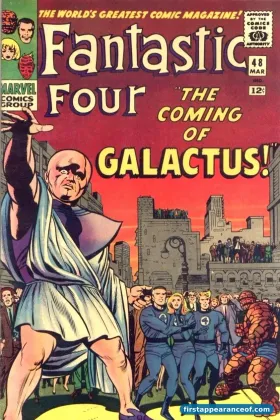
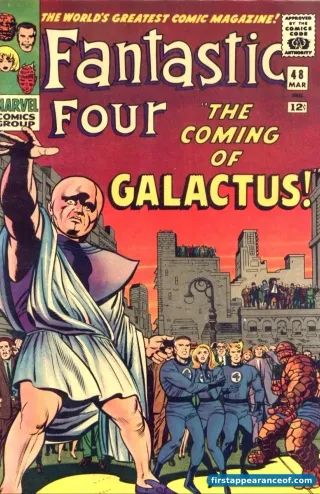
Galactus was Jack Kirby’s cosmic-scale experiment for Marvel. By 1966 Kirby had been drawing Fantastic Four for nearly five years and was pushing the book toward increasingly ambitious science-fiction territory. Fantastic Four #48 (March 1966) launched what readers would come to call the Galactus Trilogy: a three-issue arc (#48 to #50) that introduced Galactus, Silver Surfer, and reshaped the entire cosmic scale of Marvel storytelling.
The debut is structurally a cameo. FF #48’s final page shows Galactus in silhouette, looming above Earth. Silver Surfer appears in full on the cover and inside the issue as Galactus’s Herald. Fantastic Four #49 (April 1966) is Galactus’s first full appearance: Kirby’s complete design, the purple-and-pink armored cosmic-warrior silhouette, the massive helm with the horned antennae. Sixty years later this design has been essentially unchanged.
Stan Lee scripted the dialogue and provided the plot framing. The Galactus concept, visual design, and cosmic-scale operational grammar are Kirby’s. Lee’s contribution was the verbal register and the thematic framing of Galactus as a cosmic necessity rather than a moral villain. The Trial of Galactus arc (FF #262, 1984) that John Byrne later wrote formalized this ambiguous positioning.
Fantastic Four #50 (May 1966) concluded the trilogy. Silver Surfer defects against Galactus to save Earth. Reed Richards obtains the Ultimate Nullifier, a weapon capable of destroying Galactus, and the threat forces Galactus to retreat. The Silver Surfer is marooned on Earth as punishment for his defection. All three issues are Silver Age Marvel keys; FF #48 is the single most valuable of the three because of Silver Surfer’s primary first-appearance weight.
The Trial of Galactus
John Byrne’s Fantastic Four #262 (January 1984) is the second-most-consequential Galactus book after the original trilogy. Byrne writes and pencils. The story has Reed Richards put on trial by a cosmic tribunal for saving Galactus’s life during an earlier storyline. The defense Byrne constructs: Galactus is a cosmic necessity, a balancing force older than the current universe, and his destruction would create a greater harm than his consumption of individual worlds. The trial ends in Reed’s acquittal.
The arc reframed Galactus from villain into cosmic-scale ambiguity and is the reference point for every subsequent Galactus story. Modern Marvel treats the character consistently with Byrne’s positioning.
Collector context
Fantastic Four #48 is one of the most important Silver Age Marvel keys, primarily for Silver Surfer’s first appearance and secondarily for Galactus’s cameo. High-grade CGC 9.0+ copies have crossed $300,000 at auction. The book trades alongside Amazing Fantasy #15, Fantastic Four #1, and X-Men #1 as a foundational Silver Age required book.
Fantastic Four #49 (first full Galactus) is a secondary key and trades at a substantial discount relative to #48 because the primary Silver Age first-appearance demand is concentrated in #48. Fantastic Four #50 (Galactus Trilogy conclusion) is a tertiary key.
The 2025 MCU film The Fantastic Four: First Steps with Ralph Ineson voicing Galactus re-accelerated collector demand on FF #48 and the surrounding Kirby issues.