What Earth-1610 was
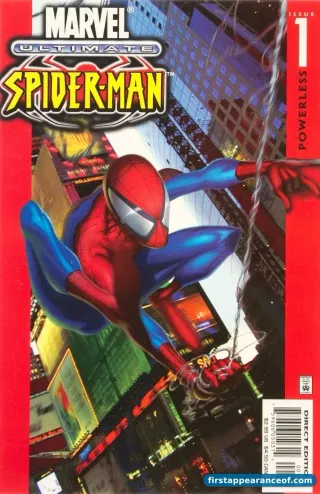
Brian Michael Bendis and Mark Bagley launched the Ultimate Marvel imprint in October 2000 with Ultimate Spider-Man #1. The pitch was a parallel Marvel continuity that started fresh: younger characters, contemporary settings, no requirement to acknowledge thirty-five years of accumulated 616 continuity. Marvel’s editorial premise was that new readers drawn to the upcoming 2002 Spider-Man film would need a clean entry-point, and Ultimate Spider-Man would provide that.
The strategy worked. Ultimate Spider-Man ran for 160 issues across eleven years, one of the most-successful Marvel launches of the 2000s. The Ultimate line expanded with Ultimate X-Men (2001), Ultimates (Mark Millar’s 2002 reframing of the Avengers, structurally important for shaping the eventual MCU), Ultimate Fantastic Four, and various ancillary titles. The line built its own cohesive continuity across roughly fifteen years of publishing.
Earth-1610 as a numerical designation was applied later. At launch, the imprint was simply Ultimate Marvel. The Earth-1610 codification came in the 2005 Official Handbook of the Marvel Universe: Alternate Universes, which formalized the imprint’s position in Marvel’s broader multiverse cataloging. Subsequent Ultimate-line stories used the designation explicitly.
Why the line ended
By the early 2010s, the Ultimate line was experiencing the same continuity-creep problem the original Earth-616 had been experiencing in 2000. Eleven years of Ultimate publishing had accumulated their own complex continuity: characters had died, relationships had shifted, the political register had darkened (Mark Millar’s Ultimates and The Ultimates 2 had pushed the line toward grim political-thriller framing), and new readers were finding the line as inaccessible as the original 616.
The 2008 Ultimatum event, written by Jeph Loeb with art by David Finch, killed off a substantial portion of the Ultimate-line cast. The event was poorly received and is generally considered the moment the Ultimate line lost its narrative momentum. Subsequent Ultimate publishing struggled to recover.
The 2015 Secret Wars event by Jonathan Hickman provided the structural mechanism for ending the imprint. The event collapsed Marvel’s multiverse, with multiple parallel Earths (including Earth-1610) destroyed during the lead-up. Surviving characters from multiple parallel Earths were folded into the post-Secret-Wars Earth-616. Miles Morales and his family transferred over and have remained 616 characters since. The Ultimate imprint formally ended with Secret Wars #9 (December 2015).
Miles Morales
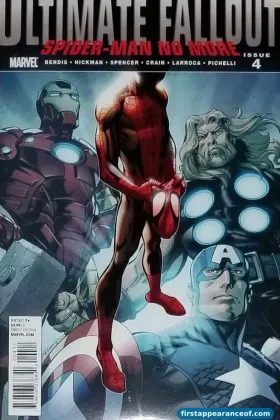
The most consequential single character originated on Earth-1610: Miles Morales, who debuted in Ultimate Fallout #4 (August 2011) under Brian Michael Bendis and Sara Pichelli. Earth-1610’s Peter Parker had died in Ultimate Spider-Man #160 (June 2011); Miles took over the Spider-Man identity in the Ultimate Universe and quickly became one of Marvel’s most-prominent new characters of the 2010s.
Miles transferred to Earth-616 during Secret Wars (2015) along with his family. He has been a mainline Marvel character ever since, with his own Spider-Man title, prominent cross-team appearances, and the lead role in the Spider-Man: Into the Spider-Verse animated film franchise. The film franchise (Into the Spider-Verse 2018, Across the Spider-Verse 2023, Beyond the Spider-Verse forthcoming) has made Miles one of the most-recognized superhero characters of the 21st century.
The Earth-1610 designation has gained collector value primarily because of Miles. Ultimate Fallout #4 trades in the high four to mid five figures at CGC 9.8, well above any other Ultimate-imprint issue. The Miles-Morales transition from Ultimate to mainline Marvel is one of the most-cited recent examples of a parallel-universe character being elevated to primary-continuity prominence.
The 2024 relaunch
Marvel relaunched the Ultimate imprint in November 2023 with Ultimate Universe #1, written by Jonathan Hickman with art by Stefano Caselli. The new line uses Earth-6160 as its numerical designation, deliberately distinct from the original Earth-1610. The 2024 Ultimate Spider-Man features a 35-year-old Peter Parker who is married to Mary Jane and has children; the framing is closer to a long-postponed Marvel-mainstay aging-up than a teen-superhero reset. Ultimate X-Men (Peach Momoko writing and drawing) and Ultimate Black Panther (Bryan Hill and Stefano Caselli) round out the new line.
The 2024 Ultimate line is structurally separate from the original Earth-1610. Marvel editorial has been clear that Earth-6160 is a new parallel universe rather than a restoration of the imprint that ended in 2015. The new line has been well-received commercially through 2024 and 2025; whether it sustains will depend on whether Marvel can avoid the continuity-creep that ultimately ended the original Ultimate line.
Collector context
Ultimate Spider-Man #1 (October 2000) is the canonical Earth-1610 first-appearance key and the foundational Ultimate-imprint launch. CGC 9.8 trades in the high three to low four figures depending on cover variant. Mark Bagley’s art and the Bendis script have held the book’s market position strong since launch.
Ultimate Fallout #4 (August 2011) is the apex Ultimate-imprint key, driven by the Miles Morales first appearance. CGC 9.8 trades in the high four to mid five figures, with significant variance by cover variant (Sara Pichelli’s variant cover trades higher than the standard cover). The Spider-Verse film franchise has kept the book’s market position growing through the 2020s.
The Ultimates #1 (March 2002) by Mark Millar and Bryan Hitch is the second-tier Ultimate-imprint key. The book is structurally significant because it shaped the eventual MCU’s visual and tonal register; Nick Fury’s Samuel L. Jackson casting in the MCU was specifically because the Ultimate-line Nick Fury was visually based on Jackson. CGC 9.8 trades in the low to mid three figures.