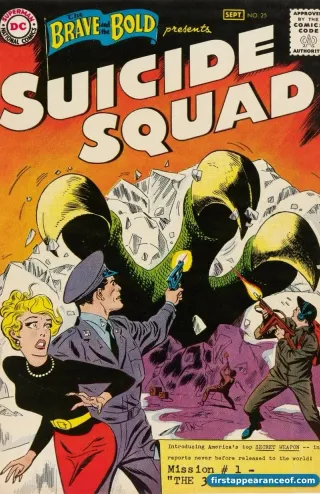
First appearance of Suicide Squad — the cover of The Brave and the Bold #25 (1959).

1st Appearance

First Appearance of Suicide Squad

The Brave and the Bold #25

August 1959 · DC · Silver Age

DC's disposable black-ops team: convicts sent on missions they may not survive, with a roster designed to lose members.

Key Issue

Created by Robert Kanigher · Ross Andru

By Atomm Updated

DC Comics Silver Age Est. 1959 Task Force X

The Suicide Squad first appeared in The Brave and the Bold #25, cover-dated August 1959, by Robert Kanigher and Ross Andru for DC, as a non-powered military adventure team called Task Force X. John Ostrander's 1987 relaunch (Suicide Squad #1) rebuilt it into the version known today: a covert unit of imprisoned supervillains run by Amanda Waller, sent on missions deadly enough to thin the roster, with Deadshot, Captain Boomerang, and Bronze Tiger at the core.

Firsts Timeline

  1. The Brave and the Bold #25 cover
    First Appearance August 1959

    The Brave and the Bold #25

    By Robert Kanigher, Ross Andru

    The original Task Force X debuts as a non-powered military adventure unit, years before the villain-team version.

    Read the full breakdown
  2. Modern Squad May 1987

    Suicide Squad #1

    By John Ostrander, Luke McDonnell

    John Ostrander rebuilds the concept as Amanda Waller's villain-led black-ops unit: Deadshot, Captain Boomerang, Bronze Tiger, and a rotating roster of convicts. This is the version every later adaptation follows.

Who are the Suicide Squad

The Suicide Squad is DC’s disposable team: criminals handed deadly missions in exchange for shorter sentences, run by people who consider them expendable. It first appeared in The Brave and the Bold #25, cover-dated August 1959, by Robert Kanigher and Ross Andru, though the version everyone knows came almost thirty years later. The roster is built to lose members, so the eras below track what the team became.

Task Force X (1959)

Roster: Rick Flag and a small non-powered military unit.

The original Suicide Squad was a war-and-adventure team: ordinary soldiers and specialists taking on monsters and menaces too strange for the regular army. It had the name and the idea of a high-risk mission unit, but none of the supervillain hook the brand is now known for.

Ostrander’s Squad (1987)

Roster: Amanda Waller running Deadshot, Captain Boomerang, Bronze Tiger, the Enchantress, and a rotating cast of convicts.

John Ostrander’s relaunch is where the Suicide Squad became itself. He added Amanda Waller, a government handler with no powers and no patience, and staffed the team with imprisoned villains wearing bombs that would kill them if they ran. Members died regularly, which made the book genuinely tense, and the premise has anchored every adaptation since.

The modern era

Roster: shifting, but always built around Waller and a few marquee villains.

Later relaunches kept Ostrander’s formula and leaned on the names audiences know, especially after the character of Harley Quinn became a fixture of the team in print and on screen. The lineup turns over constantly; Waller and the collar-bomb leash stay.

Notable issues

For collectors

Two keys, two reasons. The Brave and the Bold #25 (1959) is the original first appearance and the scarcer book. Suicide Squad #1 (1987) is the first modern Squad and the more sought issue, because it is the version the films, games, and shows are based on.
Frequently asked questions

The questions readers and collectors ask most.

What is the first appearance of the Suicide Squad?

The Brave and the Bold #25, cover-dated August 1959, by Robert Kanigher and Ross Andru. That original Task Force X was a non-powered adventure team; the modern villain squad began with Suicide Squad #1 in 1987.

Who created the modern Suicide Squad?

John Ostrander, with artist Luke McDonnell, in the 1987 relaunch. He added Amanda Waller, made the roster convicts working off sentences, and established the high body count that defines the team.

Why does the roster keep changing?

By design. The Squad takes missions that are expected to kill some members, and Amanda Waller treats them as expendable. The disposable, rotating lineup is the whole premise, which is why almost any DC villain can pass through.

Which issue should collectors want?

The Brave and the Bold #25 (1959) is the first appearance and the older key. Suicide Squad #1 (1987) is the first modern, Waller-era Squad and the issue the films and shows are built on.