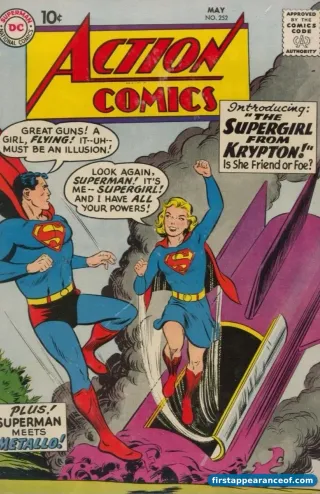
Action Comics #252 (1959). Supergirl on the cover, her first appearance and first cover.

1st Appearance and 1st Cover (Kara Zor-El)

First Appearance of Supergirl

Action Comics #252

May 1959 · DC · Silver Age

Superman's Kryptonian cousin. The Silver Age character DC tested for nine months before committing, and the longest-running supporting Superman character outside Lois Lane.

Key Issue

Created by Otto Binder · Al Plastino

By Atomm Updated

The first appearance (1st app) of Supergirl (Kara Zor-El) is Action Comics #252 (May 1959), created by Otto Binder and Al Plastino. The issue is both her first appearance and first cover, and is also the first appearance of Metallo. An earlier 'Super-Girl' prototype (a magical wish, not Kara Zor-El) appears in Superman #123 (August 1958) but is generally considered a try-out concept rather than the canonical first appearance. Supergirl's first self-titled series is Supergirl #1 (November 1972).

Quick Facts

Debut
Action Comics #252 (May 1959)
Real name
Kara Zor-El
Creators
Otto Binder (writer), Al Plastino (artist)
Publisher
DC Comics
First enemy
Metallo (debuts in same issue as Supergirl)
First ally
Superman (her cousin and mentor)
Team affiliations
Justice League (modern era), Legion of Super-Heroes (Silver Age)

Firsts Timeline

  1. First Supergirl Concept (Earlier Variant) August 1958

    Superman #123

    By Otto Binder, Dick Sprang

    An earlier 'Super-Girl' character (a magical wish-projection by Jimmy Olsen, not Kara Zor-El) appears in this issue. Considered a try-out for the Supergirl concept rather than the canonical first appearance. Otto Binder writes.

    Read the full breakdown
  2. Action Comics #252 cover
    First Appearance First Cover (Kara Zor-El) May 1959

    Action Comics #252

    By Otto Binder, Al Plastino

    Kara Zor-El, the canonical Supergirl, debuts as Superman's cousin from the Kryptonian city of Argo City. Otto Binder writes; Al Plastino pencils. The issue is both her first appearance and first cover. The same issue is also the first appearance of Metallo.

    Read the full breakdown
  3. First Self-Titled Series November 1972

    Supergirl #1

    By Cary Bates, Art Saaf

    First Supergirl self-titled ongoing. Ten-issue series through 1974. Cary Bates writes; Art Saaf pencils. The character had been a Superman-book supporting figure for thirteen years before earning a dedicated title.

    Read the full breakdown

Creation Story

Supergirl was DC’s response to a clear demand. Superman #123 (August 1958) introduced an earlier “Super-Girl” character: a magical projection conjured by Jimmy Olsen’s wish, not a permanent character. Otto Binder wrote both the prototype and the canonical version. The prototype Super-Girl was effectively a try-out: DC tested reader response to a female Superman-adjacent character, found the response strong, and built the canonical Kara Zor-El nine months later.

Action Comics #252 (May 1959) is the canonical Supergirl debut. Otto Binder wrote; Al Plastino pencilled. Kara Zor-El is Superman’s biological cousin from Argo City, a Kryptonian city that survived the planet’s destruction. Her arrival on Earth establishes the Superman-as-not-the-only-Kryptonian framework that has defined his mythology since. The same issue introduces Metallo, making Action Comics #252 a dual-first-appearance book.

The Crisis death

Crisis on Infinite Earths #7 (October 1985) by Marv Wolfman and George Perez killed Supergirl. Kara dies saving Superman in the climactic Crisis battle. DC kept the death permanent for nearly two decades, an unusually long character-death commitment. Various other Supergirl characters (Matrix, Linda Danvers, Cir-El) appeared during the post-Crisis years, but Kara Zor-El did not return to canonical continuity until Superman/Batman #8 (April 2004) by Jeph Loeb and Michael Turner.

The TV era

Melissa Benoist’s Supergirl on CBS (2015) and The CW (2016 to 2021) ran six seasons and is widely regarded as the definitive television Supergirl. Benoist’s performance reset the character’s cultural visibility at scale. The show’s commitment to the Kara Danvers framework (using Carol Danvers’s adoptive surname rather than a Kryptonian alias) connected the character to the broader Superman mythology while giving her a distinct identity.

Collector context

Action Comics #252 is the Supergirl Silver Age key. High-grade CGC 9.0+ copies have crossed $40,000 at auction. The book’s compounded first-appearance weight (Supergirl plus Metallo) gives it additional collector demand.

Secondary keys: Superman #123 (1958, Super-Girl prototype) is a niche collector target for Supergirl-completists. Supergirl #1 (1972, first solo). Crisis on Infinite Earths #7 (1985, death). Superman/Batman #8 (2004, return).
Key subsequent appearances

After the debut, these are the issues collectors and historians reach for next.

  1. 1958

    Superman #123

    Earlier Super-Girl prototype (Jimmy Olsen wish, not Kara Zor-El).

  2. 1959

    Action Comics #252

    First appearance and first cover (Kara Zor-El). Also first Metallo.

  3. 1972

    Supergirl #1 (1972)

    First solo title.

  4. 1985

    Crisis on Infinite Earths #7

    Death

    Marv Wolfman and George Perez. Supergirl dies saving Superman during Crisis on Infinite Earths. The death held in canon for nearly two decades, one of the most committed character deaths in mainstream comics.

  5. 2004

    Superman/Batman #8

    Modern Return

    Jeph Loeb and Michael Turner. Kara Zor-El returns to mainstream DC continuity after the post-Crisis dormancy. Sets up the modern Supergirl framework.

In adaptations

Film, TV, animation, and game appearances.

  1. 1984

    Supergirl

    Film

    Starring:Helen Slater

    Jeannot Szwarc directs. Slater's Supergirl in the Christopher Reeve Superman-film continuity. Critical and commercial failure.

  2. 2015

    Supergirl

    TV

    Starring:Melissa Benoist

    CBS/CW series. Six seasons (2015 to 2021). Benoist's performance is widely regarded as the definitive television Supergirl.

  3. 2025

    Supergirl: Woman of Tomorrow

    Film

    Starring:Milly Alcock

    Craig Gillespie directs. Alcock's MCU-era Supergirl in James Gunn's DC Universe.

Frequently asked questions

The questions readers and collectors ask most.

What is Supergirl's first appearance?

Supergirl's first appearance (Kara Zor-El) is Action Comics #252 (May 1959), created by Otto Binder and Al Plastino. The issue is both her first appearance and first cover. An earlier 'Super-Girl' prototype appears in Superman #123 (August 1958) but is generally treated as a try-out concept rather than the canonical first.

Is Action Comics #252 valuable?

Yes. Action Comics #252 is a Silver Age DC key with compounded first-appearance weight: Supergirl and Metallo both debut in this issue. High-grade copies (CGC 9.0 and above) have crossed $40,000 at auction. The book's value accelerated with Melissa Benoist's CW series (2015 to 2021) and the 2025 Milly Alcock casting.

Did Supergirl really die in Crisis?

Yes, and stayed dead for two decades. Supergirl died saving Superman in Crisis on Infinite Earths #7 (October 1985). Marv Wolfman and George Perez treated the death as permanent. DC kept the character dead until Superman/Batman #8 (April 2004), which brought Kara Zor-El back to mainstream continuity. The 19-year absence is one of the longest character deaths DC has committed to.

Are there other Supergirls?

Yes, multiple. Beyond Kara Zor-El, DC has used several Supergirl characters across decades: Matrix (a shape-shifting protoplasmic being in the late 1980s and 1990s), Linda Danvers (a human merged with Matrix in the 1996 Peter David ongoing), Cir-El (briefly, 2003), and Power Girl (Kara Zor-L, the Earth-Two Supergirl). Kara Zor-El is the canonical and most-recognized version.