Creation Story
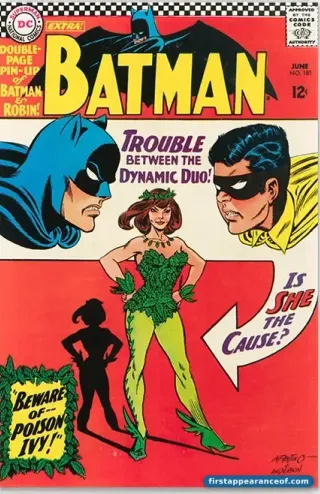
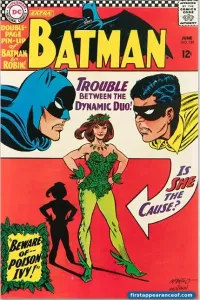
Poison Ivy was part of Robert Kanigher’s mid-1960s push to expand Batman’s rogues gallery with women antagonists. Kanigher, who had also created Wonder Woman’s supporting cast and numerous DC heroines, built the character around a botanist gimmick and a seduction-based threat vector. Batman #181 (June 1966) introduces Pamela Isley as a plant-themed criminal attempting to become Gotham’s preeminent female villain, directly challenging Catwoman’s position.
Sheldon Moldoff drew the debut. Moldoff ghost-pencilled Batman books for Bob Kane under a contract where Kane received the byline credit; the arrangement was standard 1960s DC practice and was not publicly acknowledged until decades later. Moldoff’s visual design for the character (green leotard, plant-inspired crown, red hair) became the permanent visual identity.
The issue also shipped with a pin-up poster of Poison Ivy, which affects collector grading today. Complete copies with the pin-up intact trade substantially higher than copies where the poster has been removed or damaged.
Why Ivy took thirty years to become major
Poison Ivy’s Silver and Bronze Age appearances were sporadic. She was one of many Batman antagonists Kanigher introduced in the 1960s and Marv Wolfman and others recycled through the 1970s, but she did not receive consistent character-driven attention until the Neil Gaiman and Dave McKean Black Orchid limited series (1988). Black Orchid connected Poison Ivy to Swamp Thing’s plant-elemental mythology and gave her an eco-horror framing that subsequent writers built on.
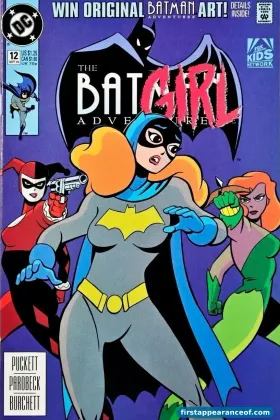
Batman: The Animated Series (1992) repositioned Ivy as a co-equal to the Joker and Catwoman in the animated canon, and Diane Pershing’s voice performance defined the character for a generation of viewers. Paul Dini’s Gotham City Sirens (2009) formalized the Catwoman / Poison Ivy / Harley Quinn trio as an ongoing book. The Ivy and Harley partnership, long subtextual in the animated series, became explicitly romantic across the 2010s and is now a defining piece of both characters’ modern portrayals.
Collector context
Batman #181 is the Poison Ivy key and a Silver Age Batman book worth knowing. High-grade CGC copies with the pin-up poster intact have crossed $10,000 at auction; low-grade reader copies trade in the mid-hundreds. The pin-up completeness is a meaningful grading factor.
Secondary keys: Black Orchid #1 (1988) is an adjacent Ivy-mythology book. Batman: Gotham City Sirens #1 (2009) is the modern team-launch key. Poison Ivy #1 (2022) is her first ongoing solo title.