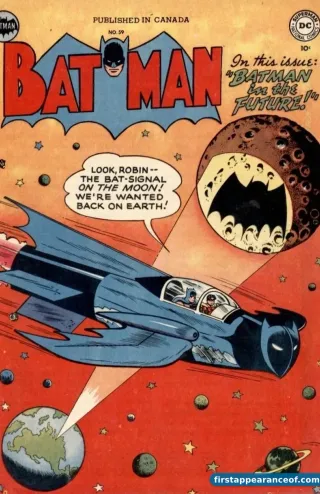
Batman #59 (1950). Deadshot debuts. Original 'gentleman gunman' interpretation, substantially different from the modern Marshall Rogers redesign.

1st Appearance (Original Tuxedo Version)

First Appearance of Deadshot

Batman #59

June 1950 · DC · Golden Age

DC's contract-killer specialist. The 1950 tuxedo gimmick villain who became a tragic-noir Suicide Squad anchor through the 1977 Englehart and Rogers redesign and the Ostrander 1988 solo run.

Key Issue

Created by Bob Kane · David Vern Reed · Lew Sayre Schwartz

By Atomm Updated

The first appearance (1st app) of Deadshot is Batman #59 (June 1950), where Floyd Lawton debuts as a tuxedoed 'gentleman gunman' antagonist. David Vern Reed writes; Bob Kane and Lew Sayre Schwartz handle the art. The character had only one Golden Age appearance and remained inactive for nearly three decades. Steve Englehart and Marshall Rogers reintroduced him with the iconic modern visual (mask, wrist-gauntlets, red-and-black armor) in Detective Comics #474 (December 1977); the redesign became canonical. Will Smith played Deadshot in Suicide Squad (2016) and Idris Elba briefly played him in The Suicide Squad (2021, repositioned as Bloodsport).

Quick Facts

Debut
Batman #59 (June 1950, original); Detective Comics #474 (December 1977, modern visual)
Real name
Floyd Lawton
Creators
Bob Kane, David Vern Reed, Lew Sayre Schwartz (original 1950); Steve Englehart and Marshall Rogers (1977 redesign that became canonical)
Publisher
DC Comics
First enemy
Antagonist himself.
First ally
Suicide Squad teammates (in Ostrander era and later); Amanda Waller (his commanding officer)
Team affiliations
Suicide Squad (long-running), Secret Six (Gail Simone era), occasional contract employer

Firsts Timeline

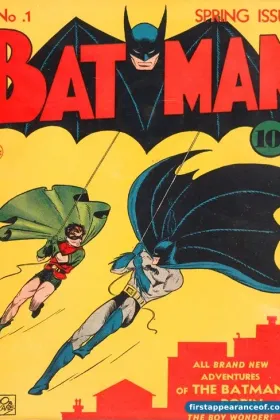
  1. Batman #59 cover
    First Appearance (Original Tuxedo Version) June 1950

    Batman #59

    By Bob Kane, David Vern Reed, Lew Sayre Schwartz

    David Vern Reed writes; Bob Kane and Lew Sayre Schwartz handle the art. Floyd Lawton debuts as a tuxedoed 'gentleman gunman' antagonist. The original interpretation was substantially different from the modern Deadshot; the character had only one Golden Age appearance and remained inactive for nearly three decades.

    Read the full breakdown
  2. Modern Visual Redesign December 1977

    Detective Comics #474

    By Steve Englehart, Marshall Rogers

    Steve Englehart writes; Marshall Rogers pencils. Deadshot reintroduced with the iconic mask, wrist-gauntlet weapons, and red-and-black armor that define the modern character. The Englehart-Rogers Detective Comics run (#471 to #476) is widely regarded as one of the strongest Bronze Age Batman creative periods; the Deadshot redesign is its most-cited character contribution.

    Read the full breakdown
  3. First Self-Titled Series November 1988

    Deadshot #1

    By John Ostrander, Kim Yale, Luke McDonnell

    First Deadshot self-titled limited series. John Ostrander and Kim Yale write; Luke McDonnell pencils. Four-issue mini that developed the modern Deadshot tragic-backstory framework. Ostrander was simultaneously writing Suicide Squad with Deadshot as a core team member.

    Read the full breakdown

Creation Story

Deadshot’s history splits into two phases: a 1950 Golden Age original and a 1977 Bronze Age redesign that became canonical.

Batman #59 (June 1950) introduces Floyd Lawton as a tuxedoed “gentleman gunman” antagonist. David Vern Reed writes; Bob Kane and Lew Sayre Schwartz handle the art. The original interpretation is a typical late-Golden-Age Batman gimmick villain: wealthy socialite by day, marksman antagonist by night, the tuxedo as visual signature. The character had only one Golden Age appearance and remained inactive for nearly three decades.

Detective Comics #474 (December 1977) reintroduces Deadshot with the iconic modern visual that defines the character across virtually every subsequent appearance. Steve Englehart writes; Marshall Rogers pencils. The Englehart-Rogers run on Detective Comics (#471 to #476) is widely regarded as one of the strongest Bronze Age Batman creative periods; the Deadshot redesign is its most-cited character contribution.

The Rogers visual interpretation (full red-and-black armor, the iconic targeting eyepiece mask, retractable wrist-gauntlet weapons) replaced the tuxedo entirely. The character’s psychology was also reframed: the modern Deadshot has a death wish, takes contracts hoping to be killed in action, and operates with substantially more tragic weight than the 1950 gimmick villain.

The Ostrander era

John Ostrander’s Suicide Squad #1 (May 1987) integrated Deadshot into the modern Suicide Squad as a core team member. Ostrander writes; Luke McDonnell pencils. The Suicide Squad run (66 issues through 1992) is the canonical Suicide Squad framework that subsequent comics and films draw from. Deadshot’s tragic-noir characterization was developed across the run: his backstory as a privileged, abusive father killed by his own gunshot during Floyd’s childhood; Floyd’s death wish as ongoing reaction; his strained relationship with his daughter.

Deadshot #1 (November 1988) was a four-issue limited series by Ostrander, Kim Yale, and Luke McDonnell that consolidated the tragic-backstory framework into a self-contained Deadshot solo arc. The mini is widely regarded as the strongest extended Deadshot character work.

The screen era

Michael Rowe’s Deadshot in Arrow (The CW, multiple appearances starting 2014) provided the character’s first significant live-action visibility. Will Smith’s Deadshot in Suicide Squad (2016, David Ayer) brought the character to mainstream film audiences. The film’s tonal register softened Deadshot considerably from the comics’ tragic-noir framework; Smith’s performance positioned the character as a charismatic protagonist rather than a death-driven contract killer.

Idris Elba was originally cast to play Deadshot in James Gunn’s The Suicide Squad (2021) when Will Smith became unavailable; the character was repositioned as Bloodsport (a similar marksman antagonist) for the film, leaving Deadshot’s screen continuity ambiguous.

Collector context

Batman #59 is the technical-first Deadshot Golden Age key. High-grade CGC 6.0+ copies have crossed $5,000 at auction.

Detective Comics #474 is the canonical-modern Deadshot key for most collector frameworks. The book introduces the iconic visual interpretation, the modern weapons, and the death-wish characterization. High-grade CGC 9.8 copies have crossed $400 at auction. Most modern Deadshot collectors target #474 over #59.

Secondary keys: Suicide Squad #1 (1987, Deadshot integrated into Ostrander Squad). Deadshot #1 (1988, first solo limited series).
Key subsequent appearances

After the debut, these are the issues collectors and historians reach for next.

  1. 1950

    Batman #59

    First appearance (original tuxedo version).

  2. 1977

    Detective Comics #474

    Modern visual redesign. Englehart and Rogers.

  3. 1987

    Suicide Squad #1

    Ostrander Squad

    John Ostrander writes; Luke McDonnell pencils. Deadshot becomes a core Suicide Squad member. The Ostrander Suicide Squad run (1987 to 1992, 66 issues) is the canonical Suicide Squad framework that subsequent comics and films draw from.

  4. 1988

    Deadshot #1 (1988)

    First solo limited series. Tragic-backstory framework canonized.

In adaptations

Film, TV, animation, and game appearances.

  1. 2014

    Arrow

    TV

    Starring:Michael Rowe

    The CW series. Rowe plays Deadshot across multiple appearances. The Arrowverse adaptation expanded the character's screen visibility before the Suicide Squad film.

  2. 2016

    Suicide Squad

    Film

    Starring:Will Smith

    David Ayer directs. Smith plays Deadshot as one of the film's primary protagonists. Substantial commercial success despite mixed critical reception.

  3. 2021

    The Suicide Squad

    Film

    Starring:Idris Elba

    James Gunn directs. Elba was originally cast as Deadshot but the character was repositioned as Bloodsport (a similar marksman antagonist) for the film. Smith was unavailable for reprisal.

Frequently asked questions

The questions readers and collectors ask most.

What is Deadshot's first appearance?

Deadshot's first appearance is Batman #59 (June 1950), where Floyd Lawton debuts as a tuxedoed 'gentleman gunman' antagonist. David Vern Reed writes; Bob Kane and Lew Sayre Schwartz handle the art. The character was reintroduced with his iconic modern visual (mask, wrist-gauntlets, red-and-black armor) in Detective Comics #474 (December 1977) by Steve Englehart and Marshall Rogers; the redesign became canonical.

Why is the original Deadshot in a tuxedo?

The 1950 character was conceived as a 'gentleman gunman' Golden Age gimmick villain: a wealthy socialite by day, a marksman antagonist by night. The tuxedo was the visual signature. The framework was typical of late-Golden-Age Batman antagonist design (Penguin's tuxedo, Catwoman's elegant criminal framing) and didn't translate to subsequent eras. After his single 1950 appearance, Deadshot remained inactive for nearly three decades until Englehart and Rogers redesigned him in 1977.

Is Detective Comics #474 valuable?

Yes, more so than the technical-first Batman #59 in most collector frameworks. Detective Comics #474 is the modern Deadshot first appearance (the visual interpretation that virtually every adaptation draws from), the first appearance of his current weapons and costume, and a notable Englehart-Rogers Bronze Age Batman issue. High-grade copies (CGC 9.8) have crossed $400 at auction. Most modern Deadshot collectors target Detective Comics #474 over Batman #59.

Is Batman #59 valuable?

Yes, but at the technical-first-appearance tier rather than the canonical-character tier. Batman #59 is a Golden Age key with first-Deadshot weight. High-grade copies (CGC 6.0 and above) have crossed $5,000 at auction. The book's collector framing is dependent on the buyer's preferred first-appearance definition; Deadshot completionists own both #59 and Detective Comics #474.

What is the Suicide Squad?

John Ostrander's Suicide Squad #1 (May 1987) launched the modern Suicide Squad: a black-ops government unit composed of incarcerated supervillains who serve as deniable assets in exchange for reduced sentences. Amanda Waller leads. Deadshot is one of the team's longest-serving members. The Ostrander run (66 issues through 1992) is the canonical Suicide Squad framework that subsequent comics and films draw from. The 2016 Suicide Squad film and the 2021 The Suicide Squad both adapted Ostrander-era frameworks.