Who are the Thunderbolts
The Thunderbolts are the team built on a lie. The whole concept turns on a single deception: the new Marvel heroes everyone was rooting for were the Masters of Evil, an established villain team, wearing new names and new costumes and running a long con on a grieving public.
What made the con work was the vacuum it filled. With the Avengers and the Fantastic Four gone, a frightened public was desperate for someone to trust, and Baron Helmut Zemo understood that desperation is the easiest thing in the world to sell to. His Masters of Evil did not menace the city; they rescued it, on camera, until the gratitude made them indispensable. The villainy was the patience.
The twist on the last page
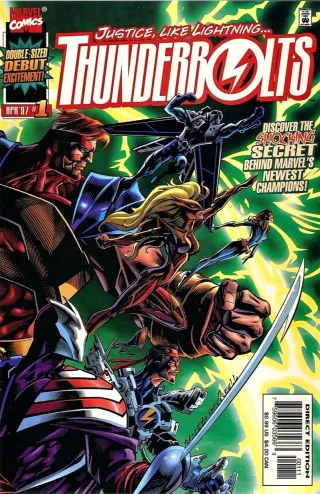
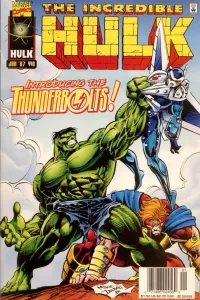
The Thunderbolts teased their arrival in a cameo in The Incredible Hulk #449 (January 1997), then got their full debut in Thunderbolts #1 (April 1997). The issue plays straight for nearly its entire length: a capable new team saves people, talks like heroes, looks the part. Then the final page turns the whole thing over and reveals their real faces. Marvel guarded the reveal carefully before release, which means the readers who bought the book expecting a sincere hero team were the exact mark the con was designed for.
It is a rare trick to pull on an audience rather than only on the characters, and it is why a 1997 launch with no established stars became one of the more talked-about debuts of the decade. The premise also carried a built-in engine: once the secret is out, the only question left is what these people do with a heroism they faked into being real.
Who was in it
Each founding Thunderbolt was an existing Marvel villain in disguise. Citizen V was Baron Helmut Zemo, the team’s mastermind. Songbird was Screaming Mimi, Atlas was the Goliath Erik Josten, MACH-1 was the Beetle Abner Jenkins, Meteorite was Moonstone (Karla Sofen), and Techno was the Fixer. The disguises were not just cosmetic. The new identities came with rehabilitated reputations, and for some of the team the costume started to fit.
That is the crack the series grew out of. A villain who spends long enough being cheered, doing the actual work of saving people, has to decide whether the act is still an act.
From con to redemption
The premise could have been a one-issue gag. Instead Busiek let the disguise change the wearer. Several Thunderbolts, Songbird and the reformed Beetle (now MACH-1) chief among them, began choosing the hero role over Zemo’s plan, and the team fractured between the members who wanted out of the con and the ones still running it. Hawkeye, a genuine Avenger with his own checkered past, eventually took over leadership and tried to make the redemption official. The book’s long-run identity is that argument: whether a person is what they were or what they decide to become.
The Osborn years
The Thunderbolts darkened as Marvel did. Warren Ellis relaunched the book with Thunderbolts #110 and handed control to Norman Osborn, turning the team into a government-sanctioned squad that hunted unregistered heroes during Civil War. When Osborn’s power peaked in Dark Reign, his Thunderbolts became his personal black-ops unit. Later runs kept rotating the concept through new wardens, including a team run by Luke Cage in 2010, but the through-line held: the Thunderbolts are whatever the person holding their leash wants them to be.
On screen
Marvel Studios adapted the team in Thunderbolts* (2025), directed by Jake Schreier and released May 2, 2025, the final film of the studio’s Phase Five. The film keeps the core idea, a squad of disreputable people pushed into heroics, but swaps the roster entirely: its team is an ensemble of MCU antiheroes including Yelena Belova (Florence Pugh), Bucky Barnes (Sebastian Stan), Red Guardian (David Harbour), Ghost, Taskmaster, and U.S. Agent, assembled by Valentina Allegra de Fontaine and rebranded in-story as the New Avengers. It is the original comic’s premise without the original comic’s lineup.
Why it endures
Most gimmick debuts fade once the gimmick is spent. The Thunderbolts did the opposite, because the twist was never the point so much as the door it opened. A team of villains pretending to be heroes is a question the medium can ask over and over: can the mask become the face. That is why the name has survived nearly three decades of rotating rosters and a Hollywood rebrand, and why the first-appearance archive treats Thunderbolts #1 as a key out of proportion to its 1997 print run.
Notable issues
- The Incredible Hulk #449 (1997): the team’s cameo first appearance.
- Thunderbolts #1 (1997): first full appearance, and the issue carrying the Masters-of-Evil reveal. The key.
- Thunderbolts #110 (Warren Ellis run): Norman Osborn takes over and the book turns toward its black-ops era.
For collectors
The collector story runs through one book. Thunderbolts #1 (1997) is the key, the first full appearance and the home of the twist, while The Incredible Hulk #449 is the lower-profile cameo first that completists chase. As a Modern Age book from 1997, it was not printed scarce, so what moves it is reputation and screen exposure rather than rarity. The 2025 film did for it what adaptations usually do: turned a story collectors already respected into one a wider audience went looking for.