Creation Story
Joe Simon and Jack Kirby built the Red Skull as the antagonist Captain America needed in 1941. The 1941 framing required a Nazi villain because Cap was a Nazi-fighting hero, and the Red Skull was the Nazi villain Simon and Kirby came up with first. The original George Maxon version was an American industrialist who collaborated with the Reich. Maxon’s tenure was short; he appeared in CA Comics #1 as the antagonist of the third chapter, returned in CA Comics #2 and #3, and died in #3. Simon, in later interviews, was unclear about why the character was killed off. The most common explanation is that Simon and Kirby had not yet committed to keeping the character recurring and a fresh start was easier than continuing.
Captain America Comics #7 (October 1941) introduced Johann Schmidt as a new Red Skull with a different backstory. Schmidt was a hotel bellboy whom Hitler personally trained as a Reich enforcer. The framing was more dramatic and more useful for sustained antagonism than Maxon’s industrialist-collaborator role. Schmidt stuck. He has been the Red Skull in Marvel continuity for eighty-four years and is the version every adaptation references.
The Silver Age revival of the Red Skull came in Tales of Suspense #65 (May 1965). Stan Lee and Jack Kirby retrieved Schmidt from the WWII era and positioned him as Captain America’s modern antagonist. The Silver Age framing kept Schmidt in suspended animation between WWII and the 1960s, which matched the Steve-Rogers-in-the-iceberg framing and gave the two characters a parallel sleep-then-wake structure. Most modern Red Skull stories use the Silver Age framing rather than the original Golden Age timeline.
The character has remained a top-tier Captain America antagonist across every era. Roy Thomas’s Invaders run in the 1970s deepened the WWII history. Mark Gruenwald’s Captain America run in the 1980s reframed Schmidt as a manipulator rather than a brawler. Ed Brubaker’s run in the 2000s used Schmidt as the architect behind the Bucky-revival storyline; the Winter Soldier era is also a Red Skull arc. Modern Red Skull stories tend to lean on the Schmidt-as-mind behind events rather than as direct combatant.
Hugo Weaving’s MCU performance in Captain America: The First Avenger (2011) is the canonical screen Red Skull. The film’s adaptation choices were broadly faithful: Schmidt is a Reich operative who experiments with the Super-Soldier serum on himself before Hitler restricts access to Erskine; the skull face is a side effect of the early serum. Weaving’s performance is widely considered one of the strongest MCU villain performances of Phase 1. Weaving did not return for subsequent appearances; the voice work transitioned to Ross Marquand starting with Avengers: Infinity War (2018), where Red Skull serves as the keeper of the Soul Stone on Vormir.
The character’s two-versions history (Maxon then Schmidt) is a Golden Age publishing anomaly that most casual readers do not know about. Specialist collectors of Captain America Comics treat CA #1 and CA #7 as separate Red Skull keys; both are recognized first-appearances under different framings. The collector market generally treats CA #1 as the foundational issue (covering the Cap-Bucky-Red Skull debut trio) and CA #7 as the canonical-Schmidt key for collectors who want the version that matters in continuity.
First Appearance: Captain America Comics #1 (Maxon)
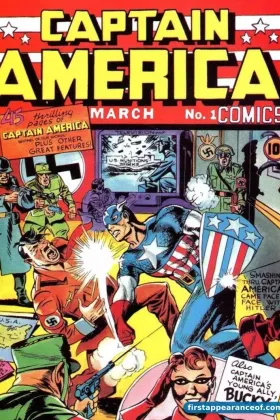
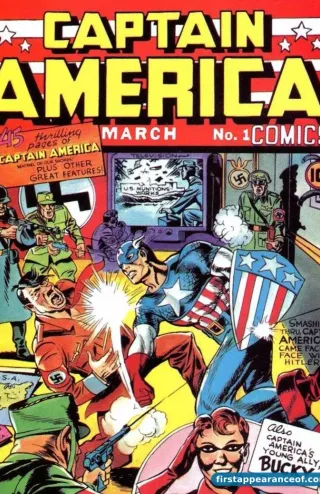
The Maxon Red Skull does not appear on the cover of CA Comics #1. The cover (Cap punching Hitler) features Cap and Bucky and a generic Nazi background. The Red Skull is a third-chapter antagonist within the issue; he gets a few pages of action before retreating. Simon’s writing positions Maxon as a generic Nazi-collaborator villain rather than a focused recurring antagonist. The visual (skull mask, business suit, plain shirt) is a Kirby design that holds up across the issue but does not get the same care that Cap and Bucky get on the cover.
For collectors, the Maxon debut sits inside the value of Captain America Comics #1, which is one of the highest-value Golden Age books in the market. CGC 9.0 and above is seven-figure territory. There is no separable Red Skull premium in the CA #1 price; the book is priced on Cap’s debut. Specialist collectors who want a “first canonical Red Skull” will track CA Comics #7 as the Johann Schmidt debut, with high-grade copies of #7 priced in the high four to low five figures.
First Appearance of Johann Schmidt: Captain America Comics #7
Captain America Comics #7 (October 1941) is the first appearance of Johann Schmidt, the canonical Red Skull. The cover features Cap and Bucky in WWII action; Schmidt is on interior pages. Simon and Kirby’s framing reintroduces the Red Skull identity through Schmidt with a fresh backstory: a hotel bellboy trained personally by Hitler as a Reich enforcer. The Schmidt origin sets the template for every modern Red Skull story.
For pricing, CA Comics #7 is a Golden Age key with a Schmidt-debut premium that has grown over the decades as MCU exposure made the canonical Red Skull more recognizable. CGC 9.0 and above trades in the high four to low five figures. CGC 9.4 is rare and reaches the mid-five figures when copies surface. The book is not in the same value tier as CA Comics #1 (which is valued for the Cap debut) but it is the canonical-Schmidt first-appearance issue, which makes it the most-sought-after Red Skull key for collectors who want the version Marvel uses in continuity.