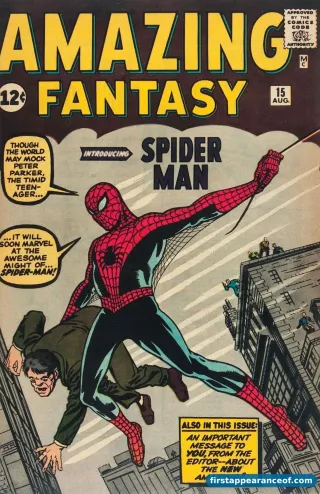
Amazing Fantasy #15 (1962). Aunt May does not appear on the cover; her debut is in the interior pages of Spider-Man's origin story alongside Uncle Ben.

1st Appearance

First Appearance of Aunt May

Amazing Fantasy #15

August 1962 · Marvel · Silver Age

The civilian heart of Spider-Man. Stan Lee and Steve Ditko's quiet old woman whose presence in the room has made Peter Parker the character he is for sixty years.

Key Issue

Created by Stan Lee · Steve Ditko

By Atomm Updated

The first appearance (1st app) of Aunt May is Amazing Fantasy #15 (August 1962), created by Stan Lee and Steve Ditko. May Parker is Peter Parker's surrogate mother and one of the central emotional anchors of the entire Spider-Man franchise. She debuts in the same issue as Peter, Uncle Ben, and Spider-Man. She has died and returned multiple times across sixty years of Spider-Man stories. Rosemary Harris played her in the Sam Raimi films (2002 to 2007). Sally Field played her in the Marc Webb films (2012 to 2014). Marisa Tomei plays her in the MCU (2016 to 2021), where the character was deliberately recast as significantly younger than the comic original.

Quick Facts

Debut
Amazing Fantasy #15 (August 1962)
Real name
May Reilly Parker
Creators
Stan Lee (writer, co-creator), Steve Ditko (artist, co-creator)
Publisher
Marvel Comics
First enemy
(None in the debut; her role is supporting cast)
First ally
Uncle Ben (her husband, also debuts AF #15), Peter Parker (her nephew)
Team affiliations
(None; civilian supporting cast)

First Appearance

  1. Amazing Fantasy #15 cover
    First Appearance August 1962

    Amazing Fantasy #15

    By Stan Lee, Steve Ditko

    Lee writes; Ditko pencils and inks. Aunt May debuts on interior pages of Spider-Man's origin issue. She is Peter Parker's surrogate mother; the original frame is that Peter lost his parents young and was raised by May and her husband Ben in Forest Hills, Queens. May is one of the four most-used supporting characters in the Marvel Universe, alongside Mary Jane Watson, J. Jonah Jameson, and Pepper Potts.

    Read the full breakdown

Creation Story

Stan Lee built Aunt May as the inversion of every Silver Age teen-hero’s home life. Robin had a rich foster father. Bucky had a fellow soldier mentor. Most of DC’s teen heroes were sidekicks attached to adult heroes. Lee’s choice for Peter Parker was to give him no parents, no costumed mentor, and an elderly aunt and uncle who were not equipped to be guardians for a teenage genius. The choice gave Peter the financial precarity that drives the whole Spider-Man premise. Without May (specifically without her health bills, her rent issues, her need for groceries), Peter has no reason to take the job at the Bugle, no reason to make morally complicated choices about how he uses his powers.

Steve Ditko drew her as physically frail. Thin frame, slightly stooped, white hair pinned up. The visual is consistent across Ditko’s run and has remained the template for every subsequent artist. May was not designed to be visually distinctive; she was designed to be unmissable in any room she enters. The Ditko default has held up because the character’s job is structural rather than visual.

The 1995 death issue (Amazing Spider-Man #400) is the strongest single piece of Aunt May writing in the franchise. J.M. DeMatteis spent the preceding arc building toward May’s awareness of Peter’s secret and toward her acceptance of him as both the orphaned nephew she raised and the costumed hero she had been worried about for years. The conversation between May and Peter as she dies is unhurried and specific. The issue ends with May at peace. The 1998 reversal (May was an actress, real May was held captive by Osborn) was a Marvel editorial decision that DeMatteis publicly disagreed with for years. Most long-time Spider-Man readers consider the 1995 death the truer ending to that version of the character.

The MCU recast was a separate decision. Marisa Tomei in 2016 was a deliberate swing at a younger May, partly so the character could play more active scenes (driving, dating, working) and partly so Peter’s home life would feel less Silver-Age-isolated. The casting was controversial in 2016 and accepted by 2021. Spider-Man: No Way Home killed the MCU May in 2021, which was structurally the same beat as the comic-book death-and-meaning event but compressed into a single film’s running time. The audience reaction to the MCU death was a measure of how thoroughly Tomei had earned the role across five films.

Aunt May has been the load-bearing emotional component of Spider-Man across every era and every adaptation. She is on stage less than Mary Jane, less than J. Jonah Jameson, less than most of the rogues. She has, in story-impact terms, mattered more than any of them. The character whose reaction Peter is most worried about, before he ever cares about Mary Jane or anyone else, is May.

First Appearance: Amazing Fantasy #15

May’s debut is on interior pages of Amazing Fantasy #15. She does not appear on the cover. Steve Ditko’s cover (Spider-Man swinging across New York with Peter Parker shadowed inside the frame) does not have room for the supporting cast. The interior debut shows May and Ben at home in Forest Hills, talking with Peter at breakfast before he leaves for the science exhibit where he is bitten by the spider. The dialogue is brief; May’s framing in the first scene is concerned-aunt mode. The visual establishment is enough. By the end of the issue, after Ben’s murder, May’s role in the next sixty years of Spider-Man comics is structurally locked in.

For collectors, AF #15 is the canonical Spider-Man debut and the canonical Aunt May debut and the canonical Uncle Ben debut. The book is priced on Spider-Man’s value, which is in the seven figures at high grade. There is no May-specific or Ben-specific market premium. The character’s debut is folded into the most expensive Marvel Silver Age book that exists, which means May is one of the most valuable supporting-character debuts in the medium without commanding any incremental premium of her own.

Subsequent May milestones (Amazing Spider-Man #1, the death issue ASM #400, the MCU debut in 2016) are tracked by collectors as run-of-title or media-event milestones rather than as character keys. The character’s collector profile is therefore identical to Spider-Man’s at the debut level and disappears into the franchise’s run pricing afterward.
Key subsequent appearances

After the debut, these are the issues collectors and historians reach for next.

  1. 1963

    The Amazing Spider-Man #1

    Lee and Ditko. May appears in Spider-Man's first ongoing issue. Her health concerns become the engine driving Peter's need for money, which drives Peter's hero-journalist double-life premise.

  2. 1980

    The Amazing Spider-Man #200

    Marv Wolfman and Keith Pollard. Burglar that killed Uncle Ben returns. May's role in the issue is structural: she is the reason Peter cannot let the murder go.

  3. 1995

    The Amazing Spider-Man #400

    J.M. DeMatteis and Mark Bagley. Aunt May's death issue, set up across the preceding 'The Final Adventure' arc. The death is reversed in 1998 (the 'May was an actress in disguise' retcon during the Clone Saga aftermath), but the issue itself is one of the strongest single Spider-Man comics ever published.

  4. 2013

    The Amazing Spider-Man #700

    Dan Slott. May appears throughout Slott's Superior Spider-Man arc as the unaware victim of Doc Ock-as-Peter. The arc generated some of the strongest May-on-page material in modern Marvel.

In adaptations

Film, TV, animation, and game appearances.

  1. 2002

    Spider-Man

    Film

    Starring:Rosemary Harris

    Sam Raimi directs. Harris's May across three Raimi films is the canonical screen version for most viewers. Quiet, weighted, present in the moments that matter.

  2. 2012

    The Amazing Spider-Man

    Film

    Starring:Sally Field

    Marc Webb directs. Field's May is more talkative and modern than Harris's. Two films.

  3. 2016

    Captain America: Civil War / Spider-Man: Homecoming / etc.

    Film

    Starring:Marisa Tomei

    MCU. Tomei was cast as a deliberately younger Aunt May than any prior version. The choice was controversial in 2016; by 2021 (No Way Home) the character had been written as the canonical MCU May for five films and the casting had stuck.

Frequently asked questions

The questions readers and collectors ask most.

What is Aunt May's first appearance?

Amazing Fantasy #15 (August 1962), Lee and Ditko. Same issue as Spider-Man, Peter Parker, and Uncle Ben. May does not appear on the cover; her debut is in the interior pages of the origin story. There is no precursor issue or earlier appearance. The character was built into the original Spider-Man premise.

How many times has Aunt May died?

At least twice in canonical continuity. The most famous is The Amazing Spider-Man #400 (April 1995), the J.M. DeMatteis and Mark Bagley issue that closed out the 'Final Adventure' arc. That death was reversed in 1998 with the retcon that the woman who died had been an actress impersonating May (a Norman Osborn plot during the Clone Saga aftermath). Subsequent deaths and resurrections have happened in alternate-reality stories. The 1995 death is the most consequential because it is the one that lasted three years in publishing time.

Is Amazing Fantasy #15 an Aunt May key?

Yes, technically. AF #15 is the first appearance of Spider-Man, Peter Parker, Aunt May, Uncle Ben, the spider that bites Peter, and the radioactive-spider mythology. Collectors price the book entirely on the Spider-Man debut. There is no incremental May or Ben premium beyond the AF #15 baseline. Subsequent appearances (Amazing Spider-Man #1, #400, etc.) are recognized as significant May moments but trade as run-of-title issues rather than as character-debut keys.

Who created Aunt May?

Stan Lee and Steve Ditko co-created May in Amazing Fantasy #15. Lee provided the orphan-raised-by-elderly-relatives framing, which was a deliberate inversion of the standard Silver Age teen-hero pattern (where the parents are alive). Ditko designed the visual: thin-framed, white-haired, a quiet body language that has held up across artists. The character's signature meal (wheatcakes) was a Lee invention from the early Spider-Man series.

Why is the MCU's Aunt May younger than the comics?

Marisa Tomei was 51 when she was cast in 2016. The previous canonical screen Mays (Harris in 2002 was 75; Field in 2012 was 65) had set the audience expectation toward an elderly May. Marvel Studios deliberately recast younger to give Peter's home life a different register and to allow May to play more active scenes. The decision was controversial in 2016 and accepted by 2021. The MCU May exists in continuity as a meaningfully younger version of the character; the comic-book May has not been adjusted in response.