Creation Story
Stan Lee killed Ben on page eleven of Amazing Fantasy #15, which is the most consequential narrative choice he ever made. Without Ben’s death, Peter Parker is a teenage genius with super-powers and no reason to put on a costume. With Ben’s death, Peter is a teenage genius who chose not to stop a small crime and then watched that small crime become the murder of his second father. Spider-Man’s entire emotional shape (the guilt, the responsibility, the obligation to act when he could) flows from one decision in one comic.
The choice to kill Ben in the debut issue is unusual for the Silver Age. Most superhero origin issues introduce the hero, the supporting cast, and the first villain. Lee’s structure for AF #15 introduces the hero, the surrogate father, kills the surrogate father, and uses the death as the engine for everything that follows. Ben is on stage for fewer than five pages of his only canonical living appearance. He matters more after he dies than the entire supporting cast of most Silver Age titles matter alive.
Steve Ditko’s contribution to Ben’s lasting weight is the visual establishment. Ditko drew Ben as physically warm, slightly heavyset, gentle-faced. The character reads as kind in every panel he appears in, which makes the death land harder. Ditko’s choice to keep Ben grounded and uncostumed (Ben does not have a hat, a uniform, a hobby, anything that makes him visually distinctive in superhero terms) makes him the most ordinary character in the issue, and the death of the most ordinary character is what gives the costumed heroics their stakes.
The “with great power comes great responsibility” line has migrated. In Lee’s original 1962 narration the line is the closing caption of the issue, spoken by Lee in voice-over. The 2002 Sam Raimi film moved the line into Ben’s mouth, where Cliff Robertson delivered it directly to Peter on a New York street. The Raimi version is now the cultural memory of the line; most adaptations since have placed the line with Ben rather than with Lee. The original Lee narration is correct for the comic. The Robertson delivery is correct for the cultural inheritance. Both are right depending on which Spider-Man you grew up with.
Marvel has been careful about Ben across sixty years. Multiple writers have proposed bringing him back, alive, in continuity. Editorial has said no every time. Peter David proposed a Ben return in the 1990s. Howard Mackie proposed one in the late 1990s. The discipline has held. The 1995 Aunt May death and the 1998 reversal of that death is exactly what Marvel did not do with Ben. The result is that Ben Parker is the most stable dead character in the Marvel Universe, which is a strange achievement for a character whose total on-panel living time is less than five pages.
First Appearance: Amazing Fantasy #15
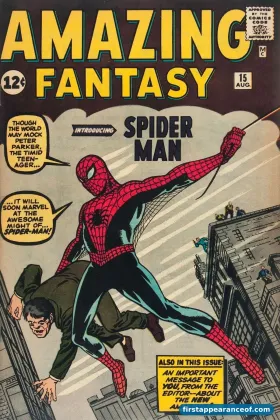
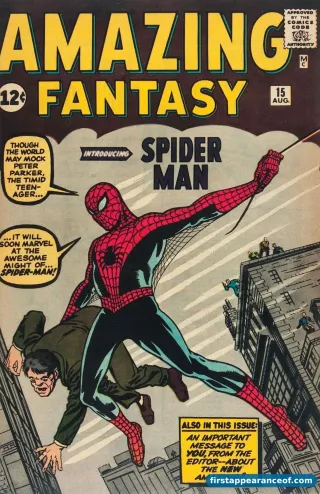
Ben’s debut and death are both inside Amazing Fantasy #15. He is not on the cover. The Ditko cover composition (Spider-Man swinging, Peter ghosted inside) does not have room for the supporting cast.
The interior pages establish Ben in three short scenes. He is at breakfast with Peter and May. He sees Peter off to the science exhibit. Later, after Peter has been bitten by the radioactive spider and started his short-lived TV career, Ben is the first to register that something is changing in Peter’s behavior. Lee writes Ben’s voice as gentle, calm, slightly worried. Then Ben is killed at home by an intruder. Peter learns about the murder and goes after the killer. The killer is the same burglar Peter could have stopped earlier and let walk past. Peter unmasks him. Lee’s closing narration delivers the responsibility line.
For pricing, Amazing Fantasy #15 is the canonical Spider-Man debut. Ben’s first and only living appearance is folded into that book’s value. There is no Ben-specific market premium. ASM #200 (the burglar’s return and death) is the only second-tier Ben-related collector key, and it trades as a Bronze Age run-of-title issue rather than as a character debut. Ben is one of the most consequential dead characters in superhero comics with no separable collector profile of his own.