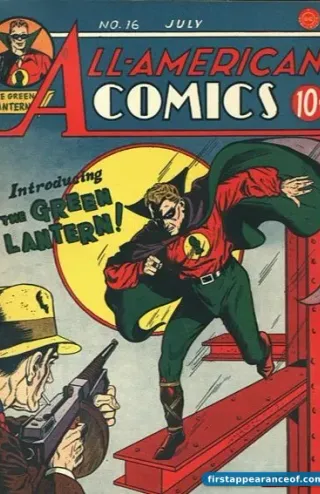
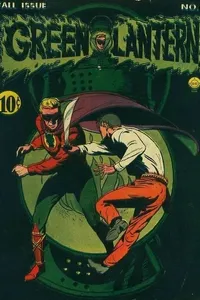
All-American Comics #16 (1940). Alan Scott as the original Green Lantern on the cover, lantern raised, in the red-and-green-and-purple costume that defines the Golden Age character.

1st Appearance and 1st Cover

First Appearance of Green Lantern

All-American Comics #16

July 1940 · DC · Golden Age

Bill Finger and Martin Nodell's 1940 railroad-engineer mystic with a magic ring. The original Green Lantern, who has spent eighty-five years coexisting with the more famous Silver Age replacement.

Key Issue

Created by Bill Finger · Martin Nodell

By Atomm Updated

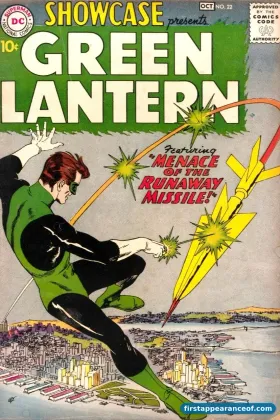
The first appearance (1st app) of Alan Scott, the original Green Lantern, is All-American Comics #16 (July 1940), created by Bill Finger and Martin Nodell. Alan is a railroad engineer who survives a train crash with a magical green lantern carved from a meteor; he fashions a ring from the lantern that channels its power. Alan Scott is the Golden Age Green Lantern, structurally distinct from Hal Jordan, the Silver Age space-cop Green Lantern who debuts in Showcase #22 (October 1959). The two share a hero name and nothing else in original framing; modern continuity bridges them through DC's Earth-2 and multiverse storytelling. Alan Scott is one of the founding members of the Justice Society of America in All Star Comics #3 (Winter 1940). Modern continuity has explored Alan as gay since the 2012 New 52 reset.

Quick Facts

Debut
All-American Comics #16 (July 1940)
Real name
Alan Scott
Creators
Bill Finger (writer, co-creator), Martin Nodell (artist, co-creator)
Publisher
DC Comics (originally All-American Publications)
First enemy
Albert Dekker (the saboteur whose train crash gives Alan the lantern)
First ally
Doiby Dickles (his cab-driver sidekick, who debuts in All-American Comics #27)
Team affiliations
Justice Society of America (founder), All-Star Squadron, Justice League (modern continuity)

First Appearance

  1. All-American Comics #16 cover
    First Appearance First Cover July 1940

    All-American Comics #16

    By Bill Finger, Martin Nodell

    Bill Finger writes; Martin Nodell pencils and creates the visual. Alan Scott is a railroad engineer who survives a train crash with a magical green lantern carved from a meteor. He fashions a ring from the lantern that channels its power. Alan Scott is the original Green Lantern; Hal Jordan, the Silver Age space-cop Green Lantern, debuts in Showcase #22 (October 1959) and is a separate character with the same hero name. The two are unrelated in original framing; modern continuity has connected them through DC's Earth-2 / multiverse storytelling.

    Read the full breakdown

Creation Story

Bill Finger and Martin Nodell built Alan Scott in 1940 as the All-American Publications counterpart to a Detective Comics property. All-American was a separate DC affiliate run by Max Gaines; the company merged with DC fully during the 1940s. Nodell pitched the character; Finger wrote the script. The premise combined Aladdin (the magic lantern), Greek mythology (the Greek god Promet figures faintly into the early origin), and railway lore (Alan Scott’s day job as a railroad engineer). The combination was unusual for 1940; most Golden Age superheroes were either pulp-detective riffs or Superman variations. Alan Scott was a mystic with a magic ring, which placed him closer to fantasy than to the Cold War science-hero archetype that would dominate the Silver Age.

Nodell’s visual was idiosyncratic. Green tunic, red shirt with yellow chest emblem, purple cape, the lantern motif worked into the costume design. The color scheme is loud by both Golden Age and modern standards. Most superhero costumes have aged toward simpler color palettes; Alan Scott’s has stayed the original 1940 look across eighty-five years of publication, with minor refinements to the silhouette but no major redesign. The visual is part of the Golden Age character’s identity; updating it has rarely been attempted.

Alan Scott’s role in the Justice Society of America (founded in All Star Comics #3, Winter 1940) is the load-bearing structural piece of the character’s long-term story. Gardner Fox wrote the JSA stories; Finger and Nodell continued the Alan Scott solo features. The dual-identity framing (solo Green Lantern title plus JSA membership) ran through the 1940s. The Golden Age Green Lantern title concluded in 1949 with the broader collapse of superhero comics at the end of the decade.

Hal Jordan’s debut in Showcase #22 (October 1959) was a deliberate reuse of the Green Lantern name with a fundamentally different premise. The Silver Age relaunch did not connect to Alan Scott; the two characters coexisted on different DC Earths through the multiverse framework that emerged across the 1960s. Earth-1 was the Silver Age home; Earth-2 became the home of Golden Age characters including Alan Scott. The framing held until Crisis on Infinite Earths in 1985-1986 collapsed the multiverse. Subsequent retcons have variously kept the two characters separated or unified; the 2012 New 52 Earth 2 reset reintroduced Alan Scott as the Earth-2 Green Lantern, distinct from Hal Jordan, with a younger redesign and an openly gay framing that has remained canonical.

The James Robinson and Nicola Scott Earth 2 reset is the most consequential modern Alan Scott update. The 2012 framing took a Golden Age character whose original portrayal had a wife and son and rewrote him as a younger man, openly gay, with a different power-set treatment. The reframing was a deliberate DC editorial choice to bring a Golden Age character into a modern framework where representation matters. The reframing has held across DC Rebirth (2016) and the James Tynion IV-era Justice Society work in the 2020s. Alan Scott as currently written in 2026 is the openly gay version, with the original Golden Age framing as a historical reference rather than the current canonical state.

Live-action treatment has been thin. Alan Scott has been referenced indirectly across Arrowverse continuity but has not had a major film or television performance. The DC Universe is currently exploring multiple Justice Society possibilities; whether Alan Scott shows up in significant live-action is open. Animation has been more accommodating: Alan Scott has appeared in Justice League Unlimited (2004-2006), Young Justice, and various DC animated features as a recurring Golden Age supporting character.

First Appearance and First Cover: All-American Comics #16

The book hit stands in May 1940 with a July 1940 cover date. 64 pages. Cover price was 10 cents. The cover by Sheldon Mayer (the editor of All-American at the time) shows Alan Scott as the Green Lantern with the lantern raised, in full costume, against a yellow background. The composition is a heroic-pose cover in the standard 1940 mode. Martin Nodell’s design is fully realized on the cover; the visual identity is locked in from the first publication.

Print run was substantial for a Golden Age launch but the print quality of 1940 paper makes pristine copies rare. Survival in high grade is poor. CGC 9.0 and above is in single-digit census numbers; 9.4 is rarer. Most copies that exist today are reader copies in the 2.0 to 5.0 range.

The story inside has Alan Scott as a railroad engineer riding a train in upstate New York. The train derails in a sabotage attempt. Alan is one of the few survivors. He finds a green metal lantern among the wreckage; the lantern speaks to him in a mystic voice and tells him to fashion a ring from its metal. Alan does, and discovers the ring channels the lantern’s power. The framing is Aladdin-by-way-of-pulp-Western, with the mystic-source-power premise driving the early stories. Alan adopts the Green Lantern identity to track down the saboteurs and discovers a wider crime ring.

For pricing, All-American Comics #16 is a top-tier Golden Age key. The 9.0-and-above tier is seven-figure territory and has been since 2018. Mid-grade copies (CGC 4.0 to 6.0) are six-figure books. The book sits in the same value tier as Marvel Comics #1, Action Comics #1, Detective Comics #27, and Flash Comics #1 because it is foundational to a major superhero publishing line. Specialist Golden Age collectors track it as one of the foundational All-American Publications launches. Restoration is common at every grade and warrants verification before any major purchase.
Key subsequent appearances

After the debut, these are the issues collectors and historians reach for next.

  1. 1940

    All Star Comics #3

    First appearance of the Justice Society of America. Alan Scott is a founding member alongside Flash (Jay Garrick), Hawkman, Atom, Doctor Fate, Hourman, Sandman, and the Spectre.

  2. 1941

    Green Lantern #1 (1941)

    First Golden Age Alan Scott solo title. Bill Finger and Martin Nodell. Ran 38 issues through 1949.

  3. 1951

    All Star Comics #57

    End of the original All Star Comics run and effectively the end of the Golden Age JSA. Alan Scott disappears from publication for several years until DC's 1960s revivals.

  4. 1963

    The Flash #137

    Gardner Fox. First Silver Age Alan Scott appearance. The framing introduces Earth-2, the alternate reality where the Golden Age heroes still exist. The Earth-2 framing is the structural device that lets Alan Scott coexist with Hal Jordan.

  5. 2012

    Earth 2 #1

    James Robinson and Nicola Scott. New 52 Earth 2 relaunch. Alan Scott is reintroduced as a younger character and as openly gay. The reframing is one of the most consequential modern Alan Scott updates.

Frequently asked questions

The questions readers and collectors ask most.

What is Alan Scott's first appearance?

All-American Comics #16 (July 1940), Bill Finger and Martin Nodell. Alan Scott is the original Green Lantern, debuting nineteen years before Hal Jordan. Same issue is one of the foundational All-American Publications launches; All-American merged with DC during the 1940s. There is no precursor or cameo issue.

Why are there two Green Lanterns?

DC rebooted the character in the Silver Age. Alan Scott (Golden Age, 1940) was a railroad engineer with a magic ring and lantern of mystic origin. Hal Jordan (Silver Age, 1959, in Showcase #22) was a test pilot recruited by an alien police force called the Green Lantern Corps. The two versions were created with different premises and different power sources. They coexisted on different DC Earths until Crisis on Infinite Earths (1985-1986) collapsed the multiverse. Subsequent retcons have variously kept them in the same timeline or separated them; the modern Earth-2 framing (since 2012) treats Alan Scott as the Earth-2 Green Lantern with a distinct identity from Hal Jordan.

Is All-American Comics #16 valuable?

Yes, top-tier Golden Age. CGC 9.0 and above is in the seven figures and trades alongside Marvel Comics #1, Action Comics #1, Detective Comics #27, and Flash Comics #1 in market position. The book is the foundational All-American Publications issue that introduced the Golden Age Green Lantern. Mid-grade copies (CGC 4.0 to 6.0) are six-figure books. Restoration is common at every grade.

Is Alan Scott gay?

In modern continuity, yes. The 2012 New 52 Earth 2 relaunch by James Robinson and Nicola Scott reintroduced Alan Scott as openly gay; the reframing was a deliberate update to a Golden Age character whose original portrayal had a wife and son. DC Rebirth and subsequent continuity have continued the framing across the 2010s and 2020s. The original Golden Age Alan Scott was written as straight; the modern reading is part of the larger DC framework of updating Golden Age characters for current readership. James Tynion IV's Justice Society work in the 2020s has kept Alan as openly gay in canonical continuity.

Who created Alan Scott?

Bill Finger wrote All-American Comics #16 and is co-credited as the character's creator. Martin Nodell pencilled and designed the visual. Nodell's design (the green-and-red-and-purple color scheme, the lantern motif, the cape and chest emblem) is one of the more idiosyncratic Golden Age superhero designs and has remained largely intact across eighty-five years of publication. Bill Finger is the same Bill Finger who co-created Batman with Bob Kane in 1939; the Alan Scott credit is part of Finger's broader Golden Age contribution.