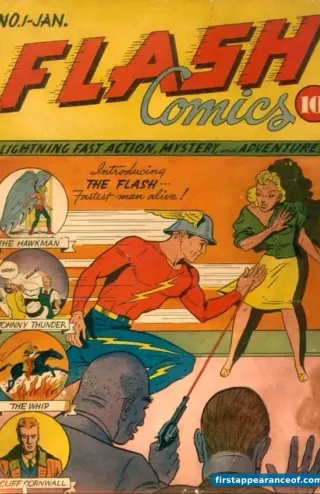
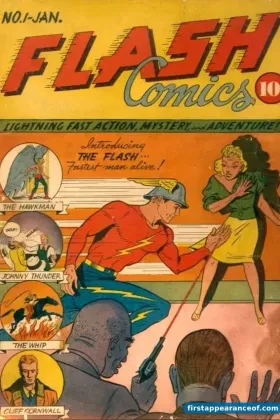
Flash Comics #1 (1940). Hawkman does not appear on the cover; the cover is the Flash. Hawkman's debut is in the interior pages.

1st Appearance (Carter Hall, Golden Age)

First Appearance of Hawkman

Flash Comics #1

January 1940 · DC · Golden Age

Gardner Fox and Dennis Neville's archaeological reincarnation hero. Two characters with the same name and forty years of contradictory continuity that DC has tried to reconcile six times.

Key Issue

Created by Gardner Fox · Dennis Neville

By Atomm Updated

The first appearance (1st app) of Hawkman is Flash Comics #1 (January 1940), created by Gardner Fox and Dennis Neville. Carter Hall is the Golden Age Hawkman, an archaeologist who is the reincarnation of Egyptian prince Khufu and uses Nth metal to fly. The Silver Age Hawkman, Katar Hol, is a Thanagarian space cop who debuts in The Brave and the Bold #34 (March 1961). The two versions are different characters with the same hero name; modern DC continuity has reconciled them through reincarnation framing across multiple retcons. Aldis Hodge plays Carter Hall in Black Adam (2022), the character's first major live-action appearance.

Quick Facts

Debut
Flash Comics #1 (January 1940)
Real name
Carter Hall (Golden Age); Katar Hol (Silver Age)
Creators
Gardner Fox (writer, co-creator), Dennis Neville (artist, co-creator)
Publisher
DC Comics (originally All-American Publications, merged with DC)
First enemy
Anton Hastor (Carter Hall's reincarnated nemesis Hath-Set)
First ally
Shiera Sanders (his eventual wife and Hawkgirl)
Team affiliations
Justice Society of America (founder), Justice League, All-Star Squadron

Firsts Timeline

  1. Flash Comics #1 cover
    First Appearance (Carter Hall, Golden Age) January 1940

    Flash Comics #1

    By Gardner Fox, Dennis Neville

    Gardner Fox writes; Dennis Neville pencils. Carter Hall is an archaeologist who discovers he is the reincarnation of Egyptian prince Khufu. He uses Nth metal (a fictional anti-gravity element) to fly. Same issue debuts the original Flash (Jay Garrick) and Johnny Thunder. Hawkman is one of the founding members of the Justice Society of America. The Carter Hall version is the Golden Age Hawkman; Katar Hol, the Silver Age space-cop version, debuts in The Brave and the Bold #34 (1961). Modern continuity merges the two through reincarnation framing.

    Read the full breakdown
  2. First Appearance of Katar Hol (Silver Age) March 1961

    The Brave and the Bold #34

    By Gardner Fox, Joe Kubert

    Fox writes; Kubert pencils. Katar Hol is a Thanagarian alien police officer who comes to Earth pursuing a criminal. The Silver Age Hawkman is a hard reboot of the Golden Age character with a different name, origin, and species. Modern continuity has reconciled the two through reincarnation, with Carter Hall's soul incarnating across multiple lifetimes, including as Katar Hol; the reconciliation is messy and has been retconned multiple times.

    Read the full breakdown

Creation Story

Gardner Fox was the most-published writer in the early Golden Age. He wrote the Justice Society. He wrote the Flash, Hawkman, the Atom, Doctor Fate, the Spectre, Sandman. The 1940 All-American Publications line was Fox’s working portfolio, and Hawkman was one of his most idiosyncratic creations: an archaeologist with reincarnation memory, an Egyptian prince’s soul in a 1940s body, anti-gravity wings made of fictional metal. The framing was unusual for Golden Age superheroes and gave the character a sense of mythic weight that most of his contemporaries lacked.

Dennis Neville designed the visual: hawk-mask helmet with a beak, wing-strap construction across the back, the chest harness with the Hawkman crest. The visual was static for forty years; Joe Kubert in the Silver Age refined the lines but did not redesign. Murphy Anderson, who took over the Silver Age book from Kubert, kept the design language intact. The Hawkman silhouette is one of the most-recognized Golden Age superhero designs that has carried into the modern era without significant redesign.

The Silver Age relaunch in 1961 was Fox’s own. Fox returned to the character with a different premise: Katar Hol of Thanagar, a planet of bird-people who use Nth metal as a flight technology. Carter Hall’s reincarnation framing was dropped. Katar Hol was a hard-science-fiction Hawkman, working as a galactic police officer. Joe Kubert drew the relaunch in The Brave and the Bold #34 (March 1961). The character migrated to a solo title (Hawkman #1, 1964) that ran 27 issues.

The two Hawkmen coexisted in DC’s multiverse until Crisis on Infinite Earths (1985-1986) collapsed the multiverse and forced reconciliation. The reconciliations have been messy. Tim Truman’s Hawkworld (1989) tried a hard reboot of Katar Hol’s origin; Geoff Johns’s later runs tried reincarnation framing; the New 52 reset; DC Rebirth tried again. None of the post-Crisis Hawkman continuity has held across editorial regimes. The current reading uses reincarnation across all prior versions, with Carter Hall’s soul incarnating multiple times including once as Katar Hol. The reading is fragile.

Aldis Hodge played Carter Hall in Black Adam (2022) as the canonical live-action Hawkman. The film’s reception was mixed but Hodge’s performance was widely praised, and the Carter version of the character became the recognized DC live-action Hawkman through that performance. The CW Arrowverse used a Carter-and-Kendra reincarnation Hawkman pairing across multiple shows starting in 2014. The MCU has not introduced Hawkman; the character is a DC property.

The character has had a peculiar problem: he is loved by writers, valued by collectors, recognized by long-time DC readers, and yet his continuity has been so badly mismanaged across thirty years that even devoted fans cannot always remember which Hawkman is currently canonical. The Black Adam film and the Geoff Johns JSA work in the early 2000s are the strongest modern Hawkman moments because they sidestep the continuity mess by anchoring on the Carter Hall reincarnation Egyptian-prince framing without forcing readers to remember the Thanagarian intervals.

First Appearance (Carter Hall): Flash Comics #1

Hawkman does not appear on the cover of Flash Comics #1. The cover is the Flash, drawn by Sheldon Moldoff. Hawkman’s debut is on interior pages, in a Gardner Fox-Dennis Neville story that introduces Carter Hall as an archaeologist who experiences past-life memories of being Egyptian prince Khufu. The Nth metal device he uses for flight is established within the first issue. The Hawkman costume is on page from the first appearance.

For collectors, Flash Comics #1 is a top-tier Golden Age key valued primarily on the Flash (Jay Garrick) debut, with Hawkman and Johnny Thunder as additional foundational debuts in the same book. CGC 9.0 and above trades in the seven figures. Mid-grade copies (CGC 4.0 to 6.0) are six-figure books. The book is one of the foundational All-American Publications issues and one of the highest-value Golden Age comics in the market.

First Appearance of Katar Hol: The Brave and the Bold #34

The Silver Age Hawkman debuts on the cover of The Brave and the Bold #34 (March 1961). Joe Kubert draws Katar Hol in flight, with the redesigned Hawkman silhouette that became the modern Silver Age standard. Gardner Fox writes the relaunch, returning to a character he had created twenty-one years earlier with a fundamentally different premise.

The story has Katar Hol arriving on Earth from Thanagar as a galactic police officer pursuing a criminal. He partners with his wife Shayera Hol (the Silver Age Hawkgirl). The hard-science-fiction framing replaces the Golden Age archaeology premise. The Silver Age Hawkman is structurally a different character from the Golden Age Hawkman who shares the hero name and the wing visual.

For pricing, B&B #34 is a recognized Silver Age key for the Hawkman relaunch. CGC 9.4 trades in the high three to low four figures. CGC 9.6 reaches into the four figures. 9.8 is rare and trades in the mid four figures. The book sits in the second tier of Silver Age first-appearance keys. Subsequent appearances (B&B #35, #36, Hawkman #1 from 1964) are Silver Age sub-keys that trade in the three-to-low-four figure range at high grade.
Key subsequent appearances

After the debut, these are the issues collectors and historians reach for next.

  1. 1940

    All Star Comics #3

    First appearance of the Justice Society of America. Hawkman is a founding member alongside Flash, Green Lantern, Atom, Doctor Fate, Hourman, Sandman, and the Spectre. Gardner Fox writes.

  2. 1941

    All Star Comics #8

    Wonder Woman debut. Hawkman is on the JSA team in this issue and continues across the All Star run.

  3. 1961

    The Brave and the Bold #34

    Katar Hol debut. Silver Age Hawkman.

  4. 1964

    Hawkman #1 (1964)

    Silver Age solo title for Katar Hol. Murphy Anderson art. Ran for 27 issues through 1968.

  5. 1989

    Hawkworld #1 (1989)

    Tim Truman three-issue prestige miniseries followed by an ongoing. Truman rewrote Katar Hol's origin and reset the post-Crisis Hawkman continuity. The Hawkworld reset is the cleanest single-take Hawkman reboot but contradicted earlier post-Crisis appearances by Hawkman, which created the multiple-Hawkmen mess that DC spent the 1990s and early 2000s trying to fix.

In adaptations

Film, TV, animation, and game appearances.

  1. 2014

    The Flash (CW)

    Film

    Starring:Falk Hentschel

    CW Arrowverse. Carter Hall and Kendra Saunders (as Hawkgirl) appear across multiple Arrowverse shows. The continuity uses the reincarnation framing.

  2. 2022

    Black Adam

    Film

    Starring:Aldis Hodge

    Jaume Collet-Serra directs. Hodge plays Carter Hall as the leader of the Justice Society. The Carter version is the canonical version in DC's live-action film universe. Reception was mixed but Hodge's performance was widely praised.

Frequently asked questions

The questions readers and collectors ask most.

What is Hawkman's first appearance?

Flash Comics #1 (January 1940), Gardner Fox and Dennis Neville. The Carter Hall version, the Golden Age Hawkman. Same issue debuts the original Flash (Jay Garrick) and Johnny Thunder. Carter Hall is an archaeologist who learns he is the reincarnation of Egyptian prince Khufu and uses Nth metal to fly. Same issue is the foundational All-American Publications launch (a DC affiliate that merged with DC during the 1940s).

Why are there two Hawkmen?

DC rebooted the character in the Silver Age. Carter Hall (Golden Age, 1940) was an archaeologist with reincarnation framing. Katar Hol (Silver Age, 1961, in Brave and the Bold #34) was a Thanagarian alien police officer. Gardner Fox (who created both) used the same hero name for an effectively new character because the Silver Age relaunch wanted a science-fiction Hawkman rather than an archaeology Hawkman. The two versions coexisted in DC's multiverse until Crisis on Infinite Earths (1985-1986) collapsed the multiverse, after which DC tried multiple times to reconcile the characters into a single continuity. The reconciliations have been messy.

Is Flash Comics #1 a Hawkman key?

Yes, alongside being the foundational Flash key. The book debuts Hawkman, Flash (Jay Garrick), and Johnny Thunder in the same issue. CGC 9.0 and above trades in the seven figures. The book is one of the highest-value Golden Age comics in the market alongside Action Comics #1, Detective Comics #27, and Marvel Comics #1. There is no separable Hawkman premium in the Flash Comics #1 price; the book is priced on the Flash debut, with Hawkman and Johnny Thunder folded into the same baseline. The Brave and the Bold #34 (Silver Age Katar Hol) is the second-tier Hawkman key, trading in the four figures at high grade.

Who created Hawkman?

Gardner Fox wrote the Golden Age Hawkman and is co-credited as creator alongside Dennis Neville, who designed and drew the character. Fox also wrote the Silver Age Hawkman in 1961, which is unusual; most DC characters who got rebooted were written by different teams across the eras. Joe Kubert pencilled the Silver Age relaunch. Tim Truman's 1989 Hawkworld reset is the third major creator-arc on the character. Modern Hawkman writing builds on a foundation laid by Fox in 1940 and reset by Truman in 1989.

Has DC fixed the Hawkman continuity?

Multiple times, badly. The character's continuity history is one of DC's most-discussed continuity messes. Crisis on Infinite Earths (1985-1986), Zero Hour (1994), Hawkworld retcons (1989-1990), JSA reincarnation framings (1999-2003), Geoff Johns reconciliations (2007-2010), New 52 reset (2011), DC Rebirth (2016), and the Robert Venditti / Bryan Hitch run (2018) have all proposed Hawkman continuity rebuilds. The current canonical reading uses reincarnation across all prior versions: Carter Hall's soul has incarnated multiple times, including once as Katar Hol of Thanagar. The reading is fragile and has not held across editorial transitions.