Creation Story
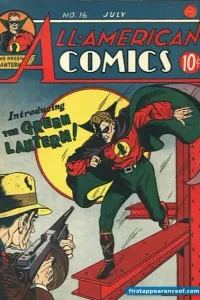
Green Lantern is the name of two fundamentally unrelated DC characters separated by nineteen years of publishing. The Golden Age Green Lantern is Alan Scott, created by Bill Finger and Martin Nodell for All-American Comics #16 (July 1940). Scott’s Green Lantern is a magical character: his ring is powered by the mystic Starheart, a fragment of a primordial magical entity. Alan Scott ran through the 1940s as a member of the Justice Society of America and was shelved when DC’s Golden Age superheroes were paused in the early 1950s.
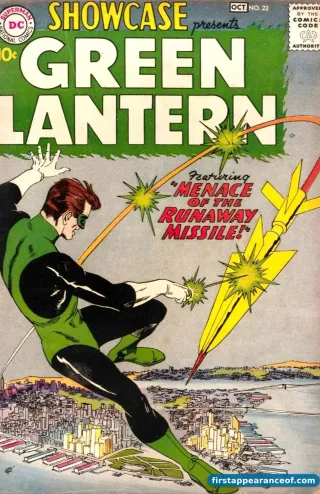
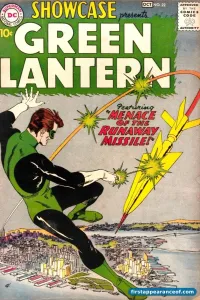
The Silver Age Green Lantern is Hal Jordan, created by John Broome and Gil Kane for Showcase #22 (October 1959). DC had revived the Flash in Showcase #4 (1956) with a new character (Barry Allen) rather than continuing Jay Garrick’s Golden Age run; the Green Lantern revival followed the same pattern three years later. Hal Jordan is a test pilot selected by a dying alien (Abin Sur) to inherit his Green Lantern ring and join the Green Lantern Corps, an intergalactic police force run by the Guardians of the Universe. The science-fiction framework has nothing to do with Alan Scott’s magical origin; they are distinct concepts sharing a name.
Both characters eventually became canonical within DC’s multiverse framework (Alan Scott on Earth-Two, Hal Jordan on Earth-One) and both have been part of team books and crossovers. But their first-appearance keys represent genuinely separate character introductions, and collectors track them separately.
The O’Neil-Adams era
Green Lantern #76 (April 1970) launched the Green Lantern/Green Arrow run by Denny O’Neil and Neal Adams. The thirteen-issue collaboration (through Green Lantern #89, April 1972) is widely regarded as the moment mainstream American superhero comics began engaging seriously with adult political content. O’Neil wrote Green Arrow as a street-level political activist who challenged Hal Jordan’s institutional-authority framework; the two heroes took a road trip across America encountering racism (GL #76’s iconic “have you done anything for the black skins?” sequence), political corruption, and drug addiction (GL/GA #85-86, Speedy’s heroin arc).
The run is foundational Bronze Age work and redefined what was possible in mainstream superhero comics. Every subsequent socially-conscious superhero book carries some debt to O’Neil-Adams.
The Johns relaunch
Geoff Johns and Ethan Van Sciver’s Green Lantern: Rebirth #1 (December 2004) relaunched Hal Jordan as the primary Green Lantern after a decade of alternative framings. Johns’s subsequent Green Lantern run (2005-2013) built the Emotional Spectrum cosmology (yellow-orange-red-violet-indigo-blue-green-white Lantern Corps representing different emotions) and produced events including Sinestro Corps War (2007), Blackest Night (2009), and War of the Green Lanterns (2011). The Johns run is the most commercially and critically important modern Green Lantern work.
Collector context
All-American Comics #16 (Alan Scott first appearance) is a Golden Age DC key. High-grade CGC copies in the low-to-mid six-figure range.
Showcase #22 (Hal Jordan first appearance) is a foundational Silver Age DC key and the more-widely-collected of the two Green Lantern first-appearance books. High-grade CGC 9.0+ copies have crossed $100,000 at auction. The book’s value has held through multiple film and television announcements.
Secondary keys: Green Lantern #1 (1960) is Hal Jordan’s first self-titled series. Green Lantern #7 (1961) is the first Sinestro. Green Lantern #76 (1970) starts the O’Neil-Adams run. Green Lantern: Rebirth #1 (2004) is the Johns-era starting point.