Who are the Justice Society
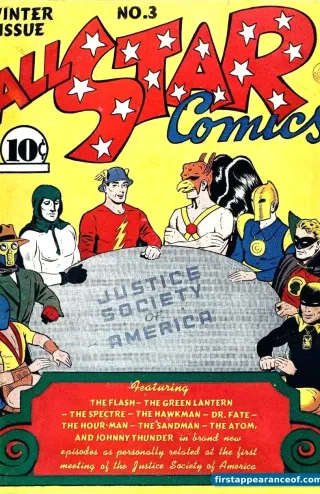
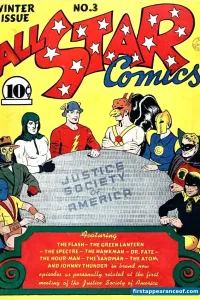
The Justice Society of America is the oldest superhero team in comics, and for a while it was the only one. Eight heroes who were each headlining their own features across All-American Publications and its sister company National sat down together in All Star Comics #3, cover-dated Winter 1940, and the team book was born.
Nobody had tried it before. The superhero was two years old, Superman having arrived in 1938, and the form was still solo by default. Putting a roomful of stars in one issue was editor Sheldon Mayer and writer Gardner Fox’s idea, and it worked the first time out.
The book that invented the team-up
All Star Comics #3 frames the team as a social club. The heroes gather around a table and take turns telling stories, and those stories are the issue. It reads like a creative flourish. It was mostly accounting: every chapter could be handed to the artist already drawing that character, so the anthology assembled itself.
What Mayer and Fox stumbled into was a sales engine. A reader who would buy one hero’s book might buy a book that promised eight. DC reran the same math with the Justice League in 1960, and Marvel with the Fantastic Four and the Avengers right after. The dinner-table gimmick outlived the gimmick.
Who was in it
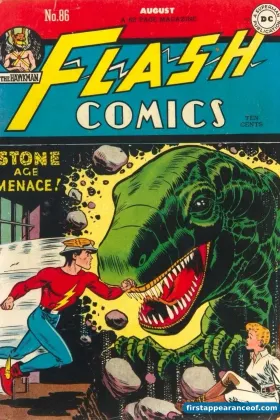
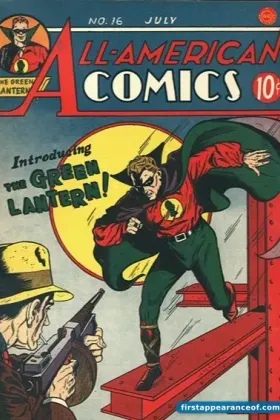
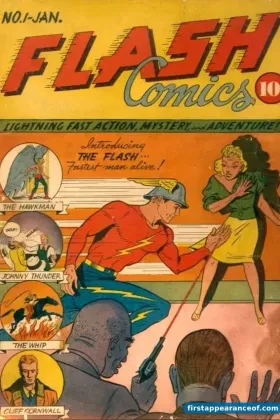
The founders are the Golden Age versions of names DC later recycled, which trips up anyone who came in through the Silver Age. This Flash is Jay Garrick, not Barry Allen. This Green Lantern is Alan Scott, not Hal Jordan. This Atom is Al Pratt, not Ray Palmer. The other four round out the eight: Hawkman (Carter Hall, the name the character has always carried), Doctor Fate, the Spectre, and Hourman, alongside the Sandman.
The roster was never fixed. When the Flash and Green Lantern graduated to their own titles they shifted to honorary status and made room for others. Johnny Thunder signed on in All Star Comics #6 (1941). Wonder Woman joined in #11 (1942), three issues after her own debut in #8, and the team installed its most powerful new member as its secretary, which dates the book as precisely as any cover.
Decline and the western years
The team did not survive its own genre. Superhero sales cratered after the war, and All Star Comics felt it: issue #57 (1951) was the last to carry the Justice Society, and with #58 the title became All Star Western. Cowboys sold; costumed heroes did not. The JSA went quiet for a decade.
The Earth-Two comeback
It came back through a continuity trick. In The Flash #123 (1961), “Flash of Two Worlds,” Barry Allen meets Jay Garrick and DC files the old heroes away as residents of a parallel world, Earth-Two. The full team returned in The Flash #137 (1963), and Justice League of America #21 (1963) sent the two teams across worlds to meet. The crossover became an annual event.
That parallel-Earth fix is why the JSA still exists. Most Golden Age teams ended and stayed ended. This one became the company’s permanent doorway back to its own beginnings.
Why it still matters
Strip the costumes off and the Justice Society is an idea: sell several heroes in one book. Every team comic since runs on it, from the Justice League to the Avengers. The JSA’s own distinction is rarer. It is the team that mattered twice, first as the prototype and then as the thread DC uses to tie its present to its past.
Notable issues
- All Star Comics #3 (1940): first appearance of the JSA.
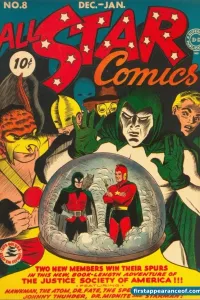
- All Star Comics #8 (1941): first appearance of Wonder Woman, in a backup feature. The money book of the run.
- All Star Comics #11 (1942): Wonder Woman joins the team as secretary.
- All Star Comics #57 (1951): the last JSA issue. The title relaunched as All Star Western with #58.
- The Flash #123 (1961): “Flash of Two Worlds” brings Jay Garrick back and establishes Earth-Two.
- The Flash #137 (1963): the full Justice Society returns, its first team appearance since 1951.
- Justice League of America #21 (1963): the JSA meets the Justice League in “Crisis on Earth-One,” the start of an annual crossover.
For collectors
Two issues carry the keys, and collectors chase them for different reasons. All Star Comics #3 is the first team, the historical anchor. All Star Comics #8 is the first Wonder Woman, and it is the one that moves real money in any grade.