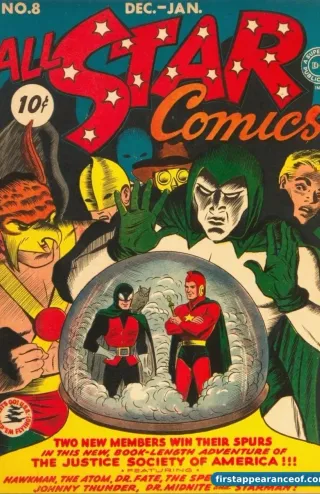
All Star Comics #8 (1941). Wonder Woman debuts inside as the Introducing Wonder Woman backup feature.

1st Appearance

First Appearance of Wonder Woman

All Star Comics #8

October 1941 · DC · Golden Age

DC's Big Three third leg. Marston's Amazonian warrior-princess, Peter's visual design, and the first superhero whose feminist framework was explicit from page one.

Key Issue

Created by William Moulton Marston · Harry G. Peter

By Atomm Updated

The first appearance (1st app) of Wonder Woman is All Star Comics #8 (October 1941), created by William Moulton Marston writing as Charles Moulton with art by Harry G. Peter. Diana debuts in a nine-page Introducing Wonder Woman backup feature. Her first cover appearance and first solo feature is Sensation Comics #1 (January 1942), and her first self-titled series is Wonder Woman #1 (June 1942). She is one of DC's Big Three alongside Superman and Batman, and one of the longest continuously-published superhero characters in American comics.

Quick Facts

Debut
All Star Comics #8 (October 1941)
Real name
Diana of Themyscira (civilian name Diana Prince)
Creators
William Moulton Marston (writer, under pen name Charles Moulton), Harry G. Peter (artist), with Elizabeth Holloway Marston and Olive Byrne as uncredited collaborators
Publisher
DC Comics
First enemy
Baroness Paula von Gunther (recurring Golden Age antagonist)
First ally
Steve Trevor (American military pilot and her recurring romantic partner)
Team affiliations
Justice Society of America (Golden Age), Justice League of America (founding member)

Firsts Timeline

  1. All Star Comics #8 cover
    First Appearance October 1941

    All Star Comics #8

    By William Moulton Marston, Harry G. Peter

    Nine-page Introducing Wonder Woman backup feature. William Moulton Marston writes under the pen name Charles Moulton; Harry G. Peter pencils. Flash is on the cover of the issue; Wonder Woman is not. First-appearance key for one of DC's Big Three.

    Read the full breakdown
  2. First Cover Appearance First Solo Feature January 1942

    Sensation Comics #1

    By William Moulton Marston, Harry G. Peter

    Wonder Woman's first cover and first solo headliner. Sensation Comics was the anthology title built around Wonder Woman; she was the lead feature for the book's entire run.

    Read the full breakdown
  3. First Self-Titled Series June 1942

    Wonder Woman #1

    By William Moulton Marston, Harry G. Peter

    Marston writes; Peter pencils. The original Wonder Woman series launches and runs continuously, making Wonder Woman one of the longest continuously-published superhero titles in American comics (only Superman and Batman predate it).

    Read the full breakdown

Creation Story

Wonder Woman is William Moulton Marston’s character. Marston was a Harvard-trained psychologist and the inventor of the systolic blood-pressure test that underlies the modern polygraph; he approached DC editor Sheldon Mayer in 1941 with a proposal for a female superhero whose framework would be explicitly feminist. DC accepted. Marston wrote under the pen name Charles Moulton. Harry G. Peter drew the debut and designed the visual character, including the star-spangled costume, the golden tiara, and the lasso of truth that drew directly from Marston’s polygraph work.

All Star Comics #8 (October 1941) introduced Wonder Woman in a nine-page “Introducing Wonder Woman” backup feature. The issue’s cover feature was Flash; Wonder Woman is inside, without cover billing. The feature establishes her Amazonian origin on Paradise Island, her rescue of American military pilot Steve Trevor, and her mission to bring Amazon ideals to “Man’s World.”

Sensation Comics #1 (January 1942) gave Wonder Woman her first cover and her first full solo feature. The anthology title was built around her; she was the lead feature for the book’s entire run. Wonder Woman #1 (June 1942) launched her self-titled series, which has run continuously (with various reboots) ever since. Only Superman and Batman predate Wonder Woman among continuously-published DC superhero titles.

The Golden Age framework

Marston’s Wonder Woman was explicitly political. The character’s Amazonian origin, her role as an emissary from a women-led civilization, her defeat of patriarchal antagonists, and her bondage-and-submission visual motifs (which Marston wrote into the scripts deliberately, tied to his psychological theories about loving submission to authority) made the character distinct from every other 1940s superhero. Marston’s collaborators Elizabeth Holloway Marston and Olive Byrne have been acknowledged by modern DC histories as uncredited creative contributors.

Marston died in 1947. The character’s tone softened significantly under subsequent writers, and much of Marston’s original framework was deliberately walked back through the 1950s and 1960s. The Silver Age Wonder Woman of the Kanigher era (1950s-1960s) is a substantially different character from the Marston original.

The Perez reboot

George Perez’s Wonder Woman #1 (February 1987) is the defining modern Wonder Woman book. Following Crisis on Infinite Earths, DC handed Perez the relaunch and he wrote and pencilled a Greek-mythology-grounded reintroduction that rebuilt Diana from first principles. Perez’s run ran through Wonder Woman #62 (February 1992) and is widely regarded as one of the best superhero reboots ever published.

Patty Jenkins’s 2017 Wonder Woman film drew substantially from Perez’s framework, as well as from Brian Azzarello’s 2011 New 52 Wonder Woman run. Gal Gadot’s performance made Wonder Woman one of the most commercially successful solo superhero films of the 2010s.

Collector context

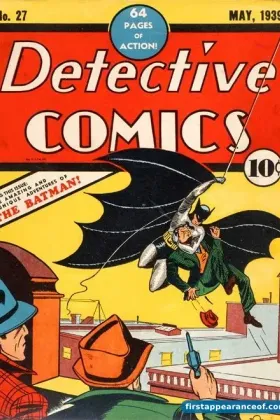
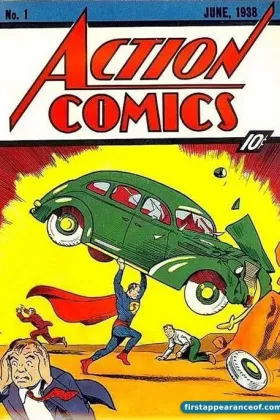
All Star Comics #8 is one of the most valuable Golden Age DC books. High-grade CGC 9.0+ copies have crossed $1 million at auction. Low-grade reader copies trade in the mid-five-figure range. The book sits alongside Action Comics #1, Detective Comics #27, Marvel Comics #1, and Captain America Comics #1 at the top tier of Golden Age collector demand.

Secondary keys: Sensation Comics #1 (1942, first cover, first solo feature). Wonder Woman #1 (1942, first self-titled). Wonder Woman #1 (1987, Perez relaunch). All three are required for a complete Wonder Woman collection.
Key subsequent appearances

After the debut, these are the issues collectors and historians reach for next.

  1. 1941

    All Star Comics #8

    First appearance.

  2. 1942

    Sensation Comics #1

    First cover, first solo feature.

  3. 1942

    Wonder Woman #1

    First self-titled series.

  4. 1960

    The Brave and the Bold #28

    Justice League Founding

    Wonder Woman as a founding member of the Silver Age Justice League of America.

  5. 1985

    Crisis on Infinite Earths #12

    Golden Age Death

    Marv Wolfman and George Perez. Golden Age Wonder Woman dies in the Crisis. George Perez's 1987 Wonder Woman #1 relaunch follows.

  6. 1987

    Wonder Woman #1 (1987)

    Perez Relaunch

    George Perez writes and pencils the post-Crisis reboot. Widely regarded as the definitive modern Wonder Woman origin and among the best superhero reboots ever published.

In adaptations

Film, TV, animation, and game appearances.

  1. 1975

    Wonder Woman

    TV

    Starring:Lynda Carter

    ABC/CBS live-action series. Three seasons. Carter's performance defined the character for a generation.

  2. 2017

    Wonder Woman

    Film

    Starring:Gal Gadot

    Patty Jenkins directs. Grossed $822M worldwide. Widely regarded as the DCEU's strongest entry. First female-led superhero blockbuster film of the modern era.

  3. 2020

    Wonder Woman 1984

    Film

    Starring:Gal Gadot

    Patty Jenkins returns. Mixed reception after a pandemic-era release.

Frequently asked questions

The questions readers and collectors ask most.

What is Wonder Woman's first appearance?

Wonder Woman's first appearance is All Star Comics #8 (October 1941), a nine-page Introducing Wonder Woman backup feature by William Moulton Marston with art by Harry G. Peter. The Flash is on the cover of the issue; Wonder Woman is not. Her first cover appearance is Sensation Comics #1 (January 1942).

Is All Star Comics #8 valuable?

Yes, extraordinarily. All Star Comics #8 is one of the most valuable Golden Age DC books after Action Comics #1 and Detective Comics #27. High-grade copies (CGC 9.0 and above) have crossed $1 million at auction. The book's value has held across decades and spiked with each major Wonder Woman adaptation. Low-grade reader copies trade in the mid-five-figure range.

Who created Wonder Woman?

William Moulton Marston, writing under the pen name Charles Moulton, is the credited creator. He was a Harvard-trained psychologist and the inventor of the systolic blood-pressure test underlying the modern polygraph. Harry G. Peter drew the debut and designed the visual character. Elizabeth Holloway Marston (William's wife) and Olive Byrne (their shared partner) were uncredited creative collaborators on the character's development; DC has acknowledged their contributions in modern histories.

Why is the Perez Wonder Woman #1 (1987) so important?

George Perez's Wonder Woman #1 (February 1987) is widely regarded as one of the best superhero reboots ever published. Perez wrote and pencilled the post-Crisis relaunch after the original Wonder Woman title ended during Crisis on Infinite Earths. His version rebuilt Diana from first principles: a clay-and-breath origin on Themyscira, a Greek-mythology framework, a Diplomat-to-Man's-World arc. The Perez run anchored modern Wonder Woman across seventy issues and is the foundation for Patty Jenkins's 2017 film.

Is the lasso of truth based on Marston's polygraph work?

Yes. Marston invented the systolic blood-pressure test that underlies the modern polygraph and spent much of his academic career on deception-detection research. The lasso of truth is a direct narrative translation of that work: a magical item that compels its captive to tell the truth. The polygraph connection is canonical in Marston scholarship and has been referenced repeatedly in modern Wonder Woman stories and critical essays.