Creation Story
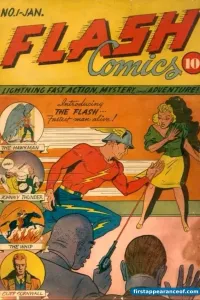
John Wentworth was a Wentworth Studio writer in the All-American Publications stable in 1939. The Flash Comics launch in January 1940 was a four-feature anthology: the Flash got the cover and the lead feature; Hawkman got a second feature; Johnny Thunder got a third feature; the Whip and Cliff Cornwall got smaller features. Johnny Thunder’s strip was the comedy break in the lineup. Wentworth’s pitch was a slow-witted civilian who happened to be born under conditions that gave him control of a thunderbolt-genie. The catchphrase ‘cei-u’ (pronounced ‘say you’) was a Wentworth verbal-tic gag that became the canonical magic word.
Stan Aschmeier (sometimes credited as Stan Asch) drew the original strip. The visual was straightforward: Johnny in a yellow jacket, a slightly bewildered facial expression, the Thunderbolt rendered as a small genie-figure in blue lightning forms. The comedy register was clear from the first strip; readers understood that Johnny was the joke and the Thunderbolt was the actual power. The pairing has stayed structurally that way for eighty-five years.
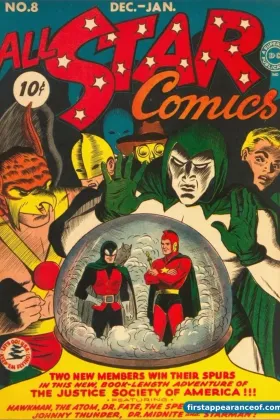
Gardner Fox took over the Justice Society stories in All Star Comics, which is where Johnny became a recurring JSA member. Fox wrote the character with more agency than Wentworth’s strip had, but kept the comedy register. Johnny was the JSA member whose stories were lightest in tone; the Flash, Green Lantern, Hawkman, Doctor Fate, and the rest carried the dramatic plots. Johnny showed up to provide a comedic angle and to deploy the Thunderbolt when the team needed magical intervention.
The character has been periodically reframed in modern continuity. James Robinson and David Goyer’s JSA relaunch in 1999 kept Johnny as a senior member but began aging the character into more reflective territory. The Geoff Johns era (2002-2010) used Johnny’s age and senility as a poignant subplot; the New 52 reset (2011) reframed him entirely. Most modern Johnny Thunder writing focuses more on the Thunderbolt as a coherent character and Johnny as the Thunderbolt’s anchor than on Johnny himself.
Adaptation work has been thin. The CW’s DC’s Legends of Tomorrow (2016 onward) used a Stargirl-related Justice Society in Earth-X and other multiverse contexts; Johnny Thunder appeared briefly. The character has not had a major film or animated-series role. The DC live-action and animated treatments tend to skip him because the comedy register and the genie-with-magic-word premise do not adapt cleanly.
Johnny Thunder is one of the founding JSA members whose continued presence in the team is more about historical lineage than about character utility. He is on the team because he was on the team in 1940. The JSA’s identity as the first superhero team in publishing history depends on its original lineup remaining recognizable, and Johnny is part of that lineup. The character is, in modern terms, a continuity load-bearing element rather than a creative driver.
First Appearance: Flash Comics #1
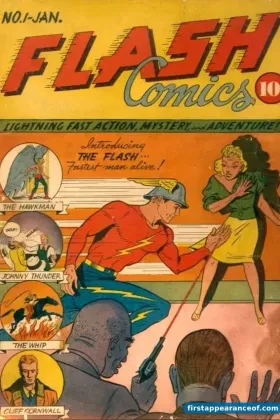
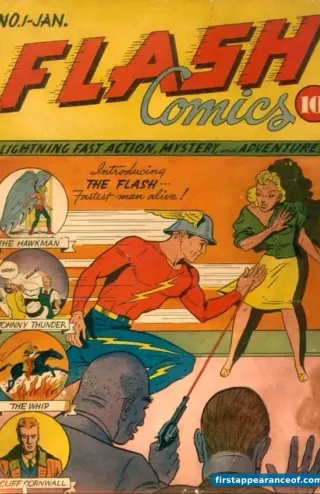
Johnny Thunder does not appear on the cover of Flash Comics #1. The cover is the Flash (Jay Garrick) drawn by Sheldon Moldoff. Johnny’s debut is on interior pages, in an eight-page Wentworth-Aschmeier strip that introduces him as a civilian with a strange ability he does not fully understand. The Thunderbolt manifests in the first strip; Johnny does not yet realize he is summoning it.
The strip is structurally a 1940 cartoon-style comedy feature, similar in tone to Funny Animals or contemporary comic-strip humor more than to other Flash Comics features. Wentworth’s writing leans on physical comedy and unaware-protagonist gags. Aschmeier’s art is loose and cartoony rather than the cleaner-lined superhero style of the Flash and Hawkman strips elsewhere in the issue. The juxtaposition gives Flash Comics #1 a tonal range across its four features that most contemporary anthology comics did not match.
For collectors, Flash Comics #1 is a top-tier Golden Age key. CGC 9.0 and above trades in the seven figures. The book’s value is priced primarily on the Flash debut, with Hawkman and Johnny Thunder as additional foundational debuts in the same issue. There is no separable Johnny Thunder premium; his debut value is folded into the Flash Comics #1 baseline. Subsequent JSA-era All Star Comics issues are recognized as Johnny appearance keys but trade as JSA keys rather than as character-specific Johnny Thunder books.