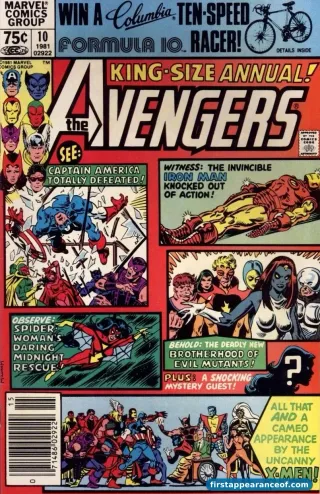
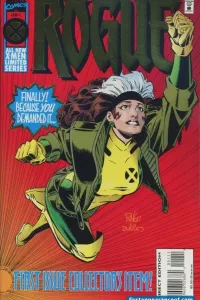
Rogue on the cover of The Avengers Annual #10 (1981), her first appearance.

1st Appearance and 1st Cover

First Appearance of Rogue

The Avengers Annual #10

November 1981 · Marvel · Copper Age

Mystique's adopted daughter who stole another woman's powers and her life, then spent decades trying to make up for it by joining the team her first victim served in.

Key Issue

Created by Chris Claremont · Michael Golden

By Atomm Updated

The first appearance (1st app) of Rogue is The Avengers Annual #10 (November 1981), created by Chris Claremont and Michael Golden. Anna Marie debuts as a member of Mystique's Brotherhood of Evil Mutants, attacking Carol Danvers (Ms. Marvel) and permanently absorbing her powers and memories. Rogue defects to the X-Men in Uncanny X-Men #171 (July 1983), becoming one of the team's longest-serving members. Her first solo title is Rogue #1 (January 1995).

Quick Facts

Debut
The Avengers Annual #10 (November 1981)
Real name
Anna Marie
Creators
Chris Claremont (script), Michael Golden (art and character design)
Publisher
Marvel Comics
First enemy
Ms. Marvel / Carol Danvers (Rogue's debut target; she absorbs Carol's powers and memories permanently)
First ally
Mystique (her adoptive mother and recruiter into the Brotherhood of Evil Mutants)
Team affiliations
X-Men (long-serving), Brotherhood of Evil Mutants (original alignment), X-Treme X-Men, Avengers Unity Squad

Firsts Timeline

  1. The Avengers Annual #10 cover
    First Appearance First Cover November 1981

    The Avengers Annual #10

    By Chris Claremont, Michael Golden

    Rogue debuts as a member of Mystique's Brotherhood of Evil Mutants, attacking Carol Danvers (Ms. Marvel) to steal her powers permanently. Chris Claremont scripts; Michael Golden designs the character and her visual identity.

    Read the full breakdown
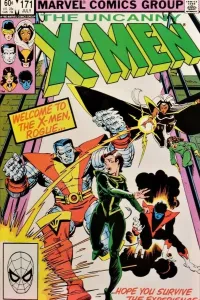
  2. Uncanny X-Men #171 cover
    First X-Men Appearance July 1983

    Uncanny X-Men #171

    By Chris Claremont, Walter Simonson

    Rogue switches sides and joins the X-Men. Chris Claremont writes; Walter Simonson on the art. The defection sets up her long X-Men tenure and makes her one of the team's most emotionally complicated members.

    Read the full breakdown
  3. Rogue #1 cover
    First Solo Title January 1995

    Rogue #1

    By Howard Mackie, Mike Wieringo

    First Rogue solo limited series. Four issues. Howard Mackie writes; Mike Wieringo on art.

    Read the full breakdown

Creation Story

Rogue was Chris Claremont’s design for an X-Men antagonist who could plausibly switch sides. Claremont had been writing Uncanny X-Men since 1975 and had built the Brotherhood of Evil Mutants into the X-Men’s most consistent opposition. By 1981 he was looking for a Brotherhood recruit distinct from the existing lineup; Michael Golden, who drew the debut, designed the visual character (the two-toned hair with the white streak, the green-and-yellow costume, the Southern-adjacent aesthetic).

The Avengers Annual #10 (November 1981) introduces Rogue attacking Carol Danvers (Ms. Marvel) with the intent to permanently absorb her powers. She succeeds. The Annual is structurally not an X-Men book; it’s an Avengers-adjacent story that uses the Brotherhood of Evil Mutants as antagonists. Claremont’s decision to spin Rogue off into the X-Men continuity rather than keep her in Avengers-adjacent territory was an editorial call made in real-time across 1981 and 1982 as the character’s commercial response became clear.

Uncanny X-Men #171 (July 1983) is the defection issue. Rogue, overwhelmed by Carol Danvers’s memories and struggling with the moral weight of her power-theft, seeks out Professor Xavier and asks to be trained in controlling her abilities. The X-Men are skeptical, and Wolverine in particular holds grudges across the following years, but Xavier takes her in. The defection arc is the emotional setup for Rogue’s long X-Men tenure.

The Gambit relationship

Rogue’s on-and-off romantic subplot with Gambit is one of the most sustained relationship arcs in X-Men continuity. They first meet in Uncanny X-Men #266 (August 1990, Gambit’s first appearance) and their romance is structured around the explicit physical impossibility of skin contact: Rogue cannot touch Gambit without absorbing him and potentially killing him. The arc runs across decades of publishing and was a defining piece of the 1990s X-Men books.

The 2024 X-Men 97 animated revival on Disney+ brought Lenore Zann back as Rogue and placed her in a central leadership role, with the Rogue-Gambit relationship getting substantial screen time. The character’s cultural visibility reset sharply with that series.

Collector context

Avengers Annual #10 is the Rogue key and a Copper Age Marvel book. High-grade copies have crossed $2,000 at auction; low-grade reader copies are widely accessible. The book’s value moved with the 2000 X-Men film, the 2024 X-Men 97 revival, and periodic renewed interest in the Claremont X-Men era.

Secondary keys: Uncanny X-Men #171 (defection) is a Claremont-era key worth knowing. Uncanny X-Men #266 (first Gambit) is the Rogue-adjacent book that matters for the relationship arc. X-Men #1 (1991) is the Jim Lee flagship relaunch and a record-setting print run; Rogue is a core team member there.
Key subsequent appearances

After the debut, these are the issues collectors and historians reach for next.

  1. 1981

    The Avengers Annual #10

    First appearance. Attacks Ms. Marvel; permanent power-absorption defines her arc.

  2. 1983

    Uncanny X-Men #171

    Joins X-Men

    Defects to the X-Men. Defining story pivot.

  3. 1990

    Uncanny X-Men #269

    Rogue's first encounter with Gambit. The setup for the long-running romantic subplot that defines both characters.

  4. 1991

    X-Men #1 (1991)

    Jim Lee's flagship relaunch. Rogue is a core team member. Record-setting print run (over eight million copies across variants).

    Newsstand variant
  5. 2001

    X-Treme X-Men #1

    Chris Claremont and Salvador Larroca. Claremont returns to Rogue as a co-lead of an off-continuity X-team.

In adaptations

Film, TV, animation, and game appearances.

  1. 1992

    X-Men: The Animated Series

    Animated

    Starring:Lenore Zann

    Fox Kids Saturday morning series. Zann's performance defined the animated Rogue for five seasons and returned for X-Men 97 (2024). Her Southern-accent voice is the reference version for most audiences.

  2. 2000

    X-Men

    Film

    Starring:Anna Paquin

    Bryan Singer directs. Paquin plays Rogue across four films, though the character's power set is simplified and her role reduced from the comics.

  3. 2024

    X-Men 97

    Animated

    Starring:Lenore Zann

    Disney+ revival of X-Men: The Animated Series. Zann returns in a more central role. Rogue leads the team for much of the first season.

Frequently asked questions

The questions readers and collectors ask most.

What is Rogue's first appearance?

Rogue's first appearance is The Avengers Annual #10 (November 1981), created by Chris Claremont and Michael Golden. She debuts as a member of Mystique's Brotherhood of Evil Mutants, not as an X-Man. She switches sides and joins the X-Men in Uncanny X-Men #171 (July 1983).

Is Avengers Annual #10 valuable?

Yes. Avengers Annual #10 is a Copper Age Marvel key. High-grade copies (CGC 9.0 and above) have crossed $2,000 at auction. The book's value moved with the 2000 film and the 2024 X-Men 97 animated revival, and it is a required book for any X-Men Copper Age collection.

What are Rogue's powers?

Rogue absorbs the powers, memories, and personality of anyone she makes skin contact with. The absorption is temporary for brief contact but permanent for extended contact. In The Avengers Annual #10, she permanently absorbs Ms. Marvel's super-strength, flight, and invulnerability, which she retains for decades of subsequent comics. Her later portrayal in the 2000s and 2010s sometimes reframes the absorption as controllable; this is a character-development arc rather than a retcon of her original power set.

Who is Mystique to Rogue?

Mystique is Rogue's adoptive mother. In the original Claremont-Golden continuity, Mystique and her partner Destiny raised Anna Marie as a runaway and brought her into the Brotherhood of Evil Mutants. The adoption relationship has been canonical across five decades of comics and is referenced in both the film adaptations and the X-Men animated series.

Did Rogue really absorb Ms. Marvel permanently?

Yes, in original continuity. The permanent absorption of Carol Danvers's powers and memories is the founding trauma that defines Rogue's arc. Rogue's time with the X-Men is partly an attempt to atone, and Carol Danvers's eventual recovery of her powers (as Binary, then back as Captain Marvel) does not undo the permanent psychic entanglement between the two characters.