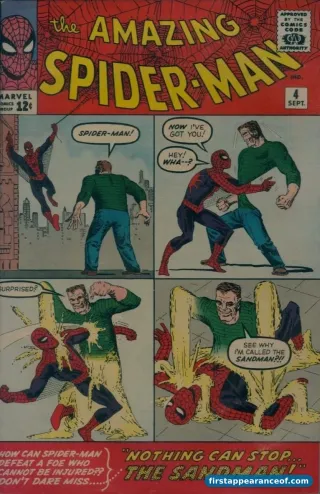
The Amazing Spider-Man #4 (1963). Stan Lee and Steve Ditko. Sandman on the cover, his first appearance and first cover.

1st Appearance and 1st Cover

First Appearance of Sandman (Marvel)

The Amazing Spider-Man #4

September 1963 · Marvel · Silver Age

Stan Lee and Steve Ditko's silver-age Spider-Man villain. The sand-manipulator with the working-class tragic register, the Sinister Six founder, and Thomas Haden Church's Spider-Man 3 lead.

Key Issue

Created by Stan Lee · Steve Ditko

By Atomm Updated

The first appearance (1st app) of the Marvel Sandman is The Amazing Spider-Man #4 (September 1963), created by Stan Lee and Steve Ditko. The issue is both his first appearance and first cover. William Baker (alias Flint Marko) is a small-time criminal who gains sand-manipulation powers after being exposed to radiation at a nuclear test site. The character became one of Spider-Man's most-recurring antagonists across sixty-plus years of stories. He is a founding member of the Sinister Six (debuting in The Amazing Spider-Man Annual #1, October 1964). Thomas Haden Church played Sandman in Spider-Man 3 (2007) and Spider-Man No Way Home (2021).

Quick Facts

Debut
The Amazing Spider-Man #4 (September 1963)
Real name
William Baker (legal); Flint Marko (primary alias)
Creators
Stan Lee (writer, co-creator), Steve Ditko (artist, co-creator)
Publisher
Marvel Comics
First enemy
Antagonist himself.
First ally
The Sinister Six teammates (Doctor Octopus, Vulture, Electro, Mysterio, Kraven the Hunter); the Frightful Four during occasional team-affiliated arcs
Team affiliations
Sinister Six (founding member), Frightful Four, briefly Avengers (anti-hero arcs), occasional Outlaws

Firsts Timeline

  1. The Amazing Spider-Man #4 cover
    First Appearance First Cover September 1963

    The Amazing Spider-Man #4

    By Stan Lee, Steve Ditko

    Stan Lee writes; Steve Ditko pencils. William Baker (alias Flint Marko) debuts as a small-time criminal who gains sand-manipulation powers after being exposed to radiation at a nuclear test site. The issue is both his first appearance and first cover. The character became one of Spider-Man's most-recurring antagonists across sixty-plus years of subsequent stories. The Sinister Six framework that defines much of the property's villain mythology was built in part on this character.

    Read the full breakdown
  2. The Amazing Spider-Man Annual #1 cover
    First Sinister Six Appearance October 1964

    The Amazing Spider-Man Annual #1

    By Stan Lee, Steve Ditko

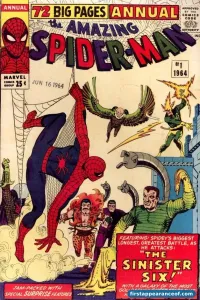
    Stan Lee and Steve Ditko. Sandman is a founding member of the Sinister Six (with Doctor Octopus, Vulture, Electro, Mysterio, and Kraven the Hunter). The annual is the first appearance of the Sinister Six framework that has become one of Marvel's most-recurring villain-team motifs.

    Read the full breakdown

Creation Story

The Marvel Sandman is Stan Lee and Steve Ditko’s Silver Age Spider-Man villain. The Amazing Spider-Man #4 (September 1963) introduces William Baker, a small-time criminal operating under the alias Flint Marko, who gains sand-manipulation powers after being exposed to radiation at a nuclear test site. Lee writes; Ditko pencils. The issue is both his first appearance and first cover.

The character’s framework is calibrated for sustained recurring use. Sandman’s powers (he can transform his body into sand at will, control his density and shape from individual grains to massive sand-constructs, and reform from apparent dispersal) make him uniquely durable as an antagonist; he can be defeated but rarely permanently incapacitated. Stan Lee deliberately built him to recur, and the character became one of Spider-Man’s most-frequent antagonists across the next sixty-plus years.

The character is an early example of Marvel’s working-class villain register. Where DC’s Silver Age villains often came from positions of wealth, scientific genius, or external menace, Sandman was a small-time criminal who fell into superpowers by accident. The framework gave Marvel a different villain demographic and contributed to the Marvel-vs-DC tonal differentiation of the 1960s.

The Sinister Six

The Amazing Spider-Man Annual #1 (October 1964) by Stan Lee and Steve Ditko introduces the Sinister Six: Doctor Octopus (the team’s founder), Sandman, Vulture, Electro, Mysterio, and Kraven the Hunter. Sandman is a founding member. The Sinister Six framework has been one of Marvel’s most-recurring villain-team motifs across sixty-plus years of stories.

The team has appeared in dozens of subsequent Spider-Man stories and was prominently featured in the 2014 The Amazing Spider-Man 2 film’s planned sequel that was eventually cancelled.

The DeFalco reframing

Marvel Two-In-One #86 (April 1982) by Tom DeFalco and Ron Wilson canonized Sandman’s tragic-personal-history register. The William-Baker-vs-Flint-Marko identity tension (between his birth name and criminal alias) became a recurring framework. His complicated relationship with his estranged daughter, his guilt over his criminal past, and his periodic efforts to operate as a hero rather than a villain became canonical character elements.

The character has alternated between villain and anti-hero registers across subsequent decades. Both modes are canonical, and different writers have framed Sandman through different registers. The framework is similar to the canonical Magneto-as-villain-vs-Magneto-as-anti-hero tension in the X-books: not a continuity contradiction but a deliberate complexity that the property tolerates and exploits.

Adaptations

Thomas Haden Church’s Sandman in Spider-Man 3 (2007, Sam Raimi) is widely regarded as the strongest film Sandman portrayal. The film canonizes the tragic-father motivation (Flint Marko committed the robbery to pay for his daughter’s medical treatment) that the comics had built up over decades. Church’s performance is widely regarded as one of the strongest single-villain performances in the Raimi Spider-Man trilogy.

Church returned as Sandman in Spider-Man: No Way Home (2021, Jon Watts) for the multiversal-villain returns sequence. The appearance is CGI-only with Church providing voice work, though the framework canonically returns the character to the Raimi-trilogy continuity.

Collector context

The Amazing Spider-Man #4 is the Marvel Sandman Silver Age first-appearance key. High-grade CGC 9.0+ copies have crossed $25,000 at auction. The book’s value has tracked with Spider-Man villain demand generally and with each Sandman adaptation.

Secondary keys: The Amazing Spider-Man Annual #1 (October 1964, first Sinister Six). Marvel Two-In-One #86 (April 1982, DeFalco’s tragic-history reframing).
Key subsequent appearances

After the debut, these are the issues collectors and historians reach for next.

  1. 1963

    The Amazing Spider-Man #4

    First appearance and first cover.

  2. 1964

    The Amazing Spider-Man Annual #1

    First Sinister Six appearance.

  3. 1972

    Marvel Team-Up #1

    Marvel Team-Up Era

    Roy Thomas writes; Ross Andru pencils. Sandman appears as the first major antagonist of the Marvel Team-Up ongoing, paired with Spider-Man and the Human Torch.

  4. 1982

    Marvel Two-In-One #86

    Anti-Hero Era

    Tom DeFalco writes; Ron Wilson pencils. Sandman's tragic-personal-history reframing. The Will-Baker-vs-Flint-Marko identity tension is canonized; the character begins his recurring anti-hero arcs that would run intermittently across subsequent decades.

In adaptations

Film, TV, animation, and game appearances.

  1. 1967

    Spider-Man (Animated)

    Animated

    Grantray-Lawrence animated series. Sandman appears as a recurring antagonist.

  2. 1994

    Spider-Man: The Animated Series

    Animated

    Fox Kids series. Sandman appears in supporting capacity across the run.

  3. 2007

    Spider-Man 3

    Film

    Starring:Thomas Haden Church

    Sam Raimi directs. Church's Sandman is widely regarded as the strongest film Sandman portrayal. The film canonizes the tragic-father motivation (Flint Marko committed the robbery to pay for his daughter's medical treatment) that the comics had built up over decades.

  4. 2021

    Spider-Man: No Way Home

    Film

    Starring:Thomas Haden Church

    Jon Watts directs. Church returns as Sandman in the multiversal-villain returns sequence. CGI-only appearance with Church providing voice work.

Frequently asked questions

The questions readers and collectors ask most.

What is Sandman's first appearance?

The Marvel Sandman's first appearance is The Amazing Spider-Man #4 (September 1963), created by Stan Lee and Steve Ditko. The issue is both his first appearance and first cover. William Baker (alias Flint Marko) gains sand-manipulation powers after being exposed to radiation at a nuclear test site. Note: this is Marvel's Sandman; DC's Vertigo Sandman (Dream / Morpheus) is an entirely separate character with his own publishing history.

Is The Amazing Spider-Man #4 valuable?

Yes. The Amazing Spider-Man #4 is a Silver Age Marvel key with strong recurring-villain collector weight. High-grade copies (CGC 9.0 and above) have crossed $25,000 at auction. The book's value tracks with Spider-Man villain demand generally and with each Sandman adaptation, particularly Thomas Haden Church's portrayal in Spider-Man 3 (2007) and Spider-Man: No Way Home (2021).

Is this the same Sandman as Vertigo's Sandman?

No. The Marvel Sandman (William Baker / Flint Marko, debut Amazing Spider-Man #4, 1963) is a Spider-Man villain with sand-manipulation powers. DC's Vertigo Sandman (Dream / Morpheus, debut The Sandman #1, 1989, Neil Gaiman and Sam Kieth) is the personification of dreams and a fundamentally different character with no relation to the Marvel character. Both characters have used the 'Sandman' name across decades; the Marvel character is older and is the original holder of the name in mainstream American comics, but the Vertigo character has substantially greater modern cultural recognition through the 2022 Netflix Sandman adaptation.

What is the Sinister Six?

Spider-Man's first major team-up of his rogues. The Amazing Spider-Man Annual #1 (October 1964) by Stan Lee and Steve Ditko introduces the Sinister Six: Doctor Octopus, Sandman, Vulture, Electro, Mysterio, and Kraven the Hunter. Sandman is a founding member. The Sinister Six framework has been one of Marvel's most-recurring villain-team motifs across sixty-plus years of stories and was prominently featured in the 2014 The Amazing Spider-Man 2 film's planned sequel that was eventually cancelled.

Why does Sandman alternate between hero and villain?

Tom DeFalco's Marvel Two-In-One #86 (April 1982) reframed the character. Sandman's tragic-personal-history (his complicated relationship with his estranged daughter, his guilt over his criminal past, the William-Baker-vs-Flint-Marko identity tension between his birth name and criminal alias) was canonized. The character has alternated between villain and anti-hero registers across subsequent decades; both modes are canonical, and different writers have framed Sandman through different registers. The Spider-Man 3 film (2007) preserves the tragic-father motivation that DeFalco established.