Creation Story
Rocket’s first-appearance history is a genuine three-book split (Marvel Preview #7, Incredible Hulk #271, Rocket Raccoon #1), which makes him one of the cleanest worked examples in the True First Appearance guide for characters with layered firsts.
Bill Mantlo is the reason Rocket Raccoon exists. Any honest telling of this character’s history has to start and finish with Mantlo, a writer whose Marvel career is undersung in proportion to its impact and whose personal story reframes how any fan reads his work.
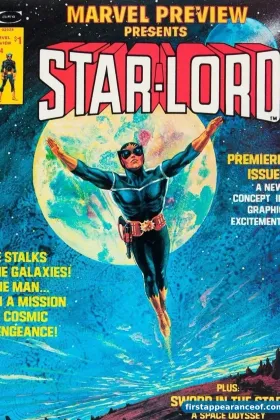
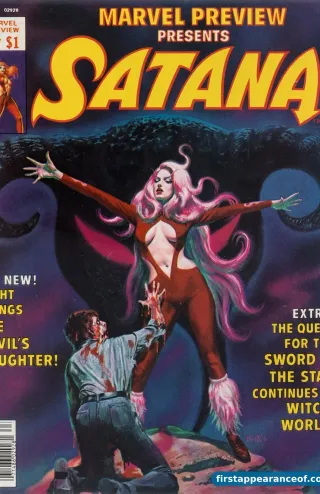
In 1976 Mantlo was writing for Marvel Preview, Marvel’s black-and-white magazine-format anthology that existed outside the Comics Code Authority framework and that Marvel used as a workshop for offbeat and mature-themed material. Marvel Preview #7 ran a story called “The Sword in the Star,” a cosmic fantasy pastiche that Mantlo had been developing. The backup feature of that issue was “The Sword in the Star, Part 2,” which Mantlo wrote and Keith Giffen drew. Inside that backup, a small anthropomorphic raccoon named Rocky Raccoon appears as a supporting character. That is the first appearance.
The name Rocky Raccoon is lifted directly from the Beatles song of the same name off the 1968 White Album. Mantlo has confirmed this in multiple interviews. The White Album connection carries into other Mantlo work — the character’s eventual planet is Halfworld, and the Beatles’s “Get Back” is the name of the spaceship in one of the later appearances. Mantlo was a Beatles fan who wrote those references into the cosmic margins of Marvel when nobody was paying attention.
Giffen’s Marvel Preview #7 design is rougher than the character would later become. Black-and-white line art, a more naturalistic raccoon shape, clothing that reads as utilitarian rather than iconic. The character was a minor figure in Mantlo and Giffen’s fantasy sidebar and nobody at Marvel seems to have expected more from him.
Marvel Preview #7 — First Appearance
Marvel Preview was a magazine-size, black-and-white publication in the mode of the better-known Savage Sword of Conan. It circulated on newsstands alongside comics but was priced and formatted more like a magazine, with higher cover price and more pages per issue.
The Rocky Raccoon sequence in #7 is a classic backup-feature cameo. Rocky does not carry the issue, is not on the cover, and the Giffen art does not yet contain the elements that later define the character. But he is there, he is named, and the story gives him enough presence to count unambiguously as a first appearance.
Marvel Preview #7 is an underprinted and under-preserved key. The magazine format meant many copies were read to death, left uncovered, or lost to the regular attrition that magazine-format comics suffer. CGC census populations for Marvel Preview #7 in high grade are substantially smaller than for a typical 1976 Marvel comic, and this is reflected in steadily rising auction prices. CGC 9.8 copies have traded into five figures.
Incredible Hulk #271 — First Color Appearance and First Cover
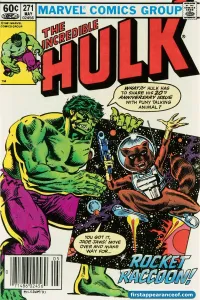
Six years after Marvel Preview #7, Mantlo (now a regular writer on Incredible Hulk) brought Rocky back. He retooled the name to Rocket Raccoon. He set the reintroduction on a planet called Halfworld, a Mental-Hospital-as-Setting concept that would become the character’s defining origin in the 1985 limited series. Sal Buscema drew the color debut and redesigned the character with sharper proportions and a more iconic silhouette.
Hulk #271 is the first cover image of Rocket Raccoon in publishing history. It is also the first time the name “Rocket Raccoon” appears in print. And it is the first time the character is rendered in color. Three firsts in a single issue, all of them meaningful, all of them documented on-page.
This creates a genuine two-book first-appearance split. Purist collectors and grading companies favor Marvel Preview #7 as the technical first. Working collectors and investors favor Incredible Hulk #271 as the key issue: first color, first cover, first use of the proper name. The market prices both as keys, and neither is a wrong answer. Hulk #271 is also a Bronze/Copper Age transition issue with a newsstand/direct-market split that continues to be underappreciated relative to the character’s profile.
Rocket Raccoon #1 (1985) — First Solo Title
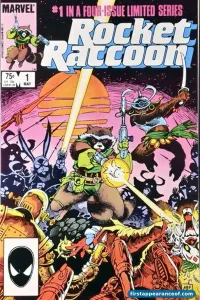
In 1985, Mantlo wrote a four-issue limited series for Rocket Raccoon. The artist was Mike Mignola, whose career was still in its early stages — this is arguably the first major Marvel work in Mignola’s bibliography, several years before his run on Doctor Strange, his DC migration, and the 1993 creation of Hellboy.
The Mignola art on Rocket Raccoon #1–#4 is an unusual snapshot: you can see the silhouettes and architectural compositions that would define Hellboy, applied to a cartoon raccoon on a planet shaped like a mental hospital. The series fleshes out Halfworld, establishes the Toy Wars, introduces Wal Rus and Judson Jakes, and gives Rocket a coherent origin that would hold up for decades.
Rocket Raccoon #1 (1985) is the first solo title. It has a newsstand variant and a direct-market edition, as was standard Copper Age practice. The newsstand copies in high grade are rarer and carry significant premiums.
Bill Mantlo and the Creator-Credit Conversation
Every Rocket Raccoon piece written after 2014 has to acknowledge the fact that Bill Mantlo is permanently disabled and has been since a hit-and-run accident in 1992. He cannot participate in interviews, speeches, or royalty negotiations. His brother Michael Mantlo manages his affairs and has been the family’s voice in every Rocket-related creator-credit conversation since the MCU adaptation arrived.
James Gunn has been public and consistent about the Mantlo debt. In multiple interviews around each Guardians film, Gunn has named Mantlo as Rocket’s creator, has directed fans to the Bill Mantlo fund set up to help with Mantlo’s medical care, and has pushed Marvel publicly to ensure Mantlo receives ongoing royalty participation. When Marvel Studios adapted the character, they did so via the character-participation system that funnels a portion of licensing revenue back to original creators where the paperwork permits it.
This background matters to how the comics are read. Every dollar paid for a copy of Marvel Preview #7, Incredible Hulk #271, or Rocket Raccoon #1 is a book that Mantlo wrote, characters he designed, a voice he invented. Rocket is one of the most directly attributable major Marvel characters in the MCU era. One writer. One vision. One career ended too early.
Modern Era and the Guardians Line
After Mantlo’s accident in 1992 and a quiet decade for the character in the 1990s and early 2000s, Dan Abnett and Andy Lanning reintroduced Rocket during the Annihilation and Annihilation: Conquest cosmic events of 2006–2008. Their Guardians of the Galaxy Vol. 2 ongoing (2008 onward) became the template that James Gunn adapted into the 2014 film. Rocket’s modern characterization — wisecracking, militant, emotionally walled-off, the group’s heart disguised as a grenade launcher — is fundamentally an Abnett/Lanning creation built on the Mantlo foundation.
The 2014 ongoing by Skottie Young and the 2017 I Am Groot positioning cemented Rocket’s visual identity for the MCU generation. Bradley Cooper’s voice, Sean Gunn’s performance capture, and James Gunn’s writing carried the character into global mainstream recognition. The 2023 Guardians Vol. 3 film finally told the Halfworld-adjacent origin story that Mantlo had been building since 1976.