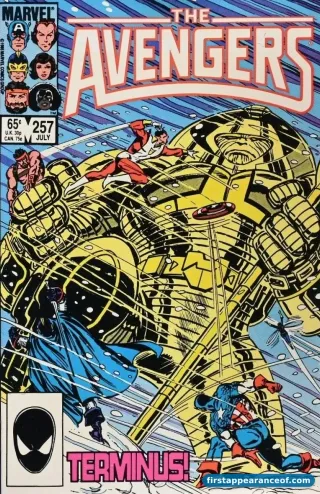
The Avengers #257 (1985). Nebula debuts. Roger Stern and John Buscema.

1st Appearance and 1st Cover

First Appearance of Nebula

The Avengers #257

July 1985 · Marvel · Copper Age

Roger Stern and John Buscema's space pirate. The cyborg adopted-daughter of Thanos, Gamora's rival-then-sister, and Karen Gillan's MCU role across nine years and seven films.

Key Issue

Created by Roger Stern · John Buscema

By Atomm Updated

The first appearance (1st app) of Nebula is The Avengers #257 (July 1985), created by Roger Stern (writer) and John Buscema (artist). The issue is both her first appearance and first cover. Nebula debuts as a space pirate claiming to be Thanos's granddaughter; the precise relationship has been retconned multiple times. Modern continuity treats her as Thanos's adopted daughter and Gamora's adopted sister. Karen Gillan played Nebula in James Gunn's Guardians of the Galaxy films starting with the 2014 original.

Quick Facts

Debut
The Avengers #257 (July 1985)
Real name
Nebula
Creators
Roger Stern (writer, co-creator), John Buscema (artist, co-creator)
Publisher
Marvel Comics
First enemy
Antagonist herself in early appearances; later reforms in modern Guardians era.
First ally
Thanos's adoptive family hierarchy (her structural framework); modern Guardians of the Galaxy team (post-reform)
Team affiliations
Guardians of the Galaxy (modern), occasional team-villain rosters

First Appearance

  1. The Avengers #257 cover
    First Appearance First Cover July 1985

    The Avengers #257

    By Roger Stern, John Buscema

    Roger Stern writes; John Buscema pencils. Nebula debuts as a space pirate claiming to be Thanos's granddaughter; the claim is partly canonical (she's an adopted granddaughter of Thanos's grandfather Kronos in the modern interpretation, with the precise relationship retconned across decades). The issue is both her first appearance and first cover.

    Read the full breakdown

Creation Story

Nebula is Roger Stern and John Buscema’s Copper Age Avengers addition. The Avengers #257 (July 1985) introduces her as a space pirate claiming to be Thanos’s granddaughter (Thanos was presumed dead at the time of her introduction, having died in the Bronze Age Starlin cosmic run). Stern writes; Buscema pencils. The issue is both her first appearance and first cover.

The character’s relationship to Thanos has been retconned multiple times across decades of stories. Her original 1985 claim was that she’s Thanos’s granddaughter; subsequent runs walked the relationship back to “adopted granddaughter of Kronos” (Thanos’s grandfather); modern continuity (post-2008 cosmic-Marvel) treats her as Thanos’s adopted daughter and Gamora’s adopted sister. The MCU adaptation uses the adopted-daughter framework consistently.

The cyborg framework is a defining character note. Thanos progressively replaced Nebula’s body parts with cybernetics as punishment for her failures during her training and his service. The framework was developed across the original Stern and Starlin runs and has been preserved across virtually every subsequent Nebula portrayal, including the MCU films where Karen Gillan’s Nebula has progressively more cybernetic replacements across each appearance.

The Infinity Gauntlet

The Infinity Gauntlet #1 (July 1991) by Jim Starlin and George Perez featured Nebula in a substantial role across the crossover, including the climactic moment where she briefly seizes the Gauntlet from Thanos. The arc is widely regarded as one of the strongest extended cosmic-Marvel storylines and gave Nebula her most prominent pre-MCU character work.

The Infinity Gauntlet sequence (Nebula trapped in a partially-decayed body, freed by Thanos’s defeat, briefly cosmic-omnipotent) is one of the most-cited sequences in the broader Infinity-saga storytelling.

The MCU era

Karen Gillan’s Nebula debuted in Guardians of the Galaxy (2014, James Gunn) as a secondary antagonist. Subsequent films progressively developed her character arc:

The MCU’s Nebula has one of the most-developed character arcs in the broader Marvel Cinematic Universe. Gillan’s performance is widely regarded as one of the strongest sustained character developments in modern superhero film. The MCU’s extensive screen time accelerated collector demand for first-print The Avengers #257 across multiple price-spike cycles.

Collector context

The Avengers #257 is the Nebula Copper Age first-appearance key. High-grade CGC 9.8 copies have crossed $400 at auction. Newsstand variants carry a meaningful premium. The book’s value tracks closely with each Nebula MCU appearance.

Secondary keys: The Infinity Gauntlet #1 (1991, substantial Nebula role in the Gauntlet crossover). Annihilation: Conquest #6 (April 2008, broader cosmic-Marvel resurgence).
Key subsequent appearances

After the debut, these are the issues collectors and historians reach for next.

  1. 1985

    The Avengers #257

    First appearance and first cover.

  2. 1991

    The Infinity Gauntlet #1

    Gauntlet Crossover

    Jim Starlin and George Perez. Nebula plays a substantial role in the Infinity Gauntlet crossover, including the climactic moment where she briefly seizes the Gauntlet from Thanos. The arc is widely regarded as one of the strongest extended cosmic-Marvel storylines.

  3. 2008

    Annihilation: Conquest #6

    Modern Cosmic Era

    Dan Abnett and Andy Lanning. Nebula's role in the broader cosmic-Marvel resurgence is established. She joins the modern Guardians of the Galaxy team in subsequent runs.

In adaptations

Film, TV, animation, and game appearances.

  1. 2014

    Guardians of the Galaxy

    Film

    Starring:Karen Gillan

    James Gunn directs. Gillan's Nebula is widely regarded as the definitive screen interpretation. Reprises across multiple MCU films through Guardians of the Galaxy Vol. 3 (2023). The MCU's extended treatment gave Nebula one of the most-developed character arcs in the franchise.

Frequently asked questions

The questions readers and collectors ask most.

What is Nebula's first appearance?

Nebula's first appearance is The Avengers #257 (July 1985), created by Roger Stern (writer) and John Buscema (artist). The issue is both her first appearance and first cover. Nebula debuts as a space pirate claiming to be Thanos's granddaughter.

Is The Avengers #257 valuable?

Yes. The Avengers #257 is a Copper Age Marvel key with strong adaptation-driven collector demand. High-grade copies (CGC 9.8) have crossed $400 at auction. Newsstand variants carry a meaningful premium. The book's value spiked sharply after Karen Gillan's casting as Nebula in Guardians of the Galaxy (2014) and has held.

Is Nebula really Thanos's granddaughter?

It depends on continuity. Her original 1985 claim was that she's the granddaughter of Thanos; the precise relationship has been retconned multiple times. Modern continuity (post-2008 cosmic-Marvel) treats her as Thanos's adopted daughter and Gamora's adopted sister, with no actual biological relationship to Thanos's family. The MCU adaptation uses the adopted-daughter framework. The 1985 'granddaughter' framing is sometimes treated as Nebula's deliberate misrepresentation rather than canonical fact.

Why is Nebula a cyborg?

Thanos progressively replaced her body parts with cybernetics as punishment for her failures during her training and his service. The cyborg framework was developed across the original 1985 to 1991 Stern and Starlin runs. The MCU adaptation preserves the framework: Karen Gillan's Nebula has progressively more cybernetic replacements across the films, with the abuse-by-Thanos framework as the explanation. The cyborg-from-Thanos-abuse register is one of the canonical character markers.

How did Karen Gillan's Nebula develop across the MCU?

Substantially. The 2014 Guardians of the Galaxy positioned Nebula as a secondary antagonist; subsequent films progressively developed her character arc through Guardians Vol. 2 (2017), Avengers: Infinity War (2018), Avengers: Endgame (2019), and Guardians Vol. 3 (2023). The MCU's Nebula has one of the most-developed character arcs in the franchise: from antagonistic adopted daughter to reluctant ally to full Guardians member to the team's emotional anchor by Vol. 3. Gillan's performance is widely regarded as one of the strongest sustained character developments in modern superhero film.