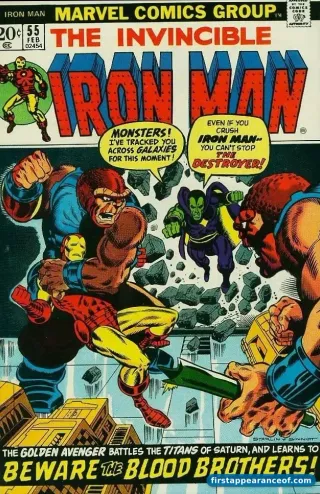
Iron Man #55 (1973). Drax debuts in the same issue as Thanos. Jim Starlin's first major Marvel writing credit.

1st Appearance

First Appearance of Drax

Iron Man #55

February 1973 · Marvel · Bronze Age

Jim Starlin's purpose-built Thanos antagonist. The cosmic-vendetta protagonist whose entire existence is anti-Thanos, plus the deadpan Guardians of the Galaxy member that Dave Bautista made canonical.

Key Issue

Created by Jim Starlin · Mike Friedrich

By Atomm Updated

The first appearance (1st app) of Drax is Iron Man #55 (February 1973), the same issue that introduces Thanos. Jim Starlin plots and pencils; Mike Friedrich co-writes. Drax was created by the cosmic entity Kronos to oppose his grandson Thanos. Arthur Douglas was a human killed alongside his family by Thanos; Kronos restored Douglas's consciousness in a manufactured powerful body specifically to kill Thanos. Drax is one of the founding members of the modern Guardians of the Galaxy team in Annihilation: Conquest #6 (April 2008).

Quick Facts

Debut
Iron Man #55 (February 1973)
Real name
Arthur Sampson Douglas
Creators
Jim Starlin (plotter, artist, co-creator), Mike Friedrich (co-writer)
Publisher
Marvel Comics
First enemy
Thanos (his cosmic-purpose antagonist target across his entire publishing history)
First ally
The Guardians of the Galaxy (modern team)
Team affiliations
Guardians of the Galaxy (modern, post-Annihilation), Infinity Watch

First Appearance

  1. Iron Man #55 cover
    First Appearance February 1973

    Iron Man #55

    By Jim Starlin, Mike Friedrich

    Jim Starlin plots and pencils; Mike Friedrich co-writes the script. Drax debuts in the same issue as Thanos as a counterweight created by the cosmic entity Kronos to oppose his grandson's universal threat. The framework establishes Drax as a Thanos-specific antagonist, a role the character has held across fifty-plus years.

    Read the full breakdown

Creation Story

Drax is Jim Starlin’s purpose-built Thanos antagonist, debuting in Iron Man #55 (February 1973) — the same issue that introduces Thanos himself. Starlin plots and pencils; Mike Friedrich co-writes the script. The compounded first-appearance weight (Drax + Thanos) is one of the most consequential Bronze Age Marvel character debuts; the issue also introduces Mentor (Thanos’s father) and Starfox (Thanos’s brother).

The character’s origin is structurally singular. Arthur Douglas was a human killed alongside his family by Thanos in a casual Earth-bound encounter. The cosmic entity Kronos (Thanos’s grandfather) restored Douglas’s consciousness in a manufactured powerful body specifically to oppose his grandson. Drax exists for one purpose: killing Thanos. The framework is unusual because most Marvel cosmic characters have layered motivations; Drax is structurally singular and has remained so for fifty-plus years.

The Starlin cosmic-Marvel run (Iron Man, Captain Marvel, Warlock) developed the Drax-Thanos vendetta across multiple titles through the 1970s and was the foundational text for Marvel’s broader cosmic mythology.

The modern Guardians era

Annihilation: Conquest #6 (April 2008) by Dan Abnett and Andy Lanning integrated Drax into the modern Guardians of the Galaxy lineup. The framework had not previously linked Drax to a team identity; the Annihilation crossover established Drax as one of the founding members of the modern Guardians alongside Star-Lord, Rocket Raccoon, Groot, Gamora, and others.

The team identity reframed Drax’s character work. He retained the Thanos-vendetta motivation but operated within a team framework rather than as a singular cosmic operator. The Abnett-Lanning Guardians run (Guardians of the Galaxy Vol. 2, 2008 to 2010) is the framework that the 2014 James Gunn film draws from.

The film era

Dave Bautista’s Drax in Guardians of the Galaxy (2014, James Gunn) is widely regarded as the definitive screen interpretation. The film’s Drax substantially modifies the comics character: deadpan literal-interpretation framework (Drax cannot understand metaphor or sarcasm), comedic-supporting register, lower combat tier than the comics character, more emotionally accessible. The framework became the canonical popular-culture version of the character.

Bautista reprised the role across Avengers: Infinity War (2018), Avengers: Endgame (2019), and Guardians of the Galaxy Vol. 3 (2023). Recent comics have moved Drax in a more comedic-direction influenced by the film’s portrayal.

Collector context

Iron Man #55 is the Drax Bronze Age first-appearance key, shared with Thanos. The compounded first-appearance weight makes the book a major Bronze Age Marvel key. High-grade CGC 9.0+ copies have crossed $4,000 at auction; CGC 9.8 copies have crossed $50,000. The book’s value spiked substantially with the MCU’s Thanos arc and has held.

Secondary keys: Captain Marvel #25 (March 1973, Drax recurs in Starlin’s cosmic-Marvel run). Annihilation: Conquest #6 (April 2008, modern Guardians founding).
Key subsequent appearances

After the debut, these are the issues collectors and historians reach for next.

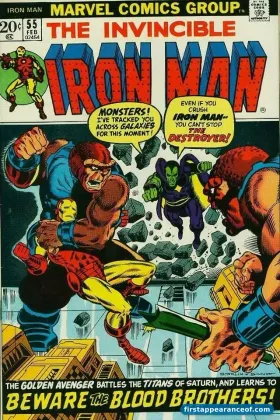
  1. 1973

    Iron Man #55

    First appearance. Same issue as Thanos.

  2. 1973

    Captain Marvel #25

    Starlin Cosmic Run

    Jim Starlin. Drax becomes a recurring presence across Starlin's cosmic-Marvel run. The Captain Marvel issues build out the Drax-Thanos conflict.

  3. 2008

    Annihilation: Conquest #6

    Modern Guardians Founding

    Dan Abnett and Andy Lanning. Drax becomes a founding member of the modern Guardians of the Galaxy team. The framework that the 2014 James Gunn film draws from.

In adaptations

Film, TV, animation, and game appearances.

  1. 2014

    Guardians of the Galaxy

    Film

    Starring:Dave Bautista

    James Gunn directs. Bautista's Drax is widely regarded as the definitive screen interpretation. The film's Drax substantially modifies the comics character (deadpan literal-interpretation framework, comedic-supporting register) but became the canonical popular-culture version. Bautista reprises across multiple MCU films through Guardians of the Galaxy Vol. 3 (2023).

Frequently asked questions

The questions readers and collectors ask most.

What is Drax's first appearance?

Drax's first appearance is Iron Man #55 (February 1973), the same issue that introduces Thanos. Jim Starlin plots and pencils; Mike Friedrich co-writes the script. The compounded first-appearance weight (Drax + Thanos) makes the book a substantial Bronze Age Marvel key.

Why was Drax created?

By the cosmic entity Kronos specifically to kill his grandson Thanos. In the comics framework, Arthur Douglas was a human killed alongside his family by Thanos. Kronos restored Douglas's consciousness in a manufactured powerful body whose only purpose was Thanos's destruction. The framework gives Drax a singular cosmic-vendetta motivation that defines his entire publishing history.

Is Iron Man #55 valuable?

Yes. Iron Man #55 is a major Bronze Age Marvel key with compounded first-appearance weight. It's the first Thanos and the first Drax in the same issue, plus first Mentor (Thanos's father) and first Starfox (Thanos's brother). High-grade copies (CGC 9.0 and above) have crossed $4,000 at auction; CGC 9.8 copies have crossed $50,000. The book's value spiked substantially with the MCU's Thanos arc and has held.

How does the comics Drax differ from the film Drax?

Substantially. The comics Drax has the singular motivation of killing Thanos; he's a deadly cosmic-warrior with a tragic backstory. The film Drax (Dave Bautista, James Gunn's Guardians of the Galaxy films) substantially modifies the character: deadpan literal-interpretation framework, comedic-supporting register, lower combat tier, more emotionally accessible. The film's Drax became the canonical popular-culture version, and recent comics have moved Drax in a more comedic-direction influenced by the film.

Is Drax always pursuing Thanos?

Across most of his publishing history, yes. The character's structural framework is Thanos-pursuit. When Thanos is dead, Drax has limited story function; when Thanos is active, Drax has cosmic-vendetta motivation. Modern continuity has expanded the character's framework somewhat (Drax has played roles in Guardians of the Galaxy stories that aren't Thanos-focused), but the Thanos-vendetta remains the defining character note.