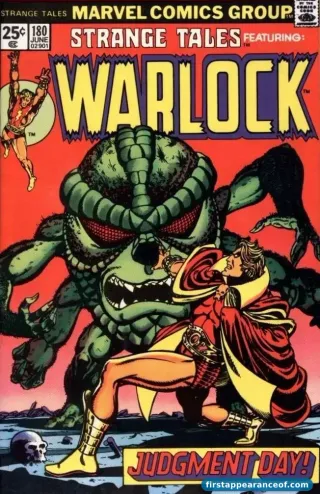
Strange Tales #180 (1975). Gamora debuts in Jim Starlin's Warlock back-up feature.

1st Appearance and 1st Cover

First Appearance of Gamora

Strange Tales #180

June 1975 · Marvel · Bronze Age

Jim Starlin's deadliest woman in the galaxy. The Thanos-raised assassin who turned against her foster-father, plus the Zoe Saldaña MCU role that defined the modern character.

Key Issue

Created by Jim Starlin

By Atomm Updated

The first appearance (1st app) of Gamora is Strange Tales #180 (June 1975), created by Jim Starlin (sole writer and artist). Gamora debuts in Starlin's Warlock back-up feature as the last surviving member of the Zen Whoberi alien race that Thanos destroyed. Thanos raises Gamora as an assassin trained from childhood. The Starlin cosmic-Marvel run developed her complete character framework, including her eventual reformation against Thanos. Gamora is a founding member of the modern Guardians of the Galaxy team in Annihilation: Conquest #6 (April 2008).

Quick Facts

Debut
Strange Tales #180 (June 1975)
Real name
Gamora Zen Whoberi Ben Titan
Creators
Jim Starlin (writer, artist, sole creator)
Publisher
Marvel Comics
First enemy
Antagonist herself in Starlin's run, then reforms against Thanos.
First ally
Adam Warlock (her romantic partner across the Starlin cosmic run); modern Guardians of the Galaxy team
Team affiliations
Guardians of the Galaxy (modern, post-Annihilation), Infinity Watch

First Appearance

  1. Strange Tales #180 cover
    First Appearance First Cover June 1975

    Strange Tales #180

    By Jim Starlin

    Jim Starlin writes and pencils. Gamora debuts in Starlin's Warlock back-up feature, raised by Thanos as the last surviving Zen Whoberi (the alien race Thanos destroyed). The issue is both her first appearance and first cover. The Starlin cosmic-Marvel run developed Gamora's complete character framework: assassin trained from childhood, eventually reformed against Thanos.

    Read the full breakdown

Creation Story

Gamora is Jim Starlin’s sole-creator addition to his cosmic-Marvel mythology. Strange Tales #180 (June 1975) introduces her in Starlin’s Warlock back-up feature within the Strange Tales anthology title. Starlin writes, pencils, and provides cover art; the framework that defines Gamora across fifty subsequent years is essentially complete in the debut.

Gamora is the last surviving member of the Zen Whoberi, an alien race that Thanos destroyed. Thanos raised Gamora from childhood as a personal assassin, trained in combat to a degree no non-cosmic-being in the Marvel universe matches. The framework gave Starlin a character whose “Most Dangerous Woman in the Galaxy” reputation was plausible without conventional superhero powers; Gamora’s combat capability is sufficient explanation for her prominence.

The character’s structural arc across Starlin’s Warlock and broader cosmic-Marvel run is reformation: Gamora gradually turns against Thanos, develops a romantic relationship with Adam Warlock, and becomes one of the cosmic resistance against Thanos’s universal threats. The arc framework has been preserved across virtually every subsequent Gamora portrayal.

The modern Guardians

Annihilation: Conquest #6 (April 2008) by Dan Abnett and Andy Lanning integrated Gamora into the modern Guardians of the Galaxy lineup. Gamora became one of the founding members of the modern team alongside Star-Lord, Rocket Raccoon, Groot, Drax, and others. The Abnett-Lanning Guardians run (Guardians of the Galaxy Vol. 2, 2008 to 2010) is the framework that the 2014 James Gunn film draws from.

The MCU era

Zoe Saldaña’s Gamora in Guardians of the Galaxy (2014, James Gunn) is widely regarded as the definitive screen interpretation. Saldaña reprised the role across the Guardians sequels and the Avengers films. Avengers: Infinity War (2018) killed Saldaña’s Gamora; Avengers: Endgame (2019) introduced an alternate-timeline Gamora who continues across subsequent MCU films, including Guardians of the Galaxy Vol. 3 (2023).

The MCU’s extensive screen time for the character expanded her cultural recognition substantially beyond what comics audiences had given her. First-print Strange Tales #180 prices accelerated sharply with each MCU appearance and have held.

Collector context

Strange Tales #180 is the Gamora Bronze Age first-appearance key. High-grade CGC 9.6+ copies have crossed $1,500 at auction. The book’s value tracks closely with each Gamora MCU appearance.

Secondary keys: Strange Tales #181 (August 1975, Gamora character development continues). Annihilation: Conquest #6 (April 2008, modern Guardians founding).
Key subsequent appearances

After the debut, these are the issues collectors and historians reach for next.

  1. 1975

    Strange Tales #180

    First appearance and first cover.

  2. 1975

    Strange Tales #181

    Starlin Warlock Run

    Jim Starlin. Gamora's full character framework develops across Starlin's continued Warlock back-up run.

  3. 2008

    Annihilation: Conquest #6

    Modern Guardians Founding

    Dan Abnett and Andy Lanning. Gamora becomes a founding member of the modern Guardians of the Galaxy team.

In adaptations

Film, TV, animation, and game appearances.

  1. 2014

    Guardians of the Galaxy

    Film

    Starring:Zoe Saldaña

    James Gunn directs. Saldaña's Gamora is widely regarded as the definitive screen interpretation. Reprises across multiple MCU films through Guardians of the Galaxy Vol. 3 (2023). Saldaña's Gamora dies in Avengers: Infinity War (2018); an alternate-timeline Gamora is introduced in Endgame (2019) and continues across subsequent films.

Frequently asked questions

The questions readers and collectors ask most.

What is Gamora's first appearance?

Gamora's first appearance is Strange Tales #180 (June 1975), created by Jim Starlin (sole writer and artist). Gamora debuts in Starlin's Warlock back-up feature within the Strange Tales anthology title. The issue is both her first appearance and first cover.

Why did Thanos raise Gamora?

Thanos destroyed Gamora's entire alien race (the Zen Whoberi) and raised the only survivor as a personal assassin trained from childhood. The framework is structurally similar to Black Widow's KGB-Red-Room training but on a cosmic scale: Gamora's combat training was the most extensive any non-cosmic-being received in the Marvel universe. The framework was a deliberate Starlin choice to give Gamora plausible 'Most Dangerous Woman in the Galaxy' framing without requiring conventional superhero powers.

Is Strange Tales #180 valuable?

Yes. Strange Tales #180 is a Bronze Age key with strong adaptation-driven collector demand. High-grade copies (CGC 9.6 and above) have crossed $1,500 at auction. The book's value tracks closely with each Gamora MCU appearance, particularly Zoe Saldaña's portrayal across Guardians of the Galaxy (2014) and the broader Avengers films.

Did Gamora die in the comics?

Multiple times. Gamora has died and returned across various Starlin cosmic events (Infinity Gauntlet, Infinity War, Infinity Crusade, multiple subsequent crossovers). The framework is consistent with cosmic-Marvel storytelling broadly: cosmic characters die, are restored through cosmic mechanisms, and continue. Modern continuity preserves the character. The MCU adaptation killed Saldaña's Gamora in Avengers: Infinity War (2018); an alternate-timeline Gamora was introduced in Endgame (2019) and continues across subsequent MCU films.

Is Gamora related to Nebula?

Both are Thanos's adopted daughters in canon. The relationship between Gamora and Nebula has been developed extensively across both comics and film: rivalry trained from childhood, mutual antagonism that gradually evolves into reluctant cooperation, eventual reframing as actual sisters bonded by shared trauma. The MCU adaptation gave the relationship substantial screen time across the Guardians and Avengers films.