What is Hydra
Hydra exists because Marvel needed something for a spy to be aimed at. The company was converting Nick Fury from a war-comic sergeant into a Cold War spymaster, and a secret agency is only as interesting as its opposition. So the opposition was written into existence alongside the agency, and it was built to be unkillable.
The order matters, because almost everything a reader now associates with Hydra arrived later. The debut has no Nazis, no Baron Strucker, and no war record. It has a death cult with an excellent slogan and a nondescript businessman in charge. The Nazi lineage, the aristocratic founder, the sleeper agents threaded through the government: writers built all of that onto a villain Marvel had sketched in one anthology issue.
The slogan did most of the work. “Cut off a limb, and two more shall take its place” is the rare comic-book boast that doubles as a design brief. It says the organization cannot be beaten the way superheroes usually beat things, which lets any writer bring it back without owing the reader an explanation. Hydra is the Silver Age villain that solved its own continuity problem on page one, and sixty years of Marvel comics have taken it up on the offer.
The issue that made both sides
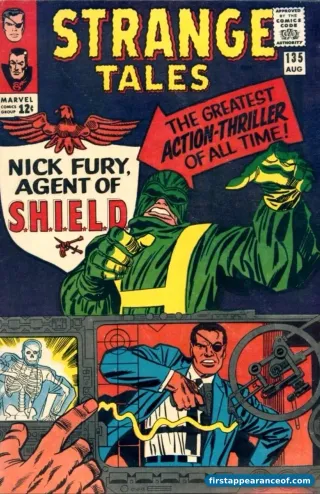
Strange Tales #135, cover-dated August 1965, is one of the denser key issues of the decade. It carries the first appearance of Hydra, the first appearance of S.H.I.E.L.D., the first Helicarrier, and the first man at the top of Hydra: a businessman named Arnold Brown, styling himself the Imperial Hydra. Lee wrote it, Kirby drew it, Dick Ayers inked it.
The plot is a recruitment pitch. Fury is brought in, told what Hydra is, and offered the job, with Tony Stark in charge of the weaponry. It reads less like a first issue than like a company orientation, which is what it was. Marvel was launching a franchise inside a shared anthology title, and the fastest way to make a new agency feel urgent was to hand it an enemy already mid-attack.
Arnold Brown did not last. S.H.I.E.L.D. killed him, Hydra carried on regardless, and the pattern was set on the first try. The organization outlives whoever is running it.
Steranko gives it a face
Two years later Jim Steranko took over the strip and supplied the thing Hydra lacked, which was a person. In Strange Tales #156 (May 1967) the Supreme Hydra is unmasked as Baron Wolfgang von Strucker, the former Nazi officer Lee and Kirby had introduced in Sgt. Fury and his Howling Commandos #5 (January 1964), more than a year before Hydra existed.
That single reveal did an enormous amount of retroactive work. Bolting Strucker onto Hydra dragged the organization backward into the war, gave it a founder with a biography, and wired the Cold War spy strip into Marvel’s own World War II titles. Steranko followed it in Captain America #110 (February 1969) with Madame Hydra, later called Viper, who arrived already leading the organization.
Where the Nazi backstory came from
Ask who founded Hydra and there are two answers. Only one of them comes from the comics.
Marvel continuity later established the organization as forming in Japan during the Second World War with Nazi assistance, with Strucker taking control and installing himself as Supreme Hydra. The Red Skull sits in that account as a patron rather than a proprietor. He sent Strucker east, he paid the bills, and early on he treated the whole venture as madness.
The other answer comes from the films. Captain America: The First Avenger (2011) recast Hydra as the Nazi deep science division with Johann Schmidt at its head, and Captain America: The Winter Soldier (2014) revealed it nesting inside S.H.I.E.L.D. Those two films are why most people now name the Red Skull when asked who runs Hydra, and Marvel’s later media has followed the films rather than the comics.
When the joke stopped being funny
Captain America: Steve Rogers #1 (2016), by Nick Spencer and Jesús Saíz, closed on Steve Rogers pushing his colleague Jack Flag out of a plane and saying “Hail Hydra.” The reaction was immediate and furious. Marvel’s answer, delivered across the next eighteen months, was that a Cosmic Cube had rewritten Rogers rather than exposed him, and the storyline resolved in Secret Empire (2017), with a Hydra Supreme Captain America holding political and military control of the United States.
Whatever the execution, it was the logical end of the 1965 premise. An enemy defined by regrowth eventually has to grow back inside the hero.
Notable issues
- Sgt. Fury and his Howling Commandos #5 (1964): first appearance of Baron Wolfgang von Strucker, a year and a half before Hydra is invented.
- Strange Tales #135 (1965): first appearance of Hydra, S.H.I.E.L.D., the Helicarrier, and the Imperial Hydra, Arnold Brown.
- Strange Tales #156 (1967): Steranko unmasks the Supreme Hydra as Strucker.
- Captain America #110 (1969): first appearance of Madame Hydra, later Viper. Steranko again.
- Captain America: Steve Rogers #1 (2016): the “Hail Hydra” page, by Nick Spencer and Jesús Saíz.
- Secret Empire (2017): Hydra takes the country.
For collectors
One book carries this page. Strange Tales #135 is a stacked Silver Age key, and the stack is the reason: first Hydra, first S.H.I.E.L.D., first Helicarrier, first Life Model Decoy, all inside a split anthology that was still sharing its page count with Steve Ditko’s Doctor Strange. Anyone hunting a Hydra first is buying the S.H.I.E.L.D. first at the same time, and pays accordingly.
Two cheaper books sit behind it. Sgt. Fury #5 is a Strucker book that only became a Hydra book in hindsight. Strange Tales #156 is where the two threads tie together, and collectors buy it for Steranko as much as for the reveal.