Creation Story
Stan Lee built the Mole Man as the first villain for his new team and built the kind of villain the team would face throughout the Silver Age: not a costumed criminal in the DC mode, but a man with a grudge and a power source. Mole Man’s grudge is being short, ugly, and rejected. His power source is the underground kingdom he stumbled into when he gave up on the surface world. Lee gave him a backstory in the first issue’s middle pages: Harvey Elder was a geologist who had been laughed off the academic circuit for proposing a hollow-Earth theory. He went looking for proof. He found the Subterranean kingdom. He stayed.
Jack Kirby drew the Subterranean creatures across multiple issues, and the visual language he developed for them (thick limbs, blunt features, eyes that catch any available light) became one of the most replicated monster styles in superhero comics. The Mole Man himself is human-sized and human-faced, which keeps him readable in scenes alongside the FF without requiring the same visual scale as his monsters. Kirby’s choice to keep the Mole Man humanoid while making his monsters distinctly nonhuman is part of why the character has held up across artists; the design is portable.
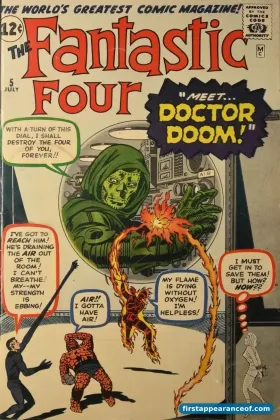
The character has stayed B-tier for sixty years on purpose. Lee never tried to elevate the Mole Man to top-tier-villain status. Doctor Doom got that role within four issues of the FF launch. The Mole Man’s job is to be the recurring nuisance who shows up when the team needs an antagonist who is not Doom or Galactus. Multiple writers have written him sympathetically (Roger Stern’s Marvel Two-in-One #43 is the standard reference for the sympathetic Mole Man); others have written him as comic relief. Both registers fit.
Mark Waid’s FF run in the 2000s and Dan Slott’s FF #1 relaunch in 2018 both used the Mole Man as a structural callback to Lee-Kirby’s original. The decision is a tell: when a writer wants to signal “this is going to be classic FF storytelling,” the first villain is the Mole Man. Doom is more important; Mole Man is more retro. The two roles do not overlap.
Live-action treatments have been thin. The 1994 Roger Corman Fantastic Four (which was made never to be released and exists in bootleg form) included a Mole Man-esque villain. The Tim Story films from 2005 and 2007 referenced the Mole Man kingdom indirectly. The 2025 MCU First Steps did not feature him in a visible way. The character has not had a meaningful screen appearance, partly because his backstory is too explicitly a Silver Age premise (rejected academic, hollow-Earth theory) to translate without rewriting.
First Appearance: Fantastic Four #1
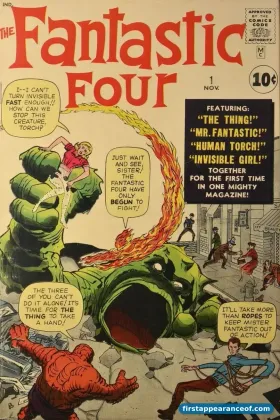
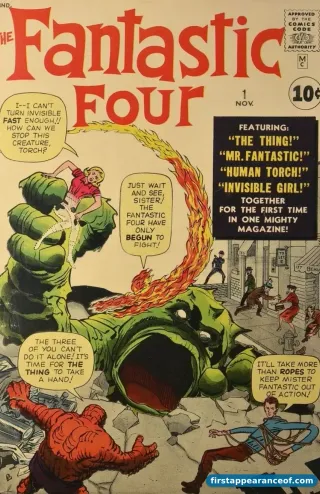
The Mole Man does not appear on the cover of FF #1. Kirby’s composition centers on the FF and the Subterranean monster the Mole Man has sent to attack New York. The Mole Man himself is held back as an interior-page reveal, which is a deliberate choice; you cannot put a stocky bearded man in a green tunic on a cover meant to launch the Marvel Age. The monster sells the cover; the Mole Man sells the story.
Inside the issue, the Mole Man appears in the back half. The FF chases the Subterranean attacks back to their source. They find the Mole Man’s underground kingdom. Lee writes a flashback explaining the origin: rejected geologist, hollow-Earth theory, escape underground. The Mole Man and the FF have a confrontation. The FF escapes. The Mole Man is left in his kingdom, defeated but not dead, which is the recurring-villain template Marvel will use for most of the Silver Age. Doctor Doom’s debut four issues later follows the same pattern.
For collectors, FF #1 is FF #1. The Mole Man’s debut is part of that book’s value, not separable from it. Subsequent Mole Man appearances (FF #22 for the first return, FF #88, Marvel Two-in-One #43) are workable Silver Age and Bronze Age books to chase but trade as run-of-title issues rather than character keys. The character’s collector profile is small relative to his historical importance, which is consistent with the way the Marvel market values first-villain status under a top-three team key.