Creation Story
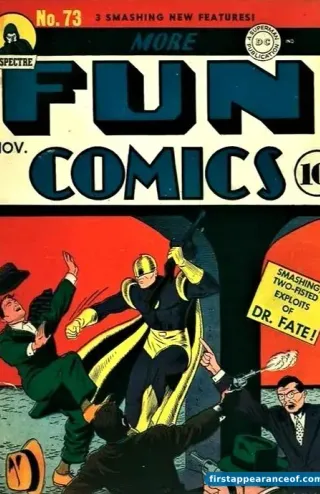
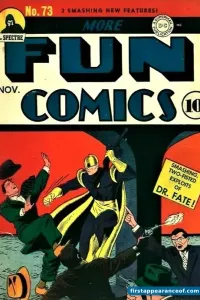
Aquaman was one of three back-up characters DC launched in More Fun Comics #73 (November 1941). The issue is historically notable because it also contains the first appearances of Green Arrow and Speedy. DC was building a Golden Age back-up roster alongside their headliner books and More Fun #73 was the result. Mort Weisinger conceived Aquaman and Paul Norris drew the debut.
Norris’s design borrowed from contemporary sea-adventure pulp. The orange-and-green costume, the golden belt, the fin-like design elements: all Norris. The original 1941 Aquaman was a surface-world hero who discovered underwater powers; his Atlantean backstory did not arrive until 1959.
The character spent the 1940s as a back-up feature without cover presence. When DC restarted the superhero line in the Silver Age, editor Mort Weisinger returned to the character he had helped create and commissioned a full origin update. Robert Bernstein and Ramona Fradon’s Adventure Comics #260 (May 1959) introduced the Atlantean-prince backstory: Aquaman is the son of an Atlantean mother and a surface-world lighthouse-keeper father. Fradon’s Silver Age art established the character’s permanent visual identity.
Why Aquaman became a joke and then stopped being one
For roughly thirty years, Aquaman’s cultural presence was defined by the Super Friends animated series (1973 onward). The Super Friends Aquaman was characterized primarily by his ability to communicate with marine animals, which the show used for light-comic effect. The “talks to fish” framing became the popular-culture default version of the character and sustained through the 1990s and early 2000s.
Peter David’s Aquaman run (1994) tried to reset the character with a harder, grimmer take (one-handed, hook for a replacement, extensive beard). The run had committed fans but did not break out commercially. It took the 2011 New 52 relaunch, Geoff Johns and Ivan Reis’s Aquaman: The Trench, to reposition the character as a physically imposing, grounded-heroic lead rather than a joke. Johns deliberately addressed the “talks to fish” framing in the book’s first arc and the reframing caught on.
James Wan’s 2018 Aquaman film with Jason Momoa grossed $1.15 billion worldwide, reset the character’s cultural visibility at scale, and closed the gap on what the Super Friends had opened. The 2018 film draws structurally and tonally from Johns’s New 52 run.
Collector context
More Fun Comics #73 is the Aquaman Golden Age key and one of the highest-value dual first-appearance books DC has published. The book also contains the first appearance of Green Arrow, which doubles its collector demand. High-grade copies have crossed $200,000 at auction.
Secondary keys: Adventure Comics #260 (1959) is the Silver Age origin update and first cover. Adventure Comics #269 (1960) is the first Aqualad. Aquaman #1 (1962) is the first self-titled series. Aquaman #11 (1963) is the first Mera. Aquaman #35 (1967) is the first Ocean Master.