Who are the Teenage Mutant Ninja Turtles
The Teenage Mutant Ninja Turtles are Leonardo, Donatello, Raphael, and Michelangelo, four turtles mutated by a radioactive accident and trained in ninjutsu by their rat sensei, Splinter, who named them for Renaissance artists. Kevin Eastman and Peter Laird created them, and the way the two met is part of the story. Eastman, working delivery jobs after moving down from Maine, found a copy of Laird’s self-published comics zine and wrote to him. He ended up moving into the house Laird shared in Dover, New Hampshire, and one night in 1983 the two sat in the kitchen drawing to make each other laugh. Eastman drew a turtle standing upright like a martial artist; the gag escalated into four of them. Laird inked the sketch and added two words to Eastman’s caption, turning “Ninja Turtles” into “Teenage Mutant Ninja Turtles.”
The concept was a parody. The two were riffing on what they were reading: Frank Miller’s Daredevil, with its ninja clan the Hand and its blind sensei, and the Marvel template of heroes made by a radioactive accident. The Foot Clan is the joke at the center of it, the Hand renamed one body part over.
One detail from those first issues still surprises people: all four Turtles wore red bandanas. A black-and-white comic had no reason to color-code them. The blue, purple, and orange that now separate Leonardo, Donatello, and Michelangelo came from the 1987 Playmates toy line, which needed the figures to read differently on a shelf. Only Raphael kept the red he started in.
The debut: Teenage Mutant Ninja Turtles #1
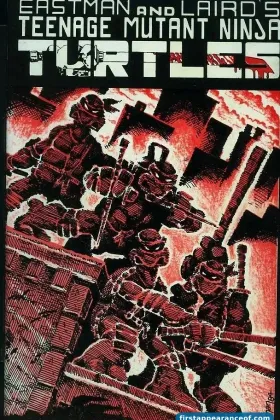
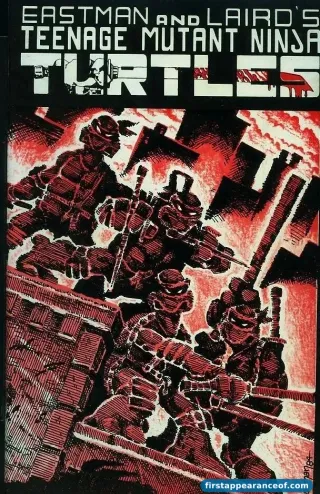
Eastman and Laird self-published Teenage Mutant Ninja Turtles #1 in May 1984 through Mirage Studios, a company that was mostly just a name, since there was no studio beyond the house in Dover. They paid for it with a tax refund and a loan from Eastman’s uncle, printed 3,275 copies of an oversized 40-page black-and-white comic at $1.50, and debuted it at a convention in Portsmouth, New Hampshire. It sold out.
The single issue does a startling amount of setup. All four Turtles, Splinter, the Foot Clan, and the Shredder, Oroku Saki, debut in it, and the Turtles kill the Shredder by the end. Every cartoon, film, and toy that followed builds on the infrastructure in this one Copper Age comic. It is now one of the most valuable books in independent comics, kept scarce in high grade by the tiny print run, the near-black cover that shows every flaw, and the oversized format that made copies hard to store. A top-graded CGC 9.8 first printing sold for $245,000 in September 2021. As demand climbed, Mirage ran several more printings at progressively larger quantities, so later printings are far more common and far less valuable than the first run of 3,275. It remains the keystone of this first-appearance archive.
The supporting cast
The Mirage run introduced the human characters the Turtles became inseparable from, and collectors track each as a separate first-appearance key. April O’Neil debuts in Teenage Mutant Ninja Turtles #2 (October 1984), not as the reporter the cartoon later made her but as a computer programmer working for the scientist Baxter Stockman; she stumbles onto his robots robbing banks and the Turtles rescue her. Casey Jones, the hockey-masked vigilante who becomes Raphael’s closest friend, first appears in the one-shot Raphael #1 (1985). Bebop, Rocksteady, and Krang were invented for the 1987 cartoon and only reached comics afterward; their first comic appearance is Archie’s Teenage Mutant Ninja Turtles Adventures #1 (August 1988).
The cartoon that made them a phenomenon
The 1987 Teenage Mutant Ninja Turtles animated series, produced by Murakami-Wolf-Swenson, turned a black-and-white indie into a worldwide property, and rewrote the Turtles for a young audience along the way: broad comedy, the pizza obsession, the color-coded masks, and a Splinter who is his master Hamato Yoshi mutated into a rat rather than the man’s pet. That is the version most people picture.
The screen history since has swung between the cartoon’s lightness and the comics’ edge. The 1990 live-action film, directed by Steve Barron, leaned back toward the Mirage tone and grossed more than $200 million on a $13.5 million budget, the highest-grossing independent film to that point. The 2003 series, produced by 4Kids with Mirage, went the other way and adapted the comics closely across seven seasons. The franchise was sold to Nickelodeon in 2009, and IDW Publishing took over the comics in 2011, running a continuous line with co-creator Kevin Eastman involved. The 2023 animated film Teenage Mutant Ninja Turtles: Mutant Mayhem, which cast teenagers as the Turtles, is the most recent screen version.