Creation Story
When Kevin Eastman and Peter Laird named the Turtles for Renaissance artists in Teenage Mutant Ninja Turtles #1 (1984), they got one of the spellings wrong. The early Mirage issues call him “Michaelangelo,” with an extra A, and the misspelling rode along on the comics for years before it settled into the painter’s actual name.
Michelangelo is the loose one, the brother Eastman and Laird wrote easygoing where Raphael is angry and Leonardo is severe. He fights with nunchaku, and his solo issue, below, is usually credited with locking in the warmth and humor that later adaptations leaned on. His bandana is orange, though, like his brothers’, it started out red. The color coding came from the 1987 Playmates toy line, not the comics.
Those nunchaku later caused him trouble abroad. When the 1987 cartoon aired in the United Kingdom it was retitled “Teenage Mutant Hero Turtles,” because broadcasters would not say “Ninja,” and censors cut Michelangelo’s nunchaku outright, eventually handing him a grappling-hook “Turtle Line” instead. The original “Ninja” branding did not return to those edits until 2009.
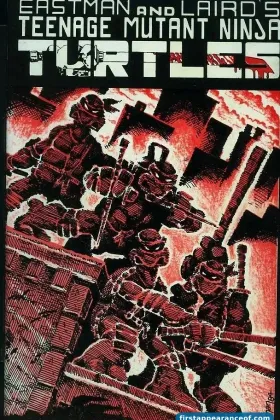
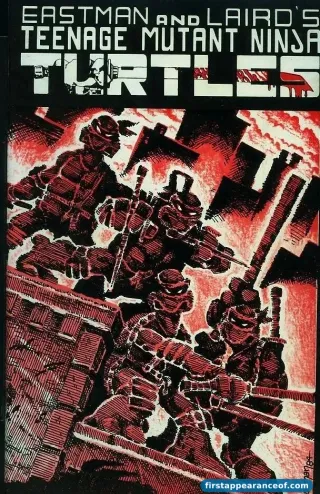
First Appearance and First Cover: Teenage Mutant Ninja Turtles #1
Michelangelo’s first appearance is Teenage Mutant Ninja Turtles #1 (May 1984), self-published by Eastman and Laird on a first print run of 3,275 copies and debuted at a comic convention in Portsmouth, New Hampshire. All four brothers, Splinter, the Foot Clan, and the Shredder arrive in this one Copper Age black-and-white issue.
It became one of the most valuable independent comics ever printed, scarce in high grade because of the tiny run, the unforgiving near-black cover, and the awkward oversized format. The top grade on the CGC census is 9.8, and one copy sold for $245,000 in September 2021. The Teenage Mutant Ninja Turtles team page carries the book’s full origin and the other keys from the Mirage run.
First Solo Issue: Michelangelo #1
Michelangelo’s one-shot, Michelangelo #1 (December 1985), is the gentlest book in the early Mirage run and the one that did the most to define him. It is a Christmas story. Out in the city, he takes in a stray cat that he keeps and names Klunk, and he breaks up a robbery of a truckload of toys meant for orphaned children, then helps hand the toys out with his brothers and April O’Neil.
There is barely a ninja fight in it. The issue trades the parody violence of the main title for empathy and comedy, and most of the easygoing, openhearted personality that the 1987 cartoon and everything after it ran with traces back to these pages.