Creation Story
Kevin Eastman and Peter Laird drew the first Turtle to make each other laugh. The two shared a house at 28 Union Street in Dover, New Hampshire, and one night in 1983 they crossed a ninja with the least intimidating animal they could think of, a turtle, then built a story around the joke. What they published was a parody. The Teenage Mutant Ninja Turtles riffed on Frank Miller’s Daredevil and Ronin, and the Foot Clan is a straight gag on the ninja outfit Miller had Daredevil fighting, the Hand. Splinter names the four brothers for Renaissance artists. Donatello takes his from the sculptor.
They paid for the comic with a tax refund and a loan from Eastman’s uncle, printed 3,275 copies, and called the operation Mirage Studios because there was no studio, only their living room. The book landed in the middle of the Copper Age independent-comics boom, and it became one of the defining debuts in our first-appearance archive.
Donatello is the technical mind of the group, the brother who builds and repairs the team’s gear and tends to talk his way around a fight before throwing one. His weapon is the bō staff, one of the two loadouts, with Leonardo’s swords, that Eastman and Laird locked in from the first issue.
One thing the comics did not give him was the purple bandana. In the original black-and-white Mirage issues all four Turtles wore red, and the early covers colored the headbands red as well. The scheme that lets casual audiences tell them apart, purple for Donatello, blue for Leonardo, red for Raphael, orange for Michelangelo, was built for the 1987 Playmates toy line and the cartoon that promoted it. Laird has said the colors were handed out at random. It has stuck in every adaptation since.
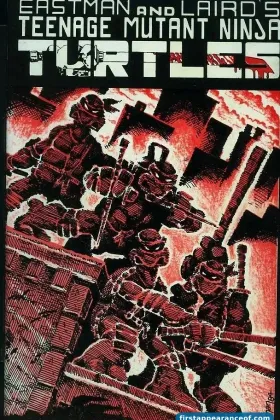
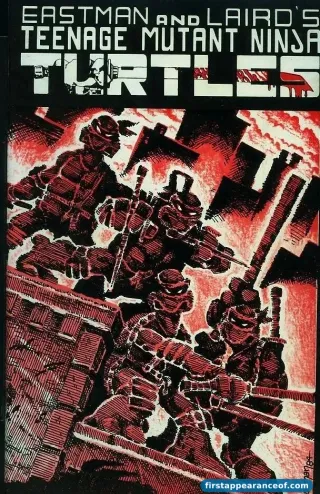
First Appearance and First Cover: Teenage Mutant Ninja Turtles #1
Donatello’s first appearance is Teenage Mutant Ninja Turtles #1 (May 1984), which debuted at a comic convention in Portsmouth, New Hampshire. All four Turtles arrive at once, full appearance and cover, with no cameo and no precursor issue to argue about. Splinter and the Foot Clan debut in the same book, and so does the Shredder, Oroku Saki, who fights the Turtles through the issue and is seemingly killed by the end of it. For a first issue it carries an unusual load: origin, team, sensei, and archenemy, all in one oversized black-and-white comic.
That comic is now one of the most valuable independent books ever published, and the reasons are as physical as they are historical. The print run was tiny at 3,275 copies. The near-black cover shows every crease and chip. The oversized format made the issue awkward to store, so clean high-grade copies are scarce. The highest grade on the CGC census is 9.8, and one of those copies sold for $245,000 in September 2021. The book’s full origin and the other first-appearance keys from the Mirage run sit on the Teenage Mutant Ninja Turtles team page.
First Solo Issue: Donatello #1
Donatello headlined his own one-shot, Donatello #1 (February 1986), part of a Mirage micro-series that gave each Turtle a solo spotlight across 1985 and 1986. Titled “Kirby and the Warp Crystal,” it sends Donatello to the building where April O’Neil lives and introduces an artist renting space there named Kirby, a nod to comics legend Jack Kirby. Kirby has found a crystal that brings his drawings to life. When one sketch turns permanently real, it pulls both of them through a portal into a world overrun by the monsters Kirby has been drawing. They fight clear before the portal closes and separates them, and Kirby leaves a parting sketch behind.
It is a self-contained side story rather than a chapter of the main title, and the warp-crystal premise hands Donatello, the team’s tinkerer, something closer to science fantasy than a ninja fight.