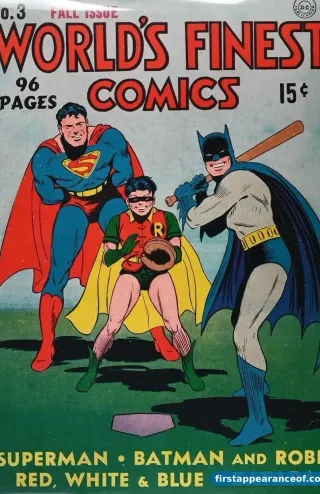
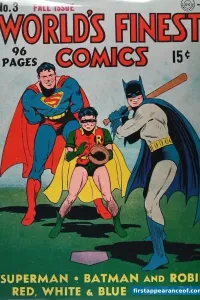
World's Finest Comics #3 (1941). The Scarecrow debuts inside; Superman, Batman, and Robin on the cover.

1st Appearance

First Appearance of Scarecrow

World's Finest Comics #3

September 1941 · DC · Golden Age

The disgraced psychology professor whose fear-toxin research turned into a weapon. Batman's longest-dormant Golden Age rogue before the 1967 revival brought him back.

Key Issue

Created by Bob Kane · Bill Finger

By Atomm Updated

The first appearance (1st app) of The Scarecrow is World's Finest Comics #3 (September 1941), created by Bill Finger and Bob Kane. Jonathan Crane debuts as a disgraced psychology professor using fear as a weapon. The Scarecrow was only used twice during the Golden Age and then went dormant for twenty-five years until Batman #189 (February 1967) reestablished the character with the fear-toxin gimmick that defines modern portrayals. The character is one of Batman's oldest recurring rogues.

Quick Facts

Debut
World's Finest Comics #3 (September 1941)
Real name
Jonathan Crane
Creators
Bill Finger (script), Bob Kane (byline, partial art)
Publisher
DC Comics
First enemy
Batman (his defining antagonist)
First ally
None long-term. Scarecrow is a solo criminal.
Team affiliations
None formal. Occasional villain team-ups during crossover events.

Firsts Timeline

  1. World's Finest Comics #3 cover
    First Appearance September 1941

    World's Finest Comics #3

    By Bob Kane, Bill Finger

    Jonathan Crane debuts as a psychology professor using fear as a weapon. Bill Finger writes; Bob Kane on byline. The Scarecrow appears in the Batman back-up feature in this Superman-and-Batman-shared title. Predates Penguin (Detective Comics #58, December 1941) by three months.

    Read the full breakdown
  2. Silver Age Return February 1967

    Batman #189

    By Gardner Fox, Sheldon Moldoff

    Scarecrow's first Silver Age appearance after twenty-five years of dormancy. Gardner Fox writes; Sheldon Moldoff pencils (credited to Bob Kane). The issue reestablishes the character's fear-toxin gimmick that defines all subsequent appearances.

    Read the full breakdown

Creation Story

The Scarecrow is Bill Finger’s earliest-created Batman rogue after the Joker and Catwoman. World’s Finest Comics #3 (September 1941) introduced Jonathan Crane in the Batman back-up feature of the Superman-and-Batman-shared anthology title. Crane is a disgraced psychology professor whose academic specialty is the study of fear, expelled from his university for unethical research, now applying his knowledge as a criminal. Finger’s script treats the character’s motivation as intellectual rather than monetary: Crane commits crimes in part because the fear he induces is its own reward.

The visual design (tattered scarecrow costume, rope noose, sack mask) is distinctive and has been essentially unchanged across eighty years of comics. The 1941 Scarecrow predates the Penguin by three months. The character was used once more in Detective Comics #73 (March 1943) and then went dormant.

The twenty-five-year gap

DC did not use Scarecrow again until Batman #189 (February 1967), twenty-five years after his last appearance. The dormancy is among the longest for any significant DC villain. Gardner Fox wrote the revival; Sheldon Moldoff pencilled under Bob Kane’s contractual byline. The 1967 issue introduced the fear toxin, a chemical compound Scarecrow synthesizes to induce hallucinatory terror. The 1941 original Scarecrow relied on fear-inducing psychology without chemical apparatus; the 1967 revival made the toxin the character’s signature and every subsequent appearance has used it.

The revival’s timing aligns with the broader Silver Age DC effort to bring back Golden Age characters. The 1966 Batman TV series had reignited commercial interest in Batman’s rogues gallery, and DC spent the late 1960s systematically reintroducing characters like Scarecrow, Riddler, and Man-Bat for modern audiences.

The Nolan-era cultural reset

Christopher Nolan’s Batman Begins (2005) made Scarecrow the primary antagonist of the Dark Knight trilogy’s opening film. Cillian Murphy’s performance is a sharp-dressed psychiatric-director figure whose fear-toxin plot drives most of the film’s second act. Murphy returned for brief scenes in The Dark Knight (2008) and The Dark Knight Rises (2012), making Scarecrow the only villain to appear in all three Nolan films. The performance reset the character’s cultural visibility at scale.

Batman: Arkham Asylum (Rocksteady, 2009) extended the psychological-horror framing with a standout fear-toxin hallucination sequence that remains widely cited as one of the best boss encounters in the Arkham series.

Collector context

World’s Finest Comics #3 is the Scarecrow Golden Age key. High-grade CGC 9.0+ copies have crossed $30,000 at auction. The book is a Superman-Batman shared title, which gives it additional collector demand beyond Scarecrow’s first-appearance weight.

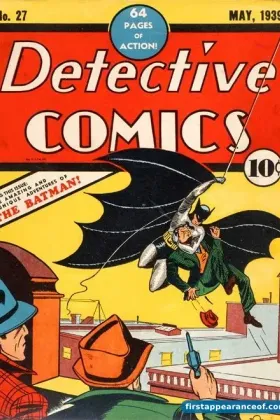
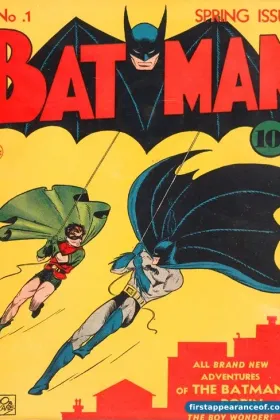
Secondary keys: Detective Comics #73 (1943 second appearance). Batman #189 (1967 revival). The 1967 issue is particularly important for collectors focused on the modern Scarecrow because it introduces the fear-toxin mechanic.
Key subsequent appearances

After the debut, these are the issues collectors and historians reach for next.

  1. 1941

    World's Finest Comics #3

    First appearance.

  2. 1943

    Detective Comics #73

    Second Appearance

    Second Golden Age appearance. Final use of the character for twenty-five years.

  3. 1967

    Batman #189

    Silver Age Revival

    First Silver Age appearance. Establishes the fear-toxin gimmick that defines modern Scarecrow.

  4. 1987

    Batman: Year One (Batman #404)

    Miller Era

    Scarecrow appears in a brief role during Frank Miller's Batman: Year One. Part of the modern framing that positions Scarecrow as a serious psychological threat rather than a camp villain.

  5. 1996

    Batman: The Long Halloween

    Jeph Loeb and Tim Sale. Scarecrow in supporting role.

In adaptations

Film, TV, animation, and game appearances.

  1. 1992

    Batman: The Animated Series

    Animated

    Starring:Henry Polic II, Jeffrey Combs

    Scarecrow appears across the animated canon in multiple episodes, with Jeffrey Combs voicing the character in the later redesign.

  2. 2005

    Batman Begins

    Film

    Starring:Cillian Murphy

    Christopher Nolan directs. Murphy's Scarecrow is the primary antagonist of the first Nolan film and continues in cameo through the trilogy. The performance reset the character's cultural weight at scale.

  3. 2009

    Batman: Arkham Asylum (video game)

    Game

    Rocksteady's game features Scarecrow in a standout playable-hallucination sequence widely cited as one of the best boss encounters in the Arkham series.

  4. 2012

    The Dark Knight Rises

    Film

    Starring:Cillian Murphy

    Murphy returns for a third time as Scarecrow, now presiding over a kangaroo-court tribunal during Bane's occupation of Gotham.

Frequently asked questions

The questions readers and collectors ask most.

What is the Scarecrow's first appearance?

The Scarecrow's first appearance is World's Finest Comics #3 (September 1941), created by Bill Finger and Bob Kane. Jonathan Crane debuts in the Batman back-up feature as a disgraced psychology professor who uses fear as a weapon. He predates the Penguin (Detective Comics #58, December 1941) by three months.

Is World's Finest #3 valuable?

Yes. World's Finest Comics #3 is a Golden Age key and a dual-character-first book (Scarecrow's first appearance, plus it's a Superman / Batman shared title issue). High-grade copies (CGC 9.0 and above) have crossed $30,000 at auction. Low-grade reader copies trade in the four-figure range.

Why did the Scarecrow disappear for so long?

After his second 1943 appearance in Detective Comics #73, the Scarecrow went dormant for nearly twenty-five years. DC did not bring the character back until Batman #189 (February 1967). The dormancy is one of the longest for any major DC villain. The revival reintroduced the fear-toxin gimmick that defines the modern character; the 1941 Scarecrow relied on fear-based psychology without the chemical apparatus.

What is the fear toxin?

The fear toxin is a chemical compound Scarecrow develops to induce hallucinatory terror in his victims. The compound was not present in the 1941 debut; it was added to the character in the 1967 Silver Age revival and has been central to every subsequent Scarecrow portrayal. Modern comics and films use the fear toxin as the character's signature weapon.

Who created the Scarecrow?

Bill Finger wrote the World's Finest #3 debut script. Bob Kane received the byline per his DC contract. The art on the issue is partially Kane and partially uncredited ghost artists. Modern DC crediting recognizes Finger as the primary creative force. The psychology-professor backstory and the fear-as-weapon concept are Finger's.