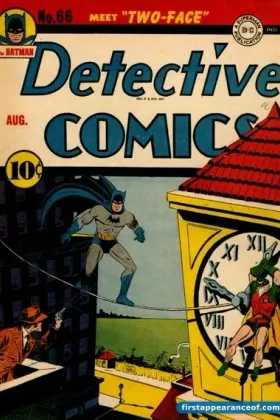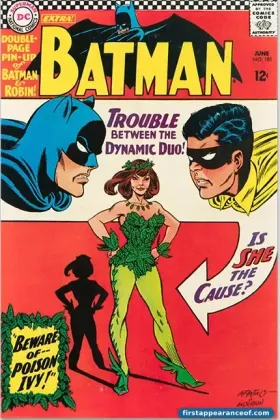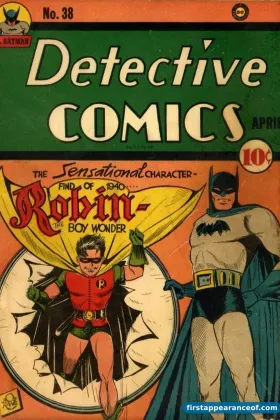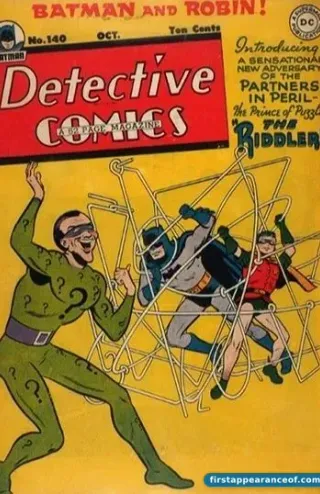
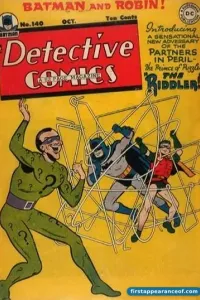
The Riddler on the cover of Detective Comics #140 (1948), his first appearance and first cover.

1st Appearance and 1st Cover

First Appearance of Riddler

Detective Comics #140

October 1948 · DC · Golden Age

The puzzle-obsessed criminal Batman can only catch by solving his clues. The rogue who went dormant for twenty years and came back bigger.

Key Issue

Created by Bill Finger · Dick Sprang

By Atomm Updated

The first appearance (1st app) of The Riddler is Detective Comics #140 (October 1948), created by Bill Finger and Dick Sprang (credited to Bob Kane). Edward Nashton debuts under the alias Edward Nigma with both his cover and his full introduction in one issue. After two Golden Age appearances, the character went dormant for twenty years until the 1966 Batman TV series revival brought him back into prominence. The character is now one of Batman's most recognizable recurring rogues.

Quick Facts

Debut
Detective Comics #140 (October 1948)
Real name
Edward Nashton, who operates under the alias Edward Nigma
Creators
Bill Finger (script), Dick Sprang (art, ghost-pencilling under Bob Kane's byline)
Publisher
DC Comics
First enemy
Batman (his defining antagonist)
First ally
None long-term. Riddler is a solo criminal.
Team affiliations
None formal. Occasional crossover villain team-ups.

First Appearance

  1. Detective Comics #140 cover
    First Appearance First Cover October 1948

    Detective Comics #140

    By Bill Finger, Dick Sprang

    Bill Finger writes. Dick Sprang pencils (credited to Bob Kane under Kane's contract). The Riddler debuts with both his cover and his full introduction in one issue. First of two Golden Age Riddler appearances before a twenty-year dormancy.

    Read the full breakdown

Creation Story

The Riddler is Bill Finger’s character. Detective Comics #140 (October 1948) introduces Edward Nigma, a criminal whose compulsion is to leave clues pointing to his own crimes. Finger built the character around a specific structural device: Riddler cannot not give Batman a puzzle before committing a crime. The compulsion reframes the hero-villain dynamic from physical combat to logical contest, and has been the character’s signature since the debut.

Dick Sprang pencilled the first appearance under Bob Kane’s contractual byline. Sprang’s run on Batman was the defining visual era between the Jerry Robinson period and the Silver Age Julius Schwartz era; his Riddler design (green suit, purple mask, question-mark aesthetic) has been essentially unchanged for seventy-five years.

Detective Comics #140 and #142 were the Riddler’s only Golden Age appearances. DC did not use the character again for two decades. The silence was long enough that the character was essentially forgotten until 1965.

The TV revival

Batman #171 (May 1965) reintroduced the Riddler for the first time since 1948, timed to precede the 1966 Batman TV series. Frank Gorshin’s performance on the show, complete with a manic laugh and green-lycra bodysuit, resurrected the character’s cultural weight at a scale that has held ever since. The Silver Age DC Riddler comics that followed drew on Gorshin’s framing more than on Finger’s original 1948 conception.

Every subsequent screen adaptation has worked in the shadow of Gorshin’s interpretation. Jim Carrey’s Batman Forever (1995) extended the camp tradition. John Glover’s Batman: The Animated Series returned to a more intellectual framing. Paul Dano’s The Batman (2022) darkened the character into a Zodiac-Killer-inspired serial-killer direction that represented the biggest tonal shift the character has absorbed.

Collector context

Detective Comics #140 is the Riddler Golden Age key and a foundational Batman book. High-grade CGC 9.0+ copies have crossed $50,000 at auction. Low-grade reader copies trade in the low five figures.

Secondary keys: Detective Comics #142 (second appearance, final Golden Age). Batman #171 (1965 return). Batman: Hush #1 (Batman #608, 2002) is the modern-framing reference point.
Key subsequent appearances

After the debut, these are the issues collectors and historians reach for next.

  1. 1948

    Detective Comics #140

    First appearance.

  2. 1948

    Detective Comics #142

    Second Appearance

    Second and final Golden Age Riddler appearance. The character did not return for twenty years.

  3. 1965

    Batman #171

    Silver Age Return

    Riddler's first Silver Age appearance, timed to precede the 1966 Batman TV series. Reestablishes the character after twenty years of dormancy.

  4. 1996

    Batman: The Long Halloween #1

    Jeph Loeb and Tim Sale. Riddler plays a supporting role in the modern Batman noir framing.

  5. 2002

    Batman: Hush #1 (Batman #608)

    Modern Framing

    Jeph Loeb and Jim Lee. The Hush arc repositions Riddler as a legitimately intellectual Batman adversary rather than a joke-criminal.

In adaptations

Film, TV, animation, and game appearances.

  1. 1966

    Batman

    TV

    Starring:Frank Gorshin

    ABC live-action series. Gorshin's manic, green-lycra Riddler is the performance that resurrected the character's cultural weight. The TV series directly drove the Silver Age Riddler comics revival.

  2. 1992

    Batman: The Animated Series

    Animated

    Starring:John Glover

    Glover's Riddler returned to the character's intellectual-gentleman framing. One of the Dini-Timm canon's most acclaimed episodes features him.

  3. 1995

    Batman Forever

    Film

    Starring:Jim Carrey

    Joel Schumacher directs. Carrey's Riddler carries the film. One of the most commercial 1990s superhero performances.

  4. 2022

    The Batman

    Film

    Starring:Paul Dano

    Matt Reeves directs. Dano's Riddler is a masked Zodiac-Killer-inspired figure. Dark reframing of the character. Grossed $772M worldwide.

Frequently asked questions

The questions readers and collectors ask most.

What is The Riddler's first appearance?

The Riddler's first appearance is Detective Comics #140 (October 1948), created by Bill Finger with art by Dick Sprang (credited to Bob Kane under Kane's contract). The issue is both his first appearance and first cover. After two Golden Age appearances in 1948, the character went dormant for twenty years.

Is Detective Comics #140 valuable?

Yes. Detective Comics #140 is a Golden Age DC key. High-grade copies (CGC 9.0 and above) have crossed $50,000 at auction. Low-grade copies trade in the low five figures. The book's value has accelerated with each major Riddler adaptation: Frank Gorshin in 1966, Jim Carrey in 1995, and Paul Dano in 2022.

Why did The Riddler go dormant?

After his second 1948 appearance in Detective Comics #142, DC did not use the Riddler for twenty years. The character returned in Batman #171 (May 1965), timed to precede the 1966 Batman TV series. Frank Gorshin's television performance resurrected the character's cultural weight, and DC kept using the Riddler consistently from the mid-1960s forward. The twenty-year gap is one of the longest dormancy periods for any major DC villain.

What is Riddler's real name?

Edward Nashton in modern continuity. He operates under the alias Edward Nigma (or Nygma, spellings have varied across decades). The Nashton birth name was canonized in later comics as a character-development reveal: his puzzle-obsession originates in childhood and his adopted Nigma/Nygma identity is the false front. Modern Batman books use Nashton as the canonical legal name.

Is the 2022 film's Riddler faithful to the comics?

Partially. Matt Reeves's The Batman (2022) reimagines the Riddler as a Zodiac-Killer-inspired masked serial killer rather than the green-lycra puzzle-villain of the Silver Age and Carrey-era interpretations. Paul Dano's performance is darker and more physically menacing than any prior screen version. The Reeves take draws structurally from the Long Halloween and Hush comics arcs rather than from the Silver Age material.