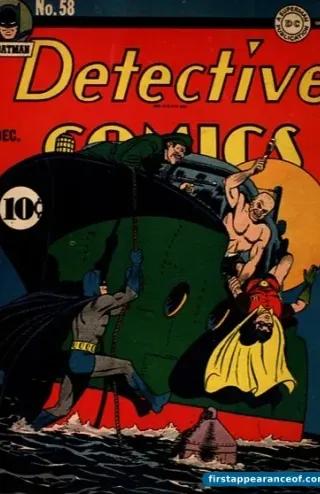
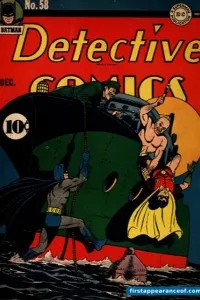
Detective Comics #58 (1941). The Penguin debuts inside; Batman and Robin on the cover.

1st Appearance

First Appearance of Penguin

Detective Comics #58

December 1941 · DC · Golden Age

Batman's gentleman crime boss. Tuxedoed, umbrella-armed, a Gotham fixture since 1941.

Key Issue

Created by Bob Kane · Bill Finger

By Atomm Updated

The first appearance (1st app) of Penguin is Detective Comics #58 (December 1941), created by Bill Finger and Bob Kane. Oswald Cobblepot debuts as a gentleman thief with a bird fixation and trick umbrellas. He was not on the cover of his debut issue. His first cover appearance is Detective Comics #67 (September 1942). The character is one of Batman's oldest recurring rogues and the franchise's most durable white-collar criminal antagonist.

Quick Facts

Debut
Detective Comics #58 (December 1941)
Real name
Oswald Chesterfield Cobblepot
Creators
Bill Finger (script), Bob Kane (byline and art)
Publisher
DC Comics
First enemy
Batman (his defining antagonist)
First ally
None long-term. Penguin operates solo or with hired henchmen.
Team affiliations
None. Occasional Gotham villain team-ups, but Penguin is structurally a solo criminal.

Firsts Timeline

  1. Detective Comics #58 cover
    First Appearance December 1941

    Detective Comics #58

    By Bob Kane, Bill Finger

    The Penguin debuts inside the issue but is not on the cover. Bill Finger scripts; Bob Kane on art per his contract. Oswald Cobblepot is introduced as a high-society gentleman thief with a bird fixation and trick umbrellas as weapons.

    Read the full breakdown
  2. First Cover Appearance September 1942

    Detective Comics #67

    By Bob Kane, Bill Finger

    Penguin's first cover appearance. He was a back-up antagonist for nine issues before earning cover billing.

    Read the full breakdown

Creation Story

The Penguin is Bill Finger’s character, one of the dozen major Batman antagonists he created during his 1940s writing tenure. Detective Comics #58 (December 1941) introduced Oswald Cobblepot as a gentleman thief with a specific visual gimmick: a short, round man in formal wear with an umbrella arsenal. The character was designed to contrast with Batman’s athletic physicality and the Joker’s chaotic flamboyance by offering a mannered, verbose, socially-positioned criminal.

Finger’s script establishes the complete character in one issue. Cobblepot is introduced as a criminal who has positioned himself in high-society Gotham circles, uses his umbrellas as concealed weapons, and operates with explicit Victorian-gentleman manners. The visual design (the tuxedo, the top hat, the monocle) is attributed in DC references variously to Bob Kane and to uncredited ghost artists, but the template has been essentially unchanged in eighty years.

The character did not appear on a cover until Detective Comics #67 (September 1942), nine issues after his debut. The delay is typical of Golden Age DC: new villains were tested as back-up antagonists before earning cover billing.

Why the Penguin kept working

Most Batman rogues created in the 1940s faded from regular use by the 1950s. The Penguin, the Joker, and Catwoman are the three who persisted continuously across eight decades. The Penguin’s durability has structural roots: the character operates as a crime boss rather than as a costumed villain, which lets writers integrate him into Gotham’s criminal ecosystem as a recurring fixture rather than a one-off antagonist. He appears in virtually every Batman animated series, live-action adaptation, and major event since.

Burgess Meredith’s 1966 Batman TV performance, Danny DeVito’s Batman Returns (1992), and Colin Farrell’s The Penguin HBO series (2024) each represent a different interpretive register: campy, grotesque, and gangster-drama respectively. All three are valid takes on a character designed to be flexible.

Collector context

Detective Comics #58 is the Penguin key and a Golden Age Batman book. High-grade CGC 9.0+ copies have crossed $40,000 at auction. The book’s value has accelerated with each major Penguin adaptation and hit a new high around the 2024 HBO series.

Secondary keys: Detective Comics #67 (first cover). Batman: The Long Halloween #1 (1996) is the modern-framing reference point. The Penguin #1 limited series launches from various eras are collector-adjacent.
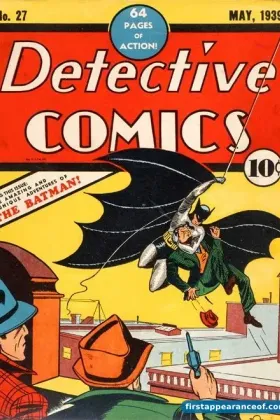
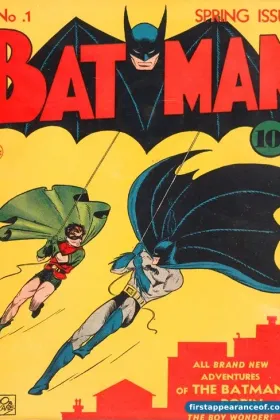
Key subsequent appearances

After the debut, these are the issues collectors and historians reach for next.

  1. 1941

    Detective Comics #58

    First appearance.

  2. 1942

    Detective Comics #67

    First cover appearance.

  3. 1996

    Batman: The Long Halloween #1

    Modern Framing

    Jeph Loeb and Tim Sale limited series. Part of the defining modern-Penguin positioning alongside Long Halloween's other Batman rogues.

  4. 2011

    Batman: Pain and Prejudice #1

    Gregg Hurwitz and Szymon Kudranski five-issue limited series. Dark modern take on the character.

In adaptations

Film, TV, animation, and game appearances.

  1. 1966

    Batman

    TV

    Starring:Burgess Meredith

    ABC live-action series. Meredith's campy Penguin with the 'wark wark' laugh defined popular perception for decades.

  2. 1992

    Batman Returns

    Film

    Starring:Danny DeVito

    Tim Burton directs. DeVito's grotesque sewer-dweller reinvention of the character. Widely regarded as one of Burton's strongest performances.

  3. 1992

    Batman: The Animated Series

    Animated

    Starring:Paul Williams

    Williams's Penguin returned to the high-society gentleman-crime-boss framing rather than the Burton reinvention. One of the Dini-Timm animated canon's signature performances.

  4. 2022

    The Batman

    Film

    Starring:Colin Farrell

    Matt Reeves directs. Farrell's Penguin is a supporting character; the performance led directly to a spin-off series.

  5. 2024

    The Penguin

    TV

    Starring:Colin Farrell

    HBO series. Farrell reprises the role in a solo series. Widely acclaimed.

Frequently asked questions

The questions readers and collectors ask most.

What is the Penguin's first appearance?

The Penguin's first appearance is Detective Comics #58 (December 1941), created by Bill Finger and Bob Kane. The character debuts inside the issue but is not on the cover. His first cover appearance is Detective Comics #67 (September 1942).

Is Detective Comics #58 valuable?

Yes. Detective Comics #58 is a Golden Age Batman key. High-grade copies (CGC 9.0 and above) have crossed $40,000 at auction. Low-grade reader copies trade in the low five figures. The book's value has been steady across decades and accelerated with Colin Farrell's acclaimed performance in The Batman (2022) and the Penguin HBO series (2024).

Why is the Penguin so durable?

The Penguin works structurally as a counter-Batman. Where Batman is dark, physical, and brooding, the Penguin is pale, verbose, and socially positioned. Where Batman is wealthy old money, the Penguin is new-money crime boss. The contrast is productive, and the character's Victorian-gentleman aesthetic has given artists a distinct visual identity to work with. The character has appeared in virtually every Batman animated series, film, and television show since 1966.

Who created the Penguin?

Bill Finger wrote the debut script and provided the character concept. Bob Kane received the byline per his DC contract. Modern DC crediting recognizes Finger as the primary creative force. Kane's contribution was predominantly in visual direction; the Penguin's now-iconic tuxedo, top hat, and umbrella-weapons are attributed in some sources to Kane and in others to uncredited ghost artists. The visual identity has been essentially unchanged for over eighty years.