Creation Story
Moon Knight was reverse-engineered from someone else’s weaknesses. In 1975, Doug Moench needed a one-off heavy for Werewolf by Night, and rather than invent a personality and work outward, he started from what would hurt Jack Russell. Silver, because silver is what a werewolf cannot take. Night, because that is when the werewolf is out. From those two constraints came a moon theme, a silver truncheon, crescent throwing weapons, spiked gloves, and a name.
Moench described the logic plainly: “someone who uses silver weapons because silver hurts the Werewolf. And tied to the night, because the Werewolf only comes out at night, and I’ll base this character on the Moon.”
Don Perlin made the one decision that turned a design brief into an image people remember. He drew the costume in white. His reasoning was commercial rather than mythic: “I wanted the costume to be just black and white. Since he’d be on a color page, that would make him a little bit different.” A figure in white on a Bronze Age color page reads like a hole cut in the art. That is the whole character’s visual identity, and it came from wanting to stand out on a rack.
None of the material readers now associate with Moon Knight was there. No Khonshu, no Egyptian tomb, no alters. Marc Spector was a mercenary taking money from a criminal outfit called the Committee, and the story treated him as a competent, well-funded problem for the hero to survive. Marvel was in a rough stretch, with 1975 sales well down from the company’s late-sixties peak, and a striking antagonist was a cheap way to make an issue feel like an event.
Then the mail arrived. Within four months Moench was writing back to readers who wanted more of him: “You people have been clamoring for more of the Moon Knight, and preferably starring in a new mag all his own.” The character that existed to lose a fight got promoted, and everything durable about him, the tomb, the god, the fractured identity, was added later by writers who now had a costume they needed to justify.
First Appearance and First Cover: Werewolf by Night #32
Werewolf by Night #32 is cover-dated August 1975. Thirty-two pages, full color, 25 cents. The story is “The Stalker Called Moon Knight!”, written by Doug Moench with interior art by Don Perlin. The cover is by Gil Kane, with Al Milgrom also credited on it.
The collector shape of this book is unusually clean for a Bronze Age key. Moon Knight is on the cover, so the first appearance and the first cover appearance are the same issue. He is the antagonist across the story rather than a last-panel tease, so there is no cameo precursor and no cameo-versus-full argument to settle. Anyone arriving from the cameo versus full appearance guide can put the checklist down: this is one book.
That is worth stating plainly, because the era’s other headline debut works the opposite way. Wolverine arrived a year earlier across two issues, a last-panel cameo in one and the real debut in the next, and collectors have argued about which one counts ever since. Moon Knight has no equivalent argument available. The only competing issue anyone raises is Werewolf by Night #33, and #33 is the second appearance.
The plot is a hunt. A criminal organization called the Committee hires Spector to bring in Jack Russell, and Spector arrives equipped for exactly that job, with a silver truncheon, crescent throwing weapons, spiked gloves, and helicopter support flown by a partner. That partner is Jean-Paul “Frenchie” DuChamp, who debuts in the same issue and stays on as his pilot. His association with the Committee was later rewritten as an undercover assignment, which is the first of many retroactive repairs to a debut nobody expected to matter.
What makes the issue scarce in high grade is the same thing that makes the story work: it shipped as an ordinary issue of a horror title. Nothing on the cover said “keep this one.” Overstreet later ranked it inside the top ten of its Top 25 Bronze Age Comics list, but that ranking arrived decades after the surviving copies had been sorted by accident rather than intent, which is the whole reason clean ones are hard to find.
Three editions circulate beyond the standard 25-cent copy. There is a British nine-pence edition, a Mark Jewelers advertisement variant, and, since 2021, a Marvel facsimile reprint. The facsimile is the one to watch when buying raw: it reproduces the original cover, and the cover variants guide covers how to tell a reprint from a 1975 copy.
First Solo Story: Marvel Spotlight #28
Marvel Spotlight #28 is cover-dated June 1976, thirty-six pages, 25 cents. Doug Moench writes, Don Perlin draws the interior and the cover, and the story is “The Crushing Conquer-Lord!” It is the first time Moon Knight carries a story with no other hero’s name on the book.
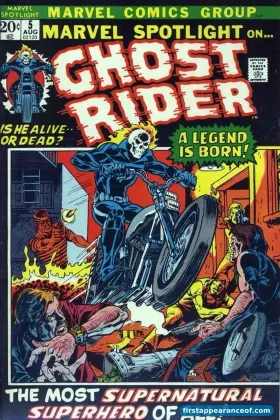
Marvel Spotlight ran from 1971 to 1977 as a showcase book, rotating characters through it rather than keeping a fixed lead. Ghost Rider, Doctor Strange, and Iron Fist all passed through the same title. The assignment for issue #28 was therefore a specific question: is there a character underneath the costume.
Moench’s answer is the one the character has run on ever since. This issue and #29 introduce Steven Grant and Jake Lockley, the businessman and the cab driver, and with them the idea that Marc Spector moves through the city as more than one person. Nothing in the 1975 debut hints at any of it. The multiple-identity premise is an addition made by the same writer, a year later, to a character who had already proved he could sell.
Collectors get two claims in this issue. It is the earliest book where Moon Knight leads the story, and it carries a price variant: alongside the standard 25-cent copies, Marvel ran a 30-cent edition of this issue in the starburst price style, plus a ten-pence UK edition and a Mark Jewelers insert variant. The price printed on the cover is what separates the first two.
First Solo Title: Moon Knight #1
Moon Knight #1 is cover-dated November 1980. Thirty-two pages, 50 cents, written by Doug Moench with art by Bill Sienkiewicz. The story is “The Macabre Moon Knight,” and it is the first issue of his own ongoing series. Marc, Steven, Jake, and Moon Knight all appear together on the cover, which is a fair summary of what the series is about.
This is the issue that installs the mythology. Editor Denny O’Neil suggested the resurrection scene, and Moench built the origin around it: Spector left for dead in a freshly opened pharaoh’s tomb, at the feet of a statue of Khonshu, the Egyptian god of the moon and of vengeance. Moench never confirms whether Spector died and came back or hallucinated the whole thing, and the ambiguity is deliberate. Five years after a costume was designed to counter a werewolf, the costume acquired a god. Bushman, the enemy the character has been measured against since, debuts in the same book.
Sienkiewicz is the other reason the book matters, and the run is the record of it. He pencilled through issue #30 and kept drawing covers to #38, where the series ended. Sales were strong enough early on that Marvel promoted the title to flagship status from issue #15.
The collector note is a distribution one. November 1980 sits right at the split between direct-market and newsstand distribution, so both editions exist for this issue, along with a fifteen-pence UK edition. If you are working out which copy you are holding, the first appearance database and the true first appearance guide cover how these distinctions are drawn across the Bronze Age and the years after it, and the Marvel hub collects the rest of the company’s keys from the same window.