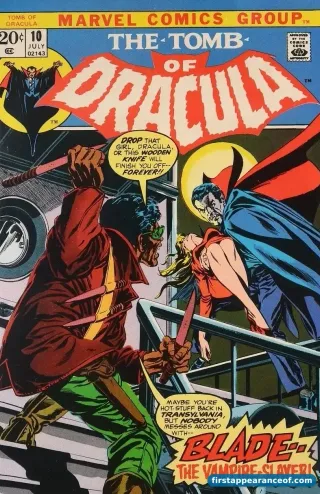
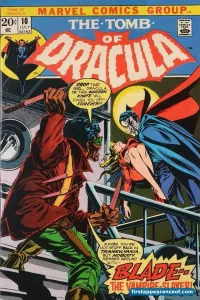
The Tomb of Dracula #10 (1973). Dracula on the cover; Blade debuts inside as a vampire hunter.

1st Appearance

First Appearance of Blade

The Tomb of Dracula #10

July 1973 · Marvel · Bronze Age

The Daywalker. Marvel's Black vampire hunter, horror-imprint breakout, and the character whose 1998 film arguably launched the modern superhero-movie era.

Key Issue

Created by Marv Wolfman · Gene Colan

By Atomm Updated

The first appearance (1st app) of Blade is The Tomb of Dracula #10 (July 1973), created by Marv Wolfman and Gene Colan. Eric Brooks debuts as a Black vampire hunter working alongside Marvel's supernatural lineup. His first cover appearance is The Tomb of Dracula #30 (March 1975). His first solo title is Blade the Vampire Hunter #1 (July 1994). The Wesley Snipes film trilogy (1998, 2002, 2004) reset the character's cultural weight at scale and is widely credited with establishing the template for the modern superhero-film era.

Quick Facts

Debut
The Tomb of Dracula #10 (July 1973)
Real name
Eric Brooks
Creators
Marv Wolfman (script, character concept), Gene Colan (art, character design)
Publisher
Marvel Comics
First enemy
Dracula (his defining antagonist; Blade's backstory is a direct response to his mother's death by Deacon Frost)
First ally
The Tomb of Dracula supporting cast (Rachel Van Helsing, Frank Drake, Quincy Harker)
Team affiliations
Midnight Sons, Mi-13, various vampire-hunter outfits

Firsts Timeline

  1. The Tomb of Dracula #10 cover
    First Appearance July 1973

    The Tomb of Dracula #10

    By Marv Wolfman, Gene Colan

    Eric Brooks debuts as Blade, a Black vampire hunter in Marvel's horror imprint. Marv Wolfman writes; Gene Colan pencils. The debut establishes the teak-wood-knife weaponry, the bandolier, and the character's born-immune-to-vampirism backstory.

    Read the full breakdown
  2. First Cover Appearance March 1975

    The Tomb of Dracula #30

    By Marv Wolfman, Gene Colan

    Blade's first cover appearance, twenty issues after his debut. He was a recurring character in the Tomb of Dracula run but did not earn cover billing for two years.

    Read the full breakdown
  3. First Solo Title July 1994

    Blade the Vampire Hunter #1

    By Ian Edginton, Douglas Wheatley

    First Blade solo ongoing. Ten-issue run. Preceded the 1998 Wesley Snipes film by four years.

    Read the full breakdown

Creation Story

Blade is Marv Wolfman’s character. The Tomb of Dracula #10 (July 1973) introduces Eric Brooks as a Black vampire hunter working alongside Marvel’s 1970s horror-imprint lineup. Wolfman wrote the Tomb of Dracula run (1972 to 1979) as Marvel’s flagship horror title; Gene Colan pencilled the entire run. The 70-issue Wolfman-Colan collaboration is widely regarded as one of Marvel’s finest sustained Bronze Age creative partnerships.

Blade arrived ten issues into the run as a supporting character: a vampire hunter working in parallel to the existing Tomb of Dracula protagonists (Rachel Van Helsing, Frank Drake, Quincy Harker). His visual design is Colan’s: the leather trench coat, the bandolier of teak-wood throwing knives, the green-tinted glasses, the afro haircut. The character’s backstory was Wolfman’s: Eric Brooks’s mother was bitten by the vampire Deacon Frost while pregnant with him, which gave Eric vampire powers without requiring him to feed on blood.

The character was popular enough to persist across the Tomb of Dracula run and into subsequent 1970s Marvel horror books. The Tomb of Dracula #30 (March 1975) is Blade’s first cover appearance, twenty issues after his debut. He was a recurring rather than flagship character through the 1970s and 1980s.

The 1998 film cultural reset

Blade (1998), directed by Stephen Norrington and starring Wesley Snipes, is the film that matters most for Blade’s cultural position. The film grossed $131 million worldwide on a $45 million budget, earned generally positive reviews, and established three key precedents that shaped the following decade of superhero cinema:

  1. R-rated comic-book films could be commercially successful. Before Blade, Hollywood studios were skeptical of R-rated superhero material.
  2. Faithful adaptation could work. The film used the comics character’s core design, weapons, and backstory rather than reworking them for film.
  3. A Black-lead superhero film could be a franchise. The Snipes trilogy (1998, 2002, 2004) produced two sequels and extensive cross-media work.

Marvel’s subsequent development of X-Men (2000) and Spider-Man (2002) happened in the wake of Blade’s commercial proof. The 1998 film predates virtually every major modern superhero film and is foundational to the industry that followed.

The modern era

Mahershala Ali was announced as the MCU Blade in 2019. The project has been repeatedly delayed through multiple directors and rewrites. The character remains on Marvel Studios’ production schedule with an anticipated 2028 release window.

Collector context

The Tomb of Dracula #10 is the Blade Bronze Age key. High-grade CGC 9.0+ copies have crossed $5,000 at auction. The book’s value has historically tracked closely with each major Blade adaptation; the Snipes trilogy drove prices up substantially through the late 1990s and early 2000s, and the Ali casting announcement accelerated them further.

Secondary keys: The Tomb of Dracula #30 (first cover). Blade the Vampire Hunter #1 (1994, first solo). Modern keys include Blade #1 (1998) and Blade #1 (2006) relaunches.
Key subsequent appearances

After the debut, these are the issues collectors and historians reach for next.

  1. 1973

    The Tomb of Dracula #10

    First appearance.

  2. 1975

    The Tomb of Dracula #30

    First cover appearance.

  3. 1994

    Blade the Vampire Hunter #1 (1994)

    First solo title.

  4. 1998

    Blade #1 (1998)

    Film Tie-In

    Marc Andreyko limited series launched alongside the Snipes film.

  5. 2006

    Blade #1 (2006)

    Marc Guggenheim relaunch. Twelve-issue ongoing.

In adaptations

Film, TV, animation, and game appearances.

  1. 1998

    Blade

    Film

    Starring:Wesley Snipes

    Stephen Norrington directs. Grossed $131M worldwide. Widely credited with launching the modern superhero-film era and proving that R-rated comic-book films could work commercially.

  2. 2002

    Blade II

    Film

    Starring:Wesley Snipes

    Guillermo del Toro directs. Grossed $155M worldwide.

  3. 2004

    Blade: Trinity

    Film

    Starring:Wesley Snipes

    David Goyer directs. Introduces Hannibal King (Ryan Reynolds) and Abigail Whistler (Jessica Biel). Closes the Snipes trilogy.

  4. 2006

    Blade: The Series

    TV

    Starring:Kirk Jones

    Spike TV series. One season. Did not continue.

  5. 2028

    Blade

    Film

    Starring:Mahershala Ali

    Mahershala Ali announced as the MCU Blade; production has been repeatedly delayed. Release window anticipated for 2028.

Frequently asked questions

The questions readers and collectors ask most.

What is Blade's first appearance?

Blade's first appearance is The Tomb of Dracula #10 (July 1973), created by Marv Wolfman and Gene Colan. Eric Brooks debuts as a Black vampire hunter in Marvel's horror imprint. His first cover appearance is The Tomb of Dracula #30 (March 1975).

Is Tomb of Dracula #10 valuable?

Yes. The Tomb of Dracula #10 is a Bronze Age Marvel key and one of the most consequential Black-superhero first-appearance books. High-grade copies (CGC 9.0 and above) have crossed $5,000 at auction. The book's value accelerated dramatically after the 1998 Wesley Snipes film and has held through the Mahershala Ali MCU casting announcement.

Who created Blade?

Marv Wolfman wrote the Tomb of Dracula #10 debut script and originated the concept. Gene Colan pencilled the issue and designed the character's visual identity (the leather trench coat, bandolier of teak-wood knives, green-tinted glasses). Modern Marvel credits Wolfman and Colan as co-creators.

Is Blade a vampire?

Partially. Eric Brooks was born immune to the vampire curse as a result of his mother's bite while she was pregnant; he has vampire strength and durability but does not require blood to survive. The 'Daywalker' framing refers to his ability to operate in sunlight without the vulnerabilities traditional vampires have. The Blade film trilogy canonized this framing and the 'Daywalker' term.

Why is Blade significant to superhero films?

Blade (1998) is widely credited with launching the modern superhero-film era. The film was R-rated, faithful to the comics source material, financially successful ($131M worldwide on a $45M budget), and demonstrated that comic-book films could work as serious-tone action movies. Before Blade, superhero films had been largely limited to Superman and Batman. After Blade, Marvel began green-lighting X-Men (2000), Spider-Man (2002), and the subsequent wave that produced the current superhero-film industry. The 1998 Blade film predates virtually every major modern superhero film.