What the shield is
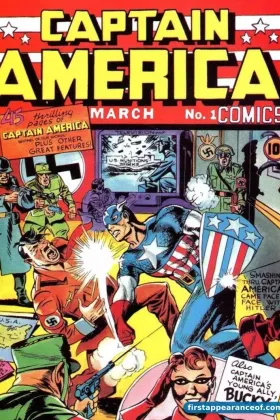
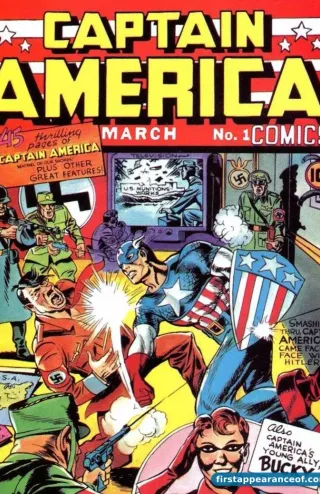
Joe Simon and Jack Kirby designed Captain America’s shield in March 1941 as part of the character’s debut in Captain America Comics #1. The original design was a triangular heater shape, modeled on medieval European cavalry shields and consistent with the patriotic-medieval visual register Simon and Kirby were using for the character. The shield in CA Comics #1 is on the cover (Cap punches Hitler with one fist while the shield is raised in the other) and is a recognizable element of Cap’s debut iconography.
The triangular design lasted one issue. MLJ Comics (later Archie Comics) complained that the heater shape was too similar to their character The Shield, who had debuted in Pep Comics #1 (January 1940) and predated Captain America by a year. Joe Higgins, MLJ’s Shield, wore a patriotic costume with a triangular chest shield. Marvel’s editorial response was to redesign Captain America’s shield to a round disc, which debuted in Captain America Comics #2 (April 1941). The round design has remained canonical for eighty-four years across every era of Marvel publishing and every adaptation.
The visual stability of the round-disc shield is unusual for a superhero artifact. Most superhero designs get redesigned multiple times across decades — the Batmobile has had dozens of versions, Iron Man’s armor has had over a hundred Mark variants, even Spider-Man’s costume has alternated between classic and black-symbiote versions across runs. The Captain America shield has stayed almost identical since 1941: the same proportions, the same star-on-blue-background-with-white-and-red-rings color scheme, the same throwing arc when used as a weapon. The visual constancy is part of what makes the shield function as a genuine American symbol within the fiction.
The vibranium retcon
Stan Lee and Jack Kirby canonized the shield’s composition as a vibranium-steel alloy in Tales of Suspense #66 (June 1965), as part of the Silver Age expansion of Captain America’s origin. The retcon framed the alloy as accidentally created by metallurgist Dr. Myron MacLain during World War II while attempting to develop an indestructible armor; the alloy combined vibranium (which had been established as Wakandan in Fantastic Four #52 the year after) with steel in proportions MacLain has been unable to replicate.
The retcon mattered. Earlier Golden Age framings had treated the shield as ordinary steel that happened to be very strong. The vibranium framing gave the shield a coherent in-universe explanation for why it could absorb impacts that would destroy any other material. Vibranium’s kinetic-energy-absorption property is what makes the shield function as a defensive weapon (it absorbs impact rather than transferring force to the wielder) and as an offensive throwing weapon (it absorbs the impact of being thrown, which is why Cap can throw it at high speed without damaging his arm). The composition explanation has held in continuity since 1965.
Mantle holders
The shield has been carried by multiple characters across decades:
- Steve Rogers (1941 to ongoing). The primary mantle holder. Has held the shield through nearly every major Captain America era except specific arcs where he was deceased, missing, or replaced.
- Bucky Barnes (2007 to 2011 in comics). Following Steve Rogers’s apparent death in Captain America #25 (Vol. 5, 2007) at the climax of Ed Brubaker’s run, Bucky Barnes took up the Captain America identity and shield. The Bucky-as-Cap arc ran for roughly four years before Steve returned. The MCU has not adapted Bucky-as-Cap directly; Bucky in the films has remained the Winter Soldier identity.
- Sam Wilson (2014 to ongoing). Sam Wilson, formerly the Falcon, inherits the Captain America identity and shield in Captain America #25 (Vol. 7, November 2014) under Rick Remender’s run. Sam held the mantle through 2017; the role has shifted between Steve and Sam multiple times since. The MCU adapted the handover in The Falcon and the Winter Soldier (2021), with Anthony Mackie’s Sam Wilson taking up the shield after Avengers: Endgame.
- John Walker / U.S. Agent (multiple brief periods). Walker held the Captain America identity briefly in the late 1980s during a Mark Gruenwald arc (Captain America #333 to #350). The MCU adapted Walker as a brief antagonist in The Falcon and the Winter Soldier.
- Isaiah Bradley. The Black Captain America of Truth: Red, White & Black (Robert Morales, Kyle Baker, 2003), a retcon-introduced character who served as a Captain America during World War II under separate experimental conditions. Adapted in The Falcon and the Winter Soldier.
- Various 1950s Captain Americas. A controversial sub-canon of Cap-replacement characters from the 1950s when Steve Rogers was frozen.
The Mjolnir worthiness moment
Avengers: Endgame (2019) established that Steve Rogers (Captain America in the MCU, played by Chris Evans) is worthy of lifting Mjolnir. The moment is one of the most-cited beats in the entire MCU and is a direct adaptation of multiple decades of comic-book worthiness moments (Avengers #44 in 1967, brief moments across various subsequent issues, and the recurring framing that Cap’s moral standing meets the Mjolnir worthiness threshold). The shield itself is destroyed during the climax of Endgame (broken by Thanos), and Cap retires after passing the shield to Sam Wilson at the film’s end. The shield’s destruction in the MCU does not match the comic-book canonical state (where the shield has been damaged but is generally intact); it is an MCU-specific narrative beat that allowed the film to give Cap’s arc a clean endpoint.
Collector context
Captain America Comics #1 (March 1941) is the canonical first-appearance key for both Captain America and the shield. The book is one of the highest-value Golden Age comics ever published; CGC 9.0 and above is in the seven figures. The shield first-appearance value is folded into the Captain America first-appearance value.
Captain America Comics #2 (April 1941, the first round-disc shield) is recognized as a shield-specific milestone but trades on Cap’s Golden Age run pricing rather than as a separable key. CGC 9.0 and above is in the high four to low five figures.
Tales of Suspense #66 (June 1965, the vibranium retcon) trades in the four-figure range at CGC 9.4 and above. The book is recognized as a foundational shield-composition key but is priced primarily on the broader Captain America Silver Age run economy.