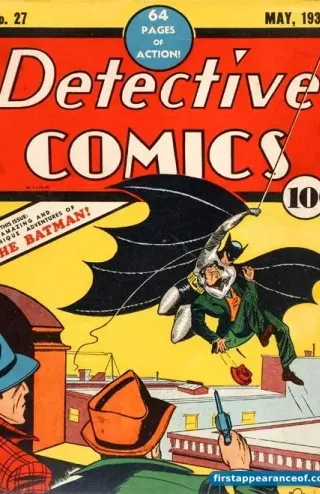
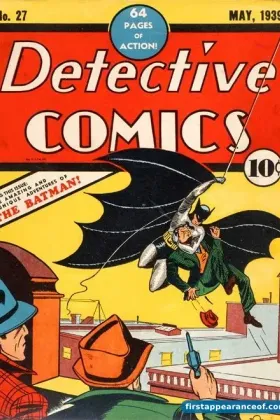
Detective Comics #27 (1939). Batman's first appearance. The car Batman drives in this issue is unnamed and red, the visual ancestor of the Batmobile.

1st Appearance (Unnamed Vehicle)

First Appearance of Batmobile

Detective Comics #27

May 1939 · DC · Golden Age

The most-redesigned superhero vehicle in comics. The Batmobile has worn dozens of silhouettes since 1939, from a red sedan to a tank, and the car keeps mattering because Batman keeps needing a car.

Key Issue

Created by Bob Kane · Bill Finger

By Atomm Updated

DC Comics Artifact Batman's car, eight decades of redesigns.

The Batmobile first appears as an unnamed red sedan in Detective Comics #27 (May 1939), Bob Kane and Bill Finger's Batman debut issue. The car gets named "Batmobile" in Detective Comics #48 (February 1941), and the bat-styled design language (fins, bat-head front, distinctive silhouette) settles in under artist Dick Sprang starting around Detective Comics #156 (February 1950). The Anton Furst design for the 1989 Tim Burton Batman film is the most-influential single redesign in the vehicle's history; subsequent comic-book Batmobiles routinely borrow Furst-era elements. Multiple Batmobile designs have been canonical across eight decades of publication; the vehicle is structurally a recurring redesign rather than a fixed object.

Firsts Timeline

  1. Detective Comics #27 cover
    First Appearance (Unnamed Vehicle) May 1939

    Detective Comics #27

    By Bob Kane, Bill Finger

    Bob Kane and Bill Finger. Batman's debut issue includes a red sedan that Batman drives between scenes. The car is unnamed in this issue and is essentially a generic period vehicle. Modern continuity treats the DC #27 car as the proto-Batmobile, the visual ancestor of the named car that comes later, but it would be inaccurate to call this issue the first appearance of 'the Batmobile' as the term and the recognizable design did not exist yet.

  2. First Named Use of 'Batmobile' February 1941

    Detective Comics #48

    By Bob Kane, Bill Finger

    Bob Kane and Bill Finger. The car gets named Batmobile in this issue. The visual is still relatively conventional 1941 sedan styling; the bat-themed design language (fins, hood ornaments, bat-shaped silhouettes) develops gradually across the early 1940s. The naming in DC #48 is the canonical first-Batmobile reference for collectors who want a single specific issue rather than the broader 'first car Batman drove' framing.

  3. First Distinctive Bat-Styled Batmobile February 1950

    Detective Comics #156

    By Dick Sprang

    Dick Sprang pencils. The Batmobile gets the bat-headed front-end and finned rear that becomes the visual template for decades of subsequent versions. Sprang's design is the first Batmobile that is recognizably distinct from a generic 1940s sedan; later artists (Carmine Infantino, Neal Adams, Jim Aparo) refined the silhouette but kept the basic Sprang language.

  4. Tim Burton Batmobile June 1989

    Batman (1989 film)

    By Anton Furst, Tim Burton

    Anton Furst designs; Tim Burton directs. The 1989 film Batmobile is one of the most influential single Batmobile redesigns ever produced. The long-nosed black-armor turbine-powered Furst design rewrote what most viewers and subsequent comic artists thought a Batmobile should look like. Comic-book Batmobiles after 1989 frequently borrowed Furst-design elements, and the Tim Burton car is what most casual fans picture when the word Batmobile is used.

What the Batmobile is

Batman has always had a car. The first issue, Detective Comics #27 (May 1939), shows him driving a red sedan that the script does not name. The visual is unremarkable; it could be any 1939 mid-priced four-door, and the panel composition treats it as a generic vehicle rather than as a piece of Batman’s iconography. That changes slowly over the next decade. The name “Batmobile” first appears in Detective Comics #48 (February 1941) and the visually distinctive bat-styling settles under Dick Sprang’s pencils starting around 1950.

The Batmobile is structurally a recurring redesign rather than a fixed object. Most comic-book vehicles get one or two canonical designs and stick with them. Spider-Man’s web-shooters have looked roughly the same for sixty years. Captain America’s shield has looked roughly the same for eighty. The Batmobile has had at least twenty significantly different designs in comics alone, plus dozens more across film, television, animation, and toy lines. The redesign cycle is a feature of the property, not a bug.

Why the redesigns keep happening

Three forces drive the recurring redesign:

Artist signature. Successive Batman artists have brought their own Batmobile designs because the car is one of the few elements of Batman’s iconography that allows visual variation. Costumes are locked in; gadgets are locked in; rogues’ galleries are locked in. The Batmobile is the slot where artists can put their own stamp on the property. Carmine Infantino’s New Look era (1964 to 1968) produced one Batmobile silhouette. Neal Adams’s late 1960s and early 1970s run produced another. Jim Aparo, Marshall Rogers, Frank Miller, Tim Sale, Greg Capullo: each successive Batman artist has had their own Batmobile, and DC editorial has not pushed back on the variation.

Licensing pressure. The Batmobile is one of the most-licensed superhero vehicles in publishing. Toy lines, model kits, film tie-ins, video game promotional vehicles, theme park attractions: every major Batman commercial cycle generates new Batmobile designs to support new product. Mattel, Hot Wheels, LEGO, and Diamond Select have produced collectible Batmobiles in dozens of variations across decades. The licensing demand for new designs feeds back into the comic continuity, where new Batmobiles often appear shortly after a major film or animated launch.

Adaptation feedback. The 1966 Adam West Batman series introduced a Batmobile (designed by George Barris, based on a 1955 Lincoln Futura concept car) that became the most recognizable Batmobile of the 20th century to mainstream audiences. The 1989 Tim Burton film introduced the Anton Furst design, which became the most influential single Batmobile redesign of all time. The Christopher Nolan Batman Begins trilogy (2005 to 2012) introduced the Tumbler, which redirected the entire visual language of the Batmobile toward military-vehicle proportions. Each major adaptation pushes a redesign back into the comics.

The four Batmobiles that matter

If the eighty-five-year history is too long to cover in detail, the four most-cited Batmobile versions are:

  1. The 1939 to 1941 unnamed red sedan — Detective Comics #27 through DC #48. The proto-Batmobile, before the design language existed.
  2. The Dick Sprang bat-styled 1950s version — Detective Comics #156 onward. The first Batmobile that is recognizably a Batmobile rather than a generic car. Sets the visual template that successive artists refine for decades.
  3. The 1966 Adam West / George Barris Batmobile — based on a 1955 Lincoln Futura concept car, customized for the TV series. The Batmobile most American adults over fifty picture when they hear the word “Batmobile.”
  4. The 1989 Tim Burton / Anton Furst Batmobile — long-nosed turbine-powered black-armor design from the Burton film. The most-influential single redesign of all time. Comic-book Batmobiles after 1989 frequently borrow Furst-era elements; the Furst silhouette reset what audiences expect a Batmobile to look like.

The Tumbler from the Nolan trilogy (2005 onward) is the strongest contender for the fifth slot, but it has not yet displaced the Furst design in collective memory.

Collector context

The Batmobile’s first-appearance status is layered, which makes it unusual among collector lore-keys. Detective Comics #27 is one of the highest-value Golden Age comics ever published; CGC 9.0 and above is in the seven figures. The book is valued on the Batman first appearance, not on the Batmobile, but the Batmobile’s first appearance technically lives inside that price. There is no separable Batmobile market premium on DC #27.

Detective Comics #48 (the first named Batmobile) trades at much lower prices, on the order of the high four to low five figures at CGC 9.0 and above. The book is recognized as a Batmobile-specific key by specialist collectors but does not command the broader market position of DC #27.

The Tim Burton 1989 film generated a separate collector market: production-used Furst Batmobile vehicles trade at six-figure prices when they surface at auction (the originals were destroyed or repurposed; surviving promotional vehicles and miniatures are the auction targets). This market sits outside the comic-book first-appearance economy and is governed by film-prop collecting conventions rather than comic-book grading conventions.
Frequently asked questions

The questions readers and collectors ask most.

What is the Batmobile's first appearance?

Detective Comics #27 (May 1939) for the unnamed proto-Batmobile, Detective Comics #48 (February 1941) for the first canonical use of the name. Different framings privilege different issues. Collectors who want the foundational appearance of any vehicle Batman drove track DC #27 (which is the Batman first appearance and is a top-tier Golden Age key). Collectors who want the first explicit named Batmobile track DC #48. Both are accurate answers under different definitions.

Why does the Batmobile keep getting redesigned?

Batman is a character whose visual identity rests on the costume and the gadgets. The car is one of the gadgets. Successive artists across eighty-five years have brought their own visual language to the Batmobile, partly as a creative signature and partly because commercial licensing (toy lines, film adaptations, animated series) keeps generating new versions. There has never been a single canonical Batmobile design across DC's editorial history; the redesign cycle is built into how the vehicle is treated.

Who designed the 1989 movie Batmobile?

Anton Furst, the production designer of Tim Burton's Batman (1989). Furst's design used a long pointed nose, turbine engines, full-body black armor, and aggressive proportions that read as both 1930s noir and 1980s industrial. The car was widely considered one of the most striking single film vehicle designs of the late 1980s. Furst won an Academy Award for Best Production Design on the film. Many subsequent Batmobile designs in comics and other media drew on Furst's visual language.

Has there ever been a Batman without a Batmobile?

Brief stretches in the early 2000s. Frank Miller's All-Star Batman and Robin (2005) and some Year One-era Batman issues frame Batman without a regular signature vehicle. The discipline rarely lasts; commercial interest in the Batmobile (toy licensing, film tie-ins) generally pulls a Batmobile design back into the comic continuity within a year or two. The car is structurally embedded in the Batman brand in a way that makes its long-term absence editorially difficult.