What Asgard is
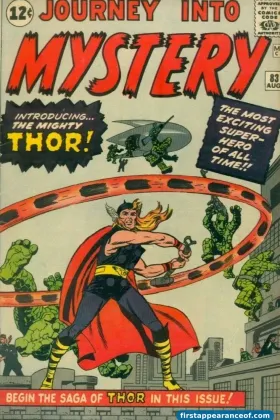
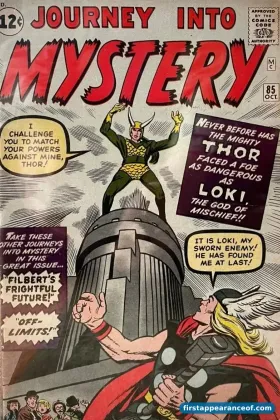
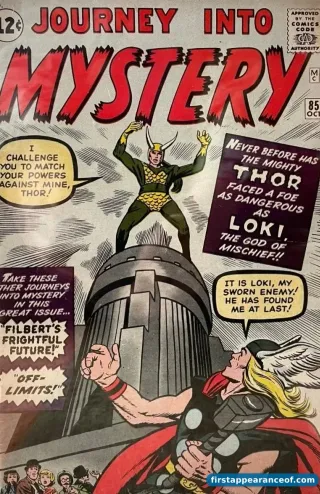
Stan Lee, Larry Lieber, and Jack Kirby created Asgard in Journey into Mystery #85 (October 1962), two issues after Thor’s own debut. The realm is the home of the Norse gods, recognized in Eddic poetry and prose dating back roughly a thousand years before any superhero comic existed. Lee borrowed from the existing mythology — the same well Tolkien drew from for The Lord of the Rings — and gave it a Marvel-Universe context. Kirby designed the visual.
The Kirby Asgard is a city of gold and stone, with towering columns, organic flowing geometric forms, and a Bifrost rainbow bridge spanning the void between realms. The architectural language is recognizable across artists. Successive Thor pencilers (John Buscema, Walt Simonson, Olivier Coipel, Esad Ribic, Russell Dauterman) have refined the design but kept the basic Kirby template. The Asgard silhouette has remained more visually consistent across sixty-three years than almost any other major Marvel location.
The realm is structurally a separate dimension. Asgard is not in space and not on Earth; it sits in its own pocket of reality, connected to Earth (Midgard) and other realms by the Bifrost. The connection mechanism is mythological in origin (the Eddic World Tree, Yggdrasil, has multiple realms hanging from its branches) and Marvel preserves the structure. Accessing Asgard typically requires Heimdall, the Bifrost guardian, to open the bridge.
Why Asgard works as a Marvel location
Most superhero settings need to be recognizable. New York gives Spider-Man a real urban context; Gotham gives Batman a noir backdrop; even fictional places like Wakanda are designed to feel like they could be specific countries. Asgard breaks this convention. It is deliberately not New York, not Earth, not even quite of-this-reality. The unfamiliarity is the point.
The choice gives Marvel cosmic political stories an anchor that the regular Earth-bound continuity cannot provide. When the cosmic-tier characters (Galactus, Thanos, the Eternals, the Celestials) interact with Asgard, the realm operates as a peer-level entity rather than as a backwater Earth nation. Asgard has its own military (the Einherjar), its own political structure (Odin’s monarchy with succession through Thor), its own cosmology (the Nine Realms hanging from Yggdrasil), and its own internal history (centuries of war with the Frost Giants, recurring Ragnarok cycles). The realm is robust enough to carry stories that do not need Earth at all.
The Simonson reset
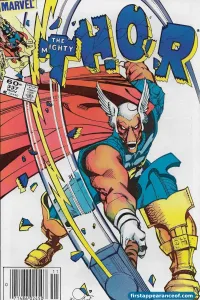
Walt Simonson’s Thor run from #337 (November 1983) to #382 (1987) is the most consequential extended Asgard treatment outside the Lee-Kirby originals. Simonson did three things that previous Thor writers had only sketched.
First, he leaned harder into the genuine Eddic source material. Lee and Kirby’s Asgard was loosely Norse in flavor; Simonson’s was structurally Norse, with runic visual elements, Eddic poetic forms, and the deep mythology of Surtur, Ragnarok, and the World Tree given direct attention. The Surtur arc in Thor #348 to #353 is the most-cited extended Asgard storyline of the modern era.
Second, he expanded Asgard’s politics. Simonson built the internal factions (loyal Asgardians, the warriors three, dwarven smiths from Nidavellir, the conflict with the Frost Giants) into recurring narrative engines rather than backdrop. Most subsequent Thor writers have used Simonson’s political framework.
Third, he established Asgard as a setting that could carry its own stories without Thor as the primary lead. The Beta Ray Bill arc, the Surtur saga, the Loki-as-protagonist sequences: all of these operate in Asgard as a place that exists for its own reasons, not just as Thor’s home base. The shift made Asgard a more flexible storytelling location.
The MCU and the Tønsberg framework
The 2011 Kenneth Branagh film established the MCU Asgard. Bo Welch’s production design preserved the Kirby architectural template while adding cinematic scale. Subsequent Thor films (Thor: The Dark World 2013, Thor: Ragnarok 2017, Thor: Love and Thunder 2022) expanded the visual treatment.
Thor: Ragnarok (2017) destroyed Asgard at its climax. Surtur fulfills the Ragnarok prophecy and burns the realm down. The surviving Asgardians evacuate as refugees on a generational ship, which is then attacked by Thanos at the start of Avengers: Infinity War (2018), reducing the population further. The MCU survivors settle in New Asgard on Earth, in Tønsberg, Norway, which is the location seen in subsequent MCU films.
The MCU framework partially echoed in comic-book continuity. The 616 Asgard has been destroyed and rebuilt multiple times across decades; the post-Ragnarok refugee status that the MCU established has not held in the comics, but the Earth-Asgard framing introduced in J. Michael Straczynski’s 2007 relaunch (Asgard hovering above Broxton, Oklahoma) was structurally similar and may have influenced the MCU’s eventual choice to ground the Asgardian survivors on Earth.
Collector context
Journey into Mystery #85 is the canonical first-appearance key for Asgard, Loki, and the Bifrost. The book is a top-tier Silver Age key, valued primarily on the Loki first appearance, with Asgard’s debut folded into the same baseline. CGC 9.0 and above trades in the high five to low six figures; 9.4 reaches into six figures.
Subsequent Asgard-significant issues trade as Thor-run keys rather than as Asgard-specific keys. JIM #97 (first cover spotlight), Thor #337 (Simonson Beta Ray Bill, also a major Asgard expansion), Thor #1 Vol. 3 (Earth-Asgard framing) are all recognized Bronze Age and Modern keys with their own collector profiles. The Asgard market premium is not separable from the broader Thor-issue pricing.