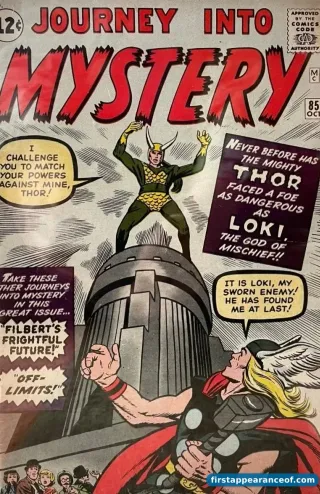
Journey into Mystery #85 (1962). Stan Lee, Larry Lieber, and Jack Kirby. Loki's canonical first appearance and the foundational Thor-adversary debut.

1st Appearance

First Appearance of Loki

Journey into Mystery #85

October 1962 · Marvel · Silver Age

Thor's adoptive brother. Marvel's Silver Age trickster god, the in-continuity reason the Avengers exist, and the MCU villain Tom Hiddleston made into a cultural icon.

Key Issue

Created by Stan Lee · Larry Lieber · Jack Kirby

By Atomm Updated

The first appearance (1st app) of Loki is Journey into Mystery #85 (October 1962), created by Stan Lee, Larry Lieber, and Jack Kirby. The issue establishes the Thor-adversary framework that has defined every subsequent Loki portrayal across comics, film, and television. An earlier Timely-era Loki figure appears in Venus #6 (August 1949) by Stan Lee and Werner Roth as a mythological-story precursor; mainstream first-appearance discussions treat Journey into Mystery #85 as the canonical first. Loki's first cover is Journey into Mystery #88 (January 1963).

Quick Facts

Debut
Journey into Mystery #85 (October 1962). Earlier Timely-era appearance in Venus #6 (August 1949).
Real name
Loki Laufeyson
Creators
Stan Lee, Larry Lieber, and Jack Kirby (Journey into Mystery #85, 1962). Stan Lee and Werner Roth (Venus #6, 1949).
Publisher
Marvel Comics
First enemy
Thor (his defining antagonist and adoptive brother)
First ally
None long-term. Loki operates as a chaos agent.
Team affiliations
Cabal (briefly), Young Avengers (Kid Loki era)

Firsts Timeline

  1. Journey into Mystery #85 cover
    First Appearance October 1962

    Journey into Mystery #85

    By Stan Lee, Larry Lieber, Jack Kirby

    Stan Lee and Larry Lieber script; Jack Kirby pencils. The canonical Loki first appearance and the foundation of the Thor-adversary framework that has defined every subsequent Loki portrayal across comics, film, and television. Loki is established as Thor's adoptive brother, a Frost Giant raised in Asgard by Odin. This is the version readers and collectors recognize as 'first Loki' across virtually every modern reference framework.

    Read the full breakdown
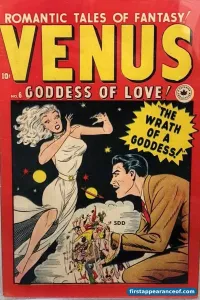
  2. Venus #6 cover
    Early Appearance (Timely-Era) August 1949

    Venus #6

    By Stan Lee, Werner Roth

    An earlier Loki figure appears in Marvel's Timely-era Venus #6, a romance-adjacent anthology that occasionally featured Norse mythology stories. Stan Lee scripts; Werner Roth pencils. The Timely-era Loki is structurally distinct from the canonical 1962 Marvel-616 character; it's a mythological-story precursor rather than the Thor-adversary framework that subsequent Loki canon draws from. Some collectors track Venus #6 as a Loki early appearance for completionist purposes; mainstream first-appearance discussions treat Journey into Mystery #85 as the canonical first.

    Read the full breakdown
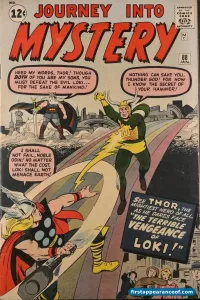
  3. Journey into Mystery #88 cover
    First Cover Appearance January 1963

    Journey into Mystery #88

    By Stan Lee, Jack Kirby

    Loki's first cover appearance, three issues after his Silver Age debut.

    Read the full breakdown

Creation Story

Loki’s canonical first appearance is Journey into Mystery #85 (October 1962). Stan Lee and Larry Lieber script; Jack Kirby pencils. This is the issue that establishes the Thor-adversary framework that every subsequent Loki portrayal draws from. Loki is positioned as Thor’s adoptive brother, a Frost Giant raised in Asgard by Odin, whose resentment of Thor drives his Trickster-god mischief. The framework has been canonical since.

The Avengers #1 (September 1963) established Loki as indirectly responsible for the formation of the Avengers: his scheme to attack Thor via manipulation of the Hulk brings together Iron Man, Thor, Ant-Man, and Wasp to fight alongside Hulk. The in-continuity origin of Earth’s Mightiest Heroes is a Loki scheme.

The Timely-era early appearance

Marvel’s predecessor Timely Comics used a Loki figure in Venus #6 (August 1949), a romance-adjacent anthology that occasionally featured Norse mythology stories. Stan Lee scripted; Werner Roth pencilled. The Timely-era Loki is structurally distinct from the canonical 1962 Marvel-616 character; it’s a mythological-story precursor rather than the Thor-adversary framework that subsequent Loki canon draws from.

Mainstream first-appearance discussions treat Journey into Mystery #85 as the canonical first. Some collectors track Venus #6 as a Loki early appearance for completionist purposes, but the cultural and collector-market center of gravity sits on the 1962 Silver Age debut.

The Kid Loki era

Kieron Gillen’s Journey into Mystery #622 (May 2011) launched the Kid Loki arc, widely regarded as the most critically acclaimed Loki comics run. After Loki’s death during the Siege event, he is reborn as a young boy with no memory of his previous lives. The Gillen run (Journey into Mystery #622 to #645, 2011 to 2013) uses Kid Loki to interrogate the character’s mythological framework and explores whether a Trickster god can choose to become something other than a Trickster.

The Kid Loki arc is the foundation for much of the MCU Disney+ Loki series’s character work and for Al Ewing’s subsequent Loki: Agent of Asgard run (2014 to 2015).

The MCU era

Tom Hiddleston’s Loki across Thor (2011), The Avengers (2012), Thor: The Dark World (2013), Thor: Ragnarok (2017), Avengers: Infinity War (2018), and two seasons of the Loki Disney+ series (2021-2023) is one of the most consistently-acclaimed performances in the MCU. The Hiddleston Loki draws from the Silver Age, the Kid Loki era, and Ewing’s Agent of Asgard framework simultaneously.

Collector context

Journey into Mystery #85 is the canonical Loki Silver Age key. High-grade CGC 9.0+ copies have crossed $15,000 at auction. The book’s value accelerated substantially with Hiddleston’s MCU performance and has held across the Disney+ Loki series.

Venus #6 (Timely 1949) is the early-appearance Timely-era key. High-grade copies are hard to find due to the low 1940s print runs; the book trades in the low-to-mid four-figure range and is collected primarily by completionists rather than canonical-first-appearance buyers.

Journey into Mystery #88 (first cover) is a secondary Silver Age key.
Key subsequent appearances

After the debut, these are the issues collectors and historians reach for next.

  1. 1962

    Journey into Mystery #85

    First appearance.

  2. 1949

    Venus #6

    Early Timely-era appearance (mythological precursor).

  3. 1963

    Journey into Mystery #88

    First cover appearance.

  4. 1963

    The Avengers #1

    Formed the Avengers

    Loki's scheme to attack Thor indirectly is the in-continuity cause of the Avengers' formation. Stan Lee and Jack Kirby.

  5. 2011

    Journey into Mystery #622

    Kid Loki

    Kieron Gillen. Loki is reborn as a young boy after his death in the Siege event. The Kid Loki arc across Journey into Mystery #622 to #645 is widely regarded as the most critically acclaimed Loki comics run.

In adaptations

Film, TV, animation, and game appearances.

  1. 1966

    The Marvel Super Heroes

    Animated

    Grantray-Lawrence Animation. Loki appears in Thor episodes.

  2. 2011

    Thor

    Film

    Starring:Tom Hiddleston

    Kenneth Branagh directs. Hiddleston's Loki is the film's primary antagonist. Widely regarded as one of the MCU's strongest early-era performances.

  3. 2012

    The Avengers

    Film

    Starring:Tom Hiddleston

    Joss Whedon directs. Hiddleston's Loki as the primary antagonist of the first Avengers film. Grossed $1.52 billion worldwide.

  4. 2021

    Loki

    TV

    Starring:Tom Hiddleston

    Disney+ series. Two seasons. Hiddleston's Loki in the lead. Widely regarded as one of the strongest MCU television adaptations.

Frequently asked questions

The questions readers and collectors ask most.

What is Loki's first appearance?

Loki's first appearance is Journey into Mystery #85 (October 1962), created by Stan Lee, Larry Lieber, and Jack Kirby. The issue establishes the Thor-adversary framework that has defined every subsequent Loki portrayal. An earlier Timely-era Loki figure appears in Venus #6 (August 1949) as a mythological-story precursor, but mainstream first-appearance discussions treat Journey into Mystery #85 as the canonical first.

Is Journey into Mystery #85 valuable?

Yes. Journey into Mystery #85 is a Silver Age Marvel key. High-grade copies (CGC 9.0 and above) have crossed $15,000 at auction. The book's value accelerated substantially with Tom Hiddleston's MCU performance starting in 2011. Demand has held across the Loki Disney+ series and the broader Avengers-saga MCU films.

What is Venus #6?

Venus #6 (August 1949) is a Timely-era Marvel romance-adjacent anthology that occasionally featured Norse mythology stories. An earlier Loki figure appears in the issue, scripted by Stan Lee with Werner Roth on art. The Timely-era Loki is structurally distinct from the canonical 1962 Marvel-616 character; it's a mythological-story precursor rather than the Thor-adversary framework. Some collectors track Venus #6 as a Loki early appearance for completionist purposes, but the canonical first appearance remains Journey into Mystery #85.

Is Loki Thor's brother?

Adoptive brother in modern continuity. Odin adopted Loki as an infant after the Frost Giant king Laufey abandoned him. The adoption framework has been canonical since the Lee-Kirby Silver Age run. Modern comics have complicated the relationship substantially, but the adoptive-brother framework is the default across comics, film, and television.

Is the MCU Loki the same character?

Loosely. Tom Hiddleston's MCU Loki draws from the Silver Age Thor-adversary framework and from the more recent Kid Loki and Agent of Asgard framings, but adapts the character significantly for mainstream audiences. Hiddleston's performance across fourteen years (2011 to 2025) is arguably the most consistently-acclaimed MCU performance. The Disney+ Loki series (2021 to 2023) expanded the character's multiverse-navigation framework that subsequent MCU projects have relied on.