What Apokolips is
Jack Kirby created Apokolips as part of his 1970 to 1973 Fourth World epic. The framework introduced the New Gods, two opposing factions of cosmic-tier deity-class beings: New Genesis (the heroic faction under Highfather) and Apokolips (the evil faction under Darkseid). The two planets are structurally counterposed; New Genesis is depicted as a paradisiacal world, Apokolips as an industrial-hellscape. The cosmic-political conflict between them is the spine of the Fourth World mythology.
Apokolips is described as a planet covered in fire pits, slave-pens, war factories, and the Tower of Rage (Darkseid’s seat of power). Granny Goodness operates an orphanage that trains children into the Female Furies, Darkseid’s elite warrior class. Desaad runs the planet’s torture and surveillance apparatus. Kalibak is Darkseid’s son. Steppenwolf is Darkseid’s military commander. The political structure is authoritarian: every aspect of Apokoliptan life serves Darkseid’s pursuit of the Anti-Life Equation, the cosmic-scale formula that would let him control all sentient minds in the universe.
Kirby left DC before completing the planned Fourth World cycle. Subsequent writers have continued and expanded the framework. Walt Simonson’s late-1980s Orion run extended the Apokolips and New Genesis storyline. Grant Morrison’s Final Crisis (2008-2009) used Apokolips as the central antagonist setting. Tom King’s Mister Miracle (2017-2019) reframed Mister Miracle’s relationship with Apokolips as deeply traumatic. Multiple DC events across decades have used Apokolips as a recurring cosmic-threat origin.
Why Apokolips matters
Apokolips is structurally important to DC continuity in ways that most planets are not. The Fourth World mythology gave DC a top-tier cosmic threat (Darkseid) that could compete with the cosmic-scale antagonists Marvel had built around Galactus and Thanos. Most major DC events from the 1980s onward have featured Apokolips or Darkseid in significant roles: Crisis on Infinite Earths (Darkseid as a peripheral cosmic presence), Cosmic Odyssey (1988, Mike Mignola pencils), Final Crisis (2008-2009, the climactic Darkseid event), Justice League: Origin (2011, the Justice League’s foundational Darkseid encounter in New 52 continuity), Darkseid War (2015-2016).
The Anti-Life Equation, the cosmic formula Darkseid pursues, has become one of DC’s most-cited high-concept threats. The Equation grants its possessor control over all sentient minds; Darkseid’s Apokolips-based pursuit of the Equation has driven multiple major DC storylines.
Adaptations
Apokolips has appeared in nearly every major DC animated and live-action property:
- Superman: The Animated Series, ‘Apokolips Now!’ (1998). Bruce Timm and Paul Dini’s two-part adaptation. Michael Ironside’s Darkseid voice has been canonical for a generation of DC fans. The animated Apokolips visuals fed back into subsequent comic-book Apokolips depictions.
- Justice League / Justice League Unlimited (2001-2006). Apokolips appears multiple times across the series; the Cadmus arc and the climactic Apokolips invasion are both highlights.
- Zack Snyder’s Justice League (2021). The Snyder Cut extensively depicted Apokolips in live-action. Substantial production design built the planet’s industrial-hellscape architecture.
- Various DC animated films. Justice League: War (2014), Justice League: Throne of Atlantis, and others.
Collector context
New Gods #1 (February 1971) is the canonical first-full-appearance Apokolips key. CGC 9.4 trades in the four-figure range; 9.6 reaches into the high four to low five figures; 9.8 is rare and reaches the mid five figures. The book is the foundational Fourth World launch.
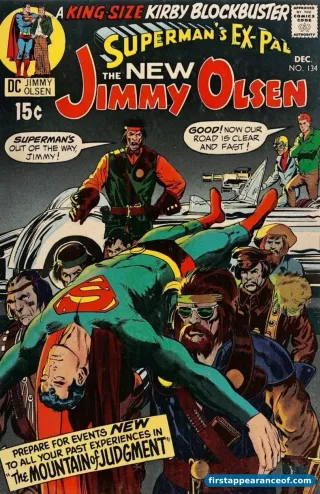
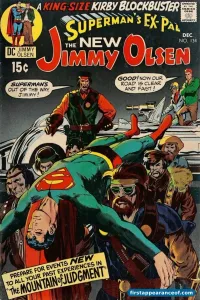
Superman’s Pal, Jimmy Olsen #134 (December 1970, the first Apokolips reference and the start of Kirby’s DC run) trades at similar prices. Some specialist collectors track it as the canonical Apokolips first appearance; others give precedence to New Gods #1. Both are recognized Fourth World keys.
The broader Fourth World run (Forever People, Mister Miracle, the Kirby-era Jimmy Olsen issues) trades as a collector category. High-grade Fourth World runs are recognized Bronze Age sets and are tracked by Kirby specialists.