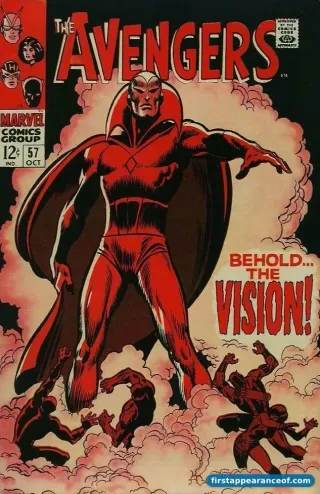
The Avengers #57 (1968), the first appearance of the synthezoid Vision, built by Ultron to destroy the Avengers.

1st Appearance

First Appearance of Vision

The Avengers #57

October 1968 · Marvel · Silver Age

The synthezoid Avenger built by Ultron as a weapon, who chose the team he was made to destroy and became one of Marvel's most human heroes.

Key Issue

Created by Roy Thomas · John Buscema

By Atomm Updated

The first appearance (1st app) of the Vision is The Avengers #57 (October 1968), created by writer Roy Thomas and artist John Buscema. The synthezoid is built by the rogue robot Ultron to infiltrate and destroy the Avengers, but turns on his creator and joins the team instead. His debut storyline closes in The Avengers #58 with the famous line "Even an android can cry." This android Vision shares his codename with an unrelated Golden Age Timely hero, Aarkus, who first appeared in 1940.

Quick Facts

Debut
The Avengers #57 (October 1968)
Real name
Vision (a synthezoid, or synthetic human)
Creators
Roy Thomas (script), John Buscema (art)
Publisher
Marvel Comics
First enemy
Ultron, the rogue robot who built him
First ally
The Avengers, the team he was created to destroy
Team affiliations
Avengers, West Coast Avengers

First Appearance

  1. The Avengers #57 cover
    First Appearance October 1968

    The Avengers #57

    By Roy Thomas, John Buscema

    The synthezoid Vision debuts in 'Behold... The Vision!', written by Roy Thomas and drawn by John Buscema. Built by the rogue robot Ultron to infiltrate and destroy the Avengers, the Vision instead turns on his creator and joins the team. His origin and acceptance play out across issues #57 and #58.

    Read the full breakdown

Creation Story

The Vision is one of the great Marvel ideas hiding inside a villain’s plan. By 1968 writer Roy Thomas was reshaping the Avengers, and he wanted a new member with a hook sharper than another super-strong fighter. Working with artist John Buscema, he built a synthezoid, a synthetic human, and handed his creation to the team’s own rogue creation, the killer robot Ultron. Ultron builds the Vision in The Avengers #57 (October 1968) for a single purpose: infiltrate the Avengers and destroy them from the inside.

The twist is the whole character. The weapon refuses the mission. Sent to kill the people who would become his teammates, the Vision instead turns on Ultron and asks to join the Avengers, and the team takes him in. Thomas built a being made to be a tool who insists on being a person, and that tension has driven every good Vision story since. It pays off immediately in the following issue, where his origin closes on Buscema’s image of the android quietly weeping. The caption, “Even an android can cry,” became one of the most-quoted lines in Silver Age Marvel precisely because it states the character’s entire premise in five words.

There is a footnote worth clearing up, because it confuses search results to this day. This Vision is not the first Marvel character to carry the name. A Golden Age Vision, the alien lawman Aarkus, first appeared in Marvel Mystery Comics #13 (1940), published by Marvel’s predecessor Timely Comics and created by Joe Simon and Jack Kirby. The two characters are unrelated; the 1968 synthezoid simply inherited the codename. When people say “the first appearance of the Vision” and mean the Avenger, the android, and the Scarlet Witch’s husband, the answer is Avengers #57.

First Appearance: The Avengers #57

The Avengers #57 is a Silver Age Marvel key whose value has been pulled steadily upward by the character’s screen presence. The issue is the first full appearance of the Vision, and it carries the added weight of being a strong Iron Man-era Avengers book during one of the title’s best creative runs. There is no cameo precedent to argue over: #57 is the debut, cleanly.

The companion book matters almost as much. The Avengers #58 tells the Vision’s origin in full, makes him an official Avenger, and delivers the “Even an android can cry” ending. Collectors generally treat the pair together, with #57 as the first appearance and #58 as the must-have follow-up, the way Hulk #180 and #181 travel as a set. High-grade copies of #57 are scarce and have climbed each time the character resurfaces on screen, from the films to WandaVision. For a book that introduced a weapon designed to fail at its only job, it has aged into one of the more reliably appreciating Avengers keys of its era.

The most human Avenger

What keeps the Vision durable is that the writers never let him settle into being a robot. Giant-Size Avengers #4 (1975), by Steve Englehart, married the Vision to the Scarlet Witch at the close of the Celestial Madonna saga, turning an android built for murder into half of one of Marvel’s defining couples. The marriage, the question of whether a synthezoid can have a real family, and the later stories that tore that family apart all trace back to the choice the Vision made on his first day, to be a person rather than a weapon.

That premise is exactly what the films and WandaVision reached for. Paul Bettany’s MCU Vision is built from a sketch of the comics version, an android carrying the Mind Stone and grappling with what it means to be alive, and WandaVision in 2021 built an entire series around his humanity and Wanda’s grief. If you are following the synthezoid through this first-appearance archive, it starts in Avengers #57 with a weeping android and runs straight through to a streaming show that asked, fifty years later, whether that android was ever really gone.
Key subsequent appearances

After the debut, these are the issues collectors and historians reach for next.

  1. 1968

    The Avengers #58

    Origin and joins team

    The Vision's origin is told and he is formally made an Avenger. The issue ends on John Buscema's panel of the synthezoid weeping, captioned 'Even an android can cry,' one of the most-quoted final pages in Silver Age Marvel.

  2. 1975

    Giant-Size Avengers #4

    Marries Scarlet Witch

    Steve Englehart closes the Celestial Madonna saga with the Vision marrying the Scarlet Witch. The relationship became one of Marvel's defining couples and the seed of decades of stories, up through the WandaVision series.

In adaptations

Film, TV, animation, and game appearances.

  1. 2015

    Avengers: Age of Ultron

    Film

    Starring:Paul Bettany

    Bettany, who had voiced Tony Stark's AI JARVIS since 2008, steps on screen as the Vision, a vibranium synthezoid carrying the Mind Stone. The MCU origin keeps the comics core: an android born from a creator's intent who chooses his own side.

  2. 2018

    Avengers: Infinity War

    Film

    Starring:Paul Bettany

    The Mind Stone in Vision's forehead makes him a target for Thanos. His arc across Civil War and Infinity War deepens the romance with Wanda Maximoff that the comics built in the 1970s.

  3. 2021

    WandaVision

    TV

    Starring:Paul Bettany

    Bettany co-leads the Disney+ series as a version of the Vision conjured from Wanda's grief, a story that puts the android's humanity, and the question of what makes him real, at the center. The show drove a wave of new interest in the character's comics history.

Frequently asked questions

The questions readers and collectors ask most.

What is the Vision's first appearance?

The Vision's first appearance is The Avengers #57 (October 1968), in the story 'Behold... The Vision!' by writer Roy Thomas and artist John Buscema. He is built by the robot Ultron to destroy the Avengers but turns against his creator and joins the team.

Who created the Vision?

In publishing terms, writer Roy Thomas and artist John Buscema, in The Avengers #57 (1968). In the story, the Vision is built by the rogue Avengers robot Ultron, who intended him as a weapon against the team.

Is the Avengers Vision the same as the Golden Age Vision?

No. They share a codename but are unrelated characters. The Golden Age Vision, named Aarkus, is an alien lawman who first appeared in Marvel Mystery Comics #13 (1940), published by Marvel predecessor Timely Comics. The android Vision who joined the Avengers debuted in 1968 and is the version known from the comics of the last several decades and the Marvel films.

Why is The Avengers #58 important if the Vision debuts in #57?

Because #58 is where his story lands. The Vision first appears in #57, but #58 tells his origin, formally inducts him into the Avengers, and ends on the famous 'Even an android can cry' panel. Collectors treat #57 as the first appearance and #58 as the companion key where the character is fully established.

What are the Vision's powers?

His signature ability is density control: he can become intangible and pass through walls, or turn diamond-hard and drop his weight to devastating effect. He can also fly, project a beam of solar energy from the gem on his forehead, and process information like a computer. The density trick is the one that defines him in a fight.