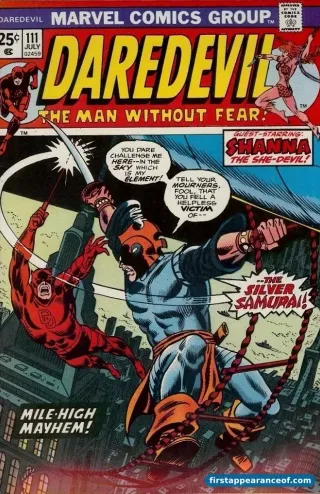
Daredevil #111 (1974). Silver Samurai is on the cover with his tachi sword raised, fighting Daredevil and Black Widow.

1st Appearance and 1st Cover

First Appearance of Silver Samurai

Daredevil #111

July 1974 · Marvel · Bronze Age

Steve Gerber and Bob Brown's Bronze Age Marvel-Universe samurai. The Daredevil villain who became a Wolverine villain because Frank Miller noticed him.

Key Issue

Created by Steve Gerber · Bob Brown

By Atomm Updated

The first appearance (1st app) of Silver Samurai is Daredevil #111 (July 1974), created by Steve Gerber and Bob Brown. Kenuichio Harada is a Japanese mutant samurai who debuts as a Daredevil antagonist before migrating to X-Men and Wolverine books in the 1980s. He is the half-brother of Mariko Yashida (Wolverine's long-running romantic partner) and a member of the Yashida clan. The character's modern shape was set by Frank Miller in the 1982 Wolverine miniseries. Will Yun Lee played Silver Samurai briefly in The Wolverine (2013), in a non-canonical version that was a robotic suit rather than the comic-book mutant.

Quick Facts

Debut
Daredevil #111 (July 1974)
Real name
Kenuichio Harada
Creators
Steve Gerber (writer, co-creator), Bob Brown (artist, co-creator)
Publisher
Marvel Comics
First enemy
(He is the antagonist; first opposed by Daredevil and Black Widow)
First ally
(Solo at debut; later allied with the Hand and the Yashida clan)
Team affiliations
Hand (briefly), Yashida clan (family), occasional Marvel villain teams

First Appearance

  1. Daredevil #111 cover
    First Appearance First Cover July 1974

    Daredevil #111

    By Steve Gerber, Bob Brown

    Gerber writes; Brown pencils. Silver Samurai debuts as a Daredevil and Black Widow antagonist before becoming primarily an X-Men and Wolverine villain through the 1980s. Kenuichio Harada is the half-brother of Mariko Yashida (Wolverine's long-running love interest) and a member of the Yashida clan. The character's modern shape (samurai armor, tachi sword, energy-blade ability) emerges in Frank Miller's Wolverine miniseries in 1982.

    Read the full breakdown

Creation Story

Steve Gerber wrote Daredevil from issue #97 to #117 in the early-to-mid 1970s, a Gerber stretch that included some of the more idiosyncratic Daredevil work of the Bronze Age. Silver Samurai was a Gerber addition to the Daredevil rogues’ gallery in #111. Gerber’s pitch was a Japanese samurai with a glowing tachi who fought Daredevil and Black Widow on US soil, drawn by Bob Brown in standard Brown style: clean lines, symmetric panel composition, less stylized than what was about to become the Marvel norm under Wolfman, Miller, and others. The character was a one-and-done at first. He returned occasionally over the next eight years but did not have a consistent character arc.

Frank Miller noticed him. Miller’s 1982 Wolverine miniseries (the first Wolverine solo book, four issues, with Chris Claremont scripting and Miller pencilling) was set in Japan and built the Yashida-clan storyline that anchored Wolverine’s romantic life for the next decade. Miller pulled Silver Samurai into the Yashida family as Mariko’s half-brother. The character now had a family-history motivation, an established place in Marvel’s Japan-set storytelling, and a redesigned visual that made him instantly recognizable. The redesigned Silver Samurai is the Silver Samurai every artist since 1982 has drawn.

The character has stayed B-tier in collector terms. He is a recognized villain across X-Men and Wolverine titles; he is not a top-five Wolverine antagonist (Sabretooth, the Hand, Magneto-by-association, and a few others rank above him). His value to the franchise is the Yashida-clan family weight, which he carries into stories about Mariko and Wolverine’s Japan-related arcs. Outside that storyline, he is an occasional villain who shows up in Hand-related plots.

Live-action treatment has been thin. The Wolverine (2013) used the Silver Samurai name for a robotic suit rather than the mutant character. The film’s plot involved Mariko and the Yashida clan but rewrote the family relationships significantly. Will Yun Lee played the human Harada; Hal Yamanouchi did the suit performance. Critics treated the film’s adaptation choices as a meaningful departure from the comic-book character. The MCU has not introduced Silver Samurai.

The original 1974 Bob Brown visual is a Bronze Age artifact. The 1982 Frank Miller redesign is the canonical version. Most modern artists draw the Miller version with minor adjustments. The character’s most recent significant appearance was in the Death of Wolverine event in 2014, where he played a tertiary role; he has not had a sustained spotlight in the post-2014 X-Men line.

First Appearance and First Cover: Daredevil #111

The book hit stands in April 1974 with a July 1974 cover date. 32 pages. Cover price was 25 cents. The cover is Bob Brown. Silver Samurai is centered on the cover, tachi raised. Daredevil and Black Widow are flanking him in defensive postures. The composition is straightforward Bronze Age fight cover, no innovation in framing, but the character design is unmistakable: silver armor, the helmet with the horn, the glowing tachi. Brown’s design has held up.

Print run was standard Marvel Bronze Age, probably in the 200K to 300K range. Survival in high grade is moderate. CGC 9.4 and above is a few hundred census copies; 9.8 is rare.

The story inside has Silver Samurai working for the Black Spectre criminal organization. He fights Daredevil and Black Widow in an action sequence that takes about a third of the issue. Gerber writes him as a hired muscle figure with samurai code as a flavor element. The energy tachi is present but underexplained; Frank Miller will give the sword a clearer power-set treatment in 1982. The issue ends with Silver Samurai escaping rather than being captured, which sets up the recurring-villain status.

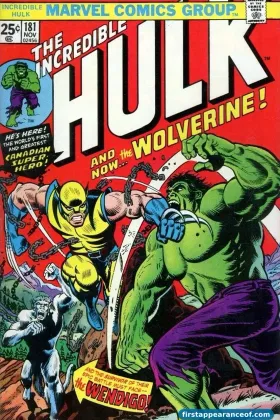
For pricing, Daredevil #111 is a solid Bronze Age key. CGC 9.4 trades in the high three to low four figures depending on comp activity. 9.6 trades in the four figures. 9.8 is rare and reaches mid four to low five figures. The book sits in the second tier of Bronze Age first-appearance keys, below Hulk #181 (Wolverine) and Werewolf By Night #32 (Moon Knight), but above most one-and-done villain debuts. The Frank Miller Wolverine #1 (1982) is the second-tier Silver Samurai key, with prices in the mid-three to low-four figures at CGC 9.8.
Key subsequent appearances

After the debut, these are the issues collectors and historians reach for next.

  1. 1982

    Wolverine #1 (1982 limited)

    Frank Miller and Chris Claremont. Silver Samurai appears in the Japan-set Wolverine miniseries that establishes the modern visual and characterization of the character. The Yashida clan's role in Wolverine's life is built in this series. Silver Samurai is half-brother to Mariko Yashida.

  2. 1982

    Wolverine #2 (1982 limited)

    Continued from #1. Silver Samurai's energy-tachi sword is a Miller invention; the original 1974 Gerber-Brown character had a less defined power set.

  3. 1983

    Uncanny X-Men #173

    Claremont and Paul Smith. Silver Samurai in the X-Men proper, joining the Yashida storyline as it expands beyond Wolverine.

  4. 1984

    X-Men: Kitty Pryde and Wolverine #1

    Claremont and Al Milgrom. Silver Samurai is a major antagonist in the Kitty Pryde miniseries that runs alongside the X-Men book.

In adaptations

Film, TV, animation, and game appearances.

  1. 2013

    The Wolverine

    Film

    Starring:Will Yun Lee (Harada), Hal Yamanouchi (suit performer)

    James Mangold directs. The Silver Samurai in this film is a robotic suit rather than the comic-book mutant. Yun Lee plays the human Harada. The film changed the character's premise significantly to fit the Wolverine-in-Japan story arc.

Frequently asked questions

The questions readers and collectors ask most.

What is Silver Samurai's first appearance?

Daredevil #111 (July 1974), Steve Gerber and Bob Brown. The character debuts as a Daredevil antagonist alongside Black Widow as Daredevil's then-current partner. There is no precursor or cameo issue. Silver Samurai was built whole-cloth for this debut and migrated to X-Men and Wolverine books eight years later.

Why is Silver Samurai considered a Wolverine villain?

Frank Miller's 1982 Wolverine miniseries pulled the character into Wolverine's storyline and established the half-brother relationship to Mariko Yashida. Before 1982, Silver Samurai was a B-tier Daredevil villain with sporadic appearances. After 1982, he was a major X-Men and Wolverine antagonist with a well-defined family-history motivation. The migration is a Frank Miller decision; the character's modern shape is the Miller version, not the Gerber-Brown original.

Is Daredevil #111 valuable?

Modestly. CGC 9.4 trades in the high three to low four figures; 9.6 trades in the four figures; 9.8 is rare and trades in the mid four to low five figures. The book is recognized as a Bronze Age key for the Silver Samurai debut but is priced lower than the Wolverine-debut keys (Hulk #181, Hulk #180) because Silver Samurai is a B-tier villain rather than a top-tier hero. The Frank Miller Wolverine #1 (1982) is the second-tier Silver Samurai key worth chasing.

Who created Silver Samurai?

Steve Gerber wrote Daredevil #111 and is credited as the character's co-creator. Bob Brown was the issue's penciller and is co-credited. The original 1974 visual is Brown's; the modern visual (Yashida-clan armor, energy-tachi, the angular samurai silhouette) is Frank Miller's from the 1982 Wolverine miniseries. Multiple artists have refined the design since (Paul Smith on Uncanny X-Men #173, John Romita Jr. on later issues), but the modern reading is mostly Miller's.