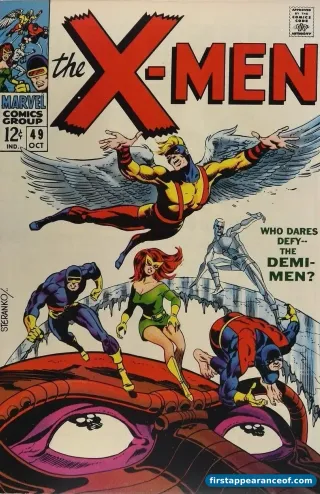
X-Men #49 (1968). Lorna Dane debuts as the X-Men investigate her mutant signature.

1st Appearance and 1st Cover

First Appearance of Polaris

X-Men #49

October 1968 · Marvel · Silver Age

Magneto's daughter, Havok's partner, and the Silver Age X-Men addition who has stayed in regular rotation longer than most of her debut-era peers.

Key Issue

Created by Arnold Drake · Don Heck · Werner Roth

By Atomm Updated

The first appearance (1st app) of Polaris is X-Men #49 (October 1968), created by Arnold Drake with art by Don Heck and Werner Roth. Lorna Dane debuts with green hair and emerging magnetic powers. The issue is both her first appearance and first cover. She takes the Polaris codename in subsequent issues (briefly using 'Magnetrix' first). Her status as Magneto's daughter has been canonical for decades and remains a defining narrative element.

Quick Facts

Debut
X-Men #49 (October 1968)
Real name
Lorna Sally Dane
Creators
Arnold Drake (writer), Don Heck and Werner Roth (artists)
Publisher
Marvel Comics
First enemy
Mesmero
First ally
Havok / Alex Summers (her long-running partner)
Team affiliations
X-Men, X-Factor (Peter David era), Brotherhood of Mutants (briefly, under mind control)

Firsts Timeline

  1. X-Men #49 cover
    First Appearance First Cover October 1968

    X-Men #49

    By Arnold Drake, Don Heck, Werner Roth

    Arnold Drake writes; Don Heck and Werner Roth provide art. Lorna Dane debuts with green hair and emerging magnetic powers. The issue is both her first appearance and first cover. The Magneto-as-her-father plot point is introduced in subsequent issues but remains canonical to the modern era.

    Read the full breakdown
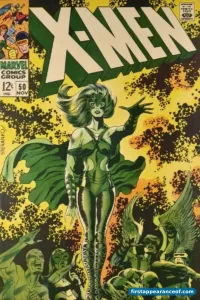
  2. X-Men #50 cover
    First Codename (Magnetrix, then Polaris) November 1968

    X-Men #50

    By Arnold Drake, Jim Steranko

    Lorna takes the codename 'Magnetrix' temporarily, then settles on 'Polaris' across subsequent issues. Jim Steranko's iconic cover. The Polaris codename has been canonical since.

    Read the full breakdown

Creation Story

Polaris is Arnold Drake, Don Heck, and Werner Roth’s 1968 X-Men addition. X-Men #49 (October 1968) introduces Lorna Dane, a young woman with bright green hair and emerging magnetic powers, after the X-Men receive an anomalous mutant signature on Cerebro. Lorna is initially unaware of her own mutant status; the issue tracks her discovery and the X-Men’s recruitment effort.

The visual design is distinctive. Drake and Heck gave Lorna a striking green-hair-and-purple-costume look that set her apart from the X-Men’s other female characters of the era. The character was clearly designed to recur, with a personal-mystery framework (the green hair, the unexplained magnetic capability) that subsequent issues could explore.

X-Men #50 (November 1968), with a celebrated Jim Steranko cover, has Lorna take the codename “Magnetrix” temporarily before settling on “Polaris.” The Polaris designation has been canonical since.

The Magneto reveal

X-Men #52 (January 1969) introduced the plot thread that would define Lorna’s character for decades: her father is Magneto. The reveal had been telegraphed by her green hair and magnetic powers (Magneto’s signature traits) and confirmed Lorna as part of the Magneto-family lineage that includes Quicksilver and Scarlet Witch. The Magneto-daughter framework would be retconned and reaffirmed multiple times across subsequent decades; the modern canonical position (post-2010s X-runs) keeps the lineage intact.

The reveal positioned Polaris as one of the X-Men’s most narratively complicated characters. Her allegiance to the X-Men against her father’s Brotherhood of Mutants is a recurring tension. Her romantic partnership with Havok (Alex Summers) is the longest-running couple-pairing in the X-books outside Cyclops and Jean Grey.

The X-Factor era

X-Factor #71 (October 1991) launched Peter David’s X-Factor with Polaris on the team alongside Havok, Strong Guy, Wolfsbane, Multiple Man, and Quicksilver. The David run is widely regarded as Polaris’s strongest extended character work outside the core X-Men. Her chemistry with Havok carried much of the team’s emotional plotting; her control of magnetism gave the team a heavy hitter without leaning on Magneto’s narrative space.

Adaptations

Emma Dumont’s Polaris in The Gifted (Fox, 2017 to 2019) is the most prominent screen portrayal of the character. The series cast Polaris as a Mutant Underground leader, with the green hair and magnetic powers preserved from the comics; the show’s two-season run gave the character her highest live-action visibility to date.

Collector context

X-Men #49 is the Polaris Silver Age key. High-grade CGC 9.0+ copies have crossed $1,500 at auction. The book’s value tracks with each Polaris appearance in adaptations, particularly The Gifted television run.

Secondary keys: X-Men #50 (Magnetrix codename, Steranko cover, an aesthetically significant Polaris collectible). X-Men #52 (Magneto reveal). X-Factor #71 (1991, Peter David X-Factor launch).
Key subsequent appearances

After the debut, these are the issues collectors and historians reach for next.

  1. 1968

    X-Men #49

    First appearance and first cover.

  2. 1968

    X-Men #50

    Magnetrix codename, then Polaris. Jim Steranko cover.

  3. 1969

    X-Men #52

    Magneto Reveal

    Lorna's father is revealed as Magneto. The reveal would be retconned and reaffirmed several times across decades but has remained the modern canonical position.

  4. 1991

    X-Factor #71

    Peter David X-Factor

    Peter David relaunches X-Factor with Polaris on the team alongside Havok, Strong Guy, Wolfsbane, Multiple Man, and Quicksilver.

    Newsstand variant

In adaptations

Film, TV, animation, and game appearances.

  1. 2017

    The Gifted

    TV

    Starring:Emma Dumont

    Fox / Marvel television series. Dumont plays Polaris as a Mutant Underground leader. Two seasons (2017 to 2019). The most prominent screen Polaris portrayal.

  2. 2024

    X-Men '97

    Animated

    Marvel Studios animated series. Polaris appears in supporting capacity within the X-Men: The Animated Series-continuing run.

Frequently asked questions

The questions readers and collectors ask most.

What is Polaris's first appearance?

Polaris's first appearance is X-Men #49 (October 1968), created by Arnold Drake with art by Don Heck and Werner Roth. The issue is both her first appearance and first cover. Lorna Dane debuts with her signature green hair and emerging magnetic powers.

Is X-Men #49 valuable?

Yes. X-Men #49 is a Silver Age X-Men key with strong recurring-character weight. High-grade copies (CGC 9.0 and above) have crossed $1,500 at auction. The book has tracked with The Gifted television run (2017 to 2019) and Polaris's continued visibility across modern X-Men runs.

Is Polaris Magneto's daughter?

Yes, in modern canonical continuity. The reveal arrived in X-Men #52 (January 1969), was retconned through several different parentage explanations across decades, and was reaffirmed as the modern canonical position. Polaris's magnetic powers and green hair are the inherited markers of Magneto's lineage. She is Quicksilver and Scarlet Witch's half-sister via the same father (in canon at the time of writing, though the Quicksilver/Wanda parentage has its own complicated history).

Why did Polaris briefly call herself Magnetrix?

Lorna's first codename in X-Men #50 (November 1968) was 'Magnetrix,' a more direct reference to her magnetic powers. The codename was abandoned across the following issues in favor of 'Polaris,' which has remained canonical since. The Magnetrix designation is a Silver Age curio collectors note but is not the character's working name.

Did Polaris serve on X-Factor?

Yes. Peter David's X-Factor #71 (October 1991) launched the government-sanctioned X-Factor team with Polaris on the roster alongside Havok (her partner), Strong Guy, Wolfsbane, Multiple Man, and Quicksilver. The David run is widely regarded as Polaris's strongest extended character work outside the core X-Men. She has continued to appear across Uncanny X-Men, X-Factor relaunches, and the Krakoa-era books.