Creation Story
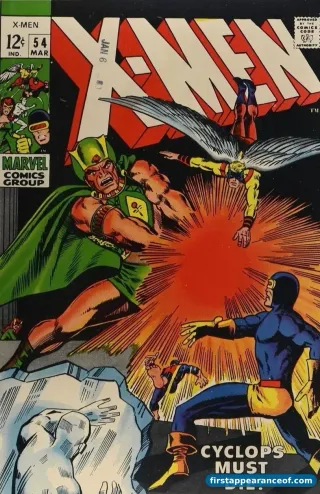
Havok is a two-issue introduction. Arnold Drake’s X-Men #54 (March 1969) introduces Alex Summers in civilian form as Cyclops’s younger brother. Don Heck pencils. Alex appears as a normal college-age human; the issue establishes the Summers-brother relationship without manifesting any mutant ability. The Roy Thomas-era X-Men was building out Cyclops’s backstory through this period; introducing a younger brother gave Scott Summers personal stakes that the team-mutant framing didn’t otherwise provide.
X-Men #58 (July 1969) is where Havok arrives. Roy Thomas writes; Neal Adams pencils and provides the cover. Alex’s plasma-energy powers manifest under stress, and Adams designs the chest-target costume that has remained essentially unchanged across fifty-five years of comics. The chest-target serves a functional in-universe purpose: it channels the discharge pattern of Havok’s plasma through a controlled outlet rather than letting the energy radiate uncontrollably. Adams’s design is one of the most-imitated and least-revised costumes in the X-books.
Most collector frameworks treat X-Men #58 as the canonical Havok first appearance. X-Men #54 is collected as the civilian-debut prologue. Both are substantial Silver Age X-Men keys.
The X-Factor era
X-Factor #71 (October 1991) launched Peter David’s X-Factor run with Havok as team leader. Larry Stroman pencilled the early issues. The team (Havok, Polaris, Strong Guy, Wolfsbane, Multiple Man, Quicksilver) was a government-sanctioned mutant unit, and David’s tonal register (sharp dialogue, character-driven plotting, comedic timing) gave the book a distinct identity from the core Uncanny X-Men. The run is widely regarded as the strongest X-Factor era and provided Havok with the most consistent extended characterization he has had outside the X-Men proper.
Mutant X and Avengers Unity
Mutant X #1 (October 1998) by Howard Mackie and Tom Raney was a Havok-led alternate-universe ongoing that ran 32 issues through 2001. The book had Havok displaced into a divergent reality where the X-Men’s history played out differently. The series is considered a niche but solid extended Havok showcase.
Uncanny Avengers #1 (October 2012) by Rick Remender and John Cassaday brought Havok back to flagship-team prominence as Captain America’s appointed leader of the Avengers Unity Squad in the post-Avengers vs. X-Men status quo. The role positioned Havok as a public mutant figurehead in a way the X-books had rarely tried.
Adaptations
Lucas Till’s Havok in X-Men: First Class (2011, Matthew Vaughn) brought the character to live-action film, with Till reprising the role across X-Men: Days of Future Past (2014) and X-Men: Apocalypse (2016). The film versions place Havok in the 1962-set First Class generation, ahead of his comic chronology.
Collector context
X-Men #58 is the canonical Havok key. High-grade CGC 9.0+ copies have crossed $2,000 at auction.
X-Men #54 is the civilian-debut prologue and a slightly more affordable key in the same Silver Age tier; high-grade copies trade closer to half the price of #58. Havok-completionists own both.
Secondary keys: X-Factor #71 (1991, Peter David X-Factor launch). Uncanny Avengers #1 (2012, Avengers Unity Squad).