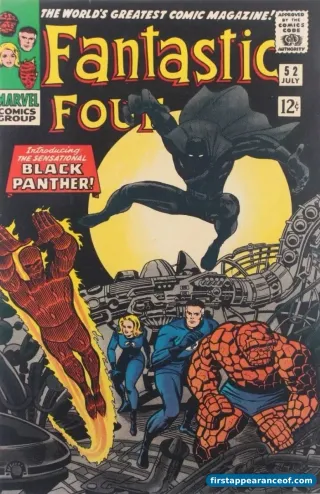
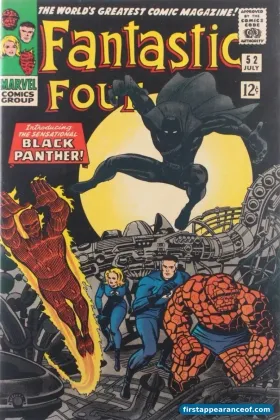
Fantastic Four #52 (1966). Black Panther's first appearance and the first appearance of Wakanda. Lee and Kirby's cover shows T'Challa pouncing on the Fantastic Four; Wakanda's vibranium-rich landscape is established in the interior pages.

1st Appearance

First Appearance of Wakanda

Fantastic Four #52

July 1966 · Marvel · Silver Age

Stan Lee and Jack Kirby's 1966 East African nation. The vibranium-rich isolationist kingdom that introduced Black Panther and reshaped Marvel's Africa coverage from a colonial backdrop into a storytelling center.

Key Issue

Created by Stan Lee · Jack Kirby

By Atomm Updated

Marvel Comics Place The most technologically advanced nation on Earth.

Wakanda first appears in Fantastic Four #52 (July 1966), created by Stan Lee and Jack Kirby in the same issue that introduces Black Panther. The fictional East African nation sits on a vibranium-rich meteorite impact site and has used the metal's wealth to maintain isolationism and develop the most advanced technology on Earth. Don McGregor's 'Panther's Rage' arc in Jungle Action #6 to #18 (1973 to 1976) is the foundational extended Wakanda treatment outside the Lee-Kirby originals. The 2018 Black Panther film, directed by Ryan Coogler and designed by Hannah Beachler, reset the visual language for Wakanda across all subsequent comic-book and film treatments. Ta-Nehisi Coates's 2016 to 2018 comic run is the most-acclaimed modern run set in Wakanda.

Firsts Timeline

  1. Fantastic Four #52 cover
    First Appearance July 1966

    Fantastic Four #52

    By Stan Lee, Jack Kirby

    Stan Lee writes; Jack Kirby pencils. Wakanda debuts in the same issue as Black Panther (T'Challa). Lee and Kirby establish the nation's isolationism, its vibranium-mound geography, and T'Challa's role as both king and the costumed Black Panther in this single 22-page debut. The framing is unusually substantial for a 1966 backdrop introduction; Lee and Kirby treated Wakanda as a fully-realized place rather than a generic exotic locale.

  2. First Wakanda Cover Spotlight August 1966

    Fantastic Four #53

    By Stan Lee, Jack Kirby

    Lee and Kirby. Continuation of the FF #52 arc. T'Challa's origin and Wakanda's vibranium-mound geography get expanded across this issue. The Klaw conflict (Klaw is the antagonist who killed T'Challa's father T'Chaka and stole Wakandan vibranium) is introduced and is one of the most recurring Black Panther / Wakanda storylines of the next sixty years.

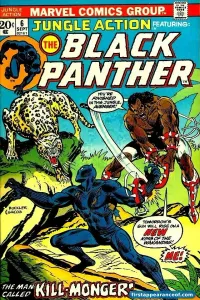
  3. Jungle Action #6 cover
    Don McGregor Wakanda Expansion September 1973

    Jungle Action #6

    By Don McGregor, Rich Buckler

    Don McGregor writes; Rich Buckler pencils. The first sustained Wakanda-set storyline outside the Lee-Kirby originals. McGregor's 'Panther's Rage' arc runs through Jungle Action #6 to #18 and develops Wakanda as a real political entity with regional factions, internal conflict, and a depth of culture that the brief Lee-Kirby framings had only sketched. The arc is one of the strongest Bronze Age Marvel runs and is the foundational text for nearly every modern Wakanda story.

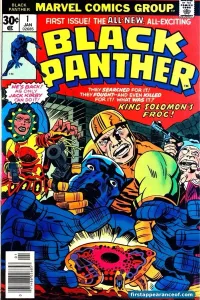
  4. Black Panther #1 (Vol. 3, 1998) cover
    Christopher Priest Wakanda Reset November 1998

    Black Panther #1 (Vol. 3, 1998)

    By Christopher Priest, Mark Texeira

    Christopher Priest writes; Mark Texeira pencils. The 1998 Black Panther relaunch reframes Wakanda as a major geopolitical power on the world stage rather than as an exotic backdrop. Priest's run from 1998 to 2003 is the most-respected modern Black Panther work and is what subsequent writers (Reginald Hudlin, Ta-Nehisi Coates, Tochi Onyebuchi) have built on. The Coates run (2016 to 2018) and the 2018 Black Panther film both draw on Priest's framework.

  5. Black Panther Film February 2018

    Black Panther (2018 film)

    By Ryan Coogler, Hannah Beachler

    Ryan Coogler directs; Hannah Beachler designs the production. The 2018 film is the most-influential single live-action depiction of Wakanda. Coogler and Beachler built a fully-realized Afrofuturist nation with internal architecture, language (Xhosa-based), military culture, and a cinematic visual identity that pushed the comic book version to evolve. Ta-Nehisi Coates's contemporary comic run incorporated film-era visual elements; subsequent comic-book Wakanda is partially a reflection of the film's worldbuilding.

What Wakanda is

Stan Lee and Jack Kirby created Wakanda in Fantastic Four #52 (July 1966) as the home of Black Panther, T’Challa, who debuts in the same issue. The framing was unusual for 1966 American comics. Most superhero fiction of the period treated Africa as either a colonial backdrop (Tarzan-derived jungle adventure) or as a generic exotic setting (the kind of unspecified African terrain used by lesser pulp magazines). Lee and Kirby gave Wakanda specific characteristics: a meteoric vibranium deposit, a hereditary monarchy, a history of resisting colonization, and a level of technological advancement that exceeded any Western nation in the Marvel Universe.

The choice mattered. Wakanda was the first fully-realized fictional African nation in mainstream Marvel publishing, and Black Panther was the first major Black superhero in mainstream American comics. The political and narrative implications of presenting an African nation as more advanced than any Western country were unusual enough in 1966 that the framing has remained the defining structural element of every subsequent Wakanda story.

The country sits on a meteorite impact site that deposited vibranium thousands of years before the present-day stories. Vibranium absorbs kinetic energy and is one of the strongest substances in the Marvel Universe; Captain America’s shield is a vibranium alloy. The metal is the basis of Wakanda’s wealth, its isolationism, and its technological lead. Without vibranium, Wakanda would not work as a fictional concept; with it, the country has a plausible economic and material foundation for its narrative role.

The McGregor expansion

Don McGregor’s ‘Panther’s Rage’ arc in Jungle Action #6 to #18 (1973 to 1976) is the foundational extended Wakanda treatment outside Lee and Kirby. McGregor wrote Wakanda as a real political entity with regional factions, internal conflict over the king’s leadership, and a depth of culture that the Lee-Kirby originals had only sketched. The arc takes T’Challa back to Wakanda after a Fantastic Four-adjacent absence and forces him to reckon with internal political pressure he had been avoiding. The villain, Erik Killmonger, is a Wakandan-born exile whose grievance against T’Challa is grounded in the king’s neglect of his country.

McGregor’s run is one of the most-respected Bronze Age Marvel runs and is the source text for nearly every subsequent Wakanda story. Christopher Priest’s 1998 Black Panther relaunch built on McGregor. Reginald Hudlin’s 2005 run built on Priest. Ta-Nehisi Coates’s 2016 to 2018 run built on all three. Ryan Coogler’s 2018 film drew on Coates and on Priest, with Killmonger as the central antagonist directly adapted from McGregor’s original.

The 2018 film canonization

Ryan Coogler’s Black Panther (2018) is the most-influential single live-action depiction of any Marvel location. Hannah Beachler’s production design built a fully-realized Afrofuturist Wakanda with internal architecture, transportation systems, military design, and visual cohesion that pushed beyond what the comics had ever fully developed. Beachler won the Academy Award for Best Production Design, the first Black woman to do so.

The film’s worldbuilding fed back into the comics. Ta-Nehisi Coates’s contemporary run incorporated film-era visual elements. Subsequent Black Panther titles by Tochi Onyebuchi and others have continued the visual integration. The current comic-book Wakanda is partially a reflection of the 2018 film’s design language, which is unusual for a comic-book property; most film adaptations import comic visuals rather than the reverse.

Collector context

Fantastic Four #52 is the canonical first-appearance key for both Wakanda and Black Panther. The book is a Silver Age tier-2 key by market activity, sitting below the absolute top tier (FF #1, AF #15, Hulk #1, X-Men #1) but above most Silver Age second-rank issues. CGC 9.0 trades in the high four to low five figures; 9.6 is rare and reaches the high five to low six figures. The 2018 film significantly increased the book’s market prices and the values have stayed strong since.

There is no separable Wakanda-specific market premium on FF #52; the book is priced on the Black Panther debut. Subsequent Wakanda-significant issues (FF #53, Jungle Action #6 for the McGregor arc, Black Panther #1 Vol. 3 for the Priest reset) trade as Bronze Age and Modern character keys rather than as Wakanda-specific keys.
Frequently asked questions

The questions readers and collectors ask most.

What is Wakanda's first appearance?

Fantastic Four #52 (July 1966), Stan Lee and Jack Kirby. Wakanda debuts in the same issue as Black Panther (T'Challa), the country's king and ruler. There is no earlier appearance; Wakanda was built whole-cloth for this debut as the home base for the new costumed character. The book is one of the most consequential single-issue contributions to Marvel's worldbuilding in the entire Silver Age.

Why is Wakanda important?

Wakanda was Marvel's first fully-realized fictional African nation and is the home of Black Panther, the first major Black superhero in mainstream American comics. Lee and Kirby's framing rejected the colonial-Africa backdrop convention common in 1960s American comics and instead presented Wakanda as more advanced than any Western nation. The political and narrative implications of that choice shaped Marvel's Africa coverage for the next sixty years. The 2018 film amplified Wakanda's cultural footprint significantly and made it one of the most-recognized fictional places in any superhero franchise.

What is vibranium and why does it matter to Wakanda?

Vibranium is a fictional rare metal that absorbs kinetic energy and is one of the strongest substances in the Marvel Universe. The metal was deposited in Wakanda by a meteorite impact thousands of years ago and is the source of the nation's wealth and technological advantage. Captain America's shield is made of a vibranium-steel alloy. The Black Panther suit incorporates vibranium. Most of Wakanda's military and energy infrastructure runs on vibranium-derived technology. The metal is the load-bearing economic and narrative element that makes Wakanda's isolationism and technological lead plausible within the fiction.

Is Fantastic Four #52 valuable?

Yes, top-tier Silver Age. CGC 9.0 and above is in the high four to low five figures; 9.4 reaches into the five-to-six-figure range; 9.6 and above is rare and trades in the six figures. The book is recognized as both the Black Panther first-appearance key and the Wakanda first-appearance key, though collector pricing is driven primarily by the Black Panther debut. The 2018 film significantly increased the book's market position and prices have remained strong since.

Is the comic-book Wakanda the same as the MCU's?

Mostly aligned but with differences. The 2018 Ryan Coogler film built a fully-realized Afrofuturist Wakanda with deep production design (Hannah Beachler won an Academy Award for Best Production Design) that introduced visual elements not present in earlier comic-book depictions. Subsequent comic-book Wakanda has incorporated film-era visual elements, particularly in Ta-Nehisi Coates's run. Some specifics differ: the comic-book Wakanda has a longer documented history of internal political factions; the MCU Wakanda has condensed family relationships and political structure for screen. Both versions share the core framework of isolationism, vibranium wealth, and Black Panther's monarchy.

Linked characters

2 characters that originate in or use this.