What the symbiote is
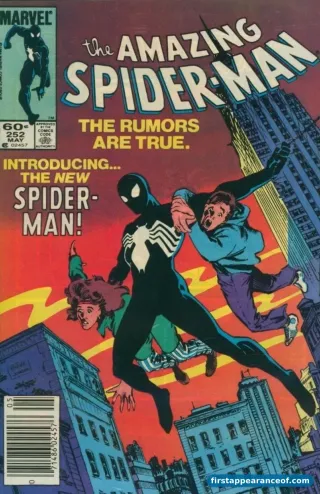
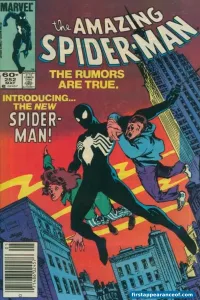
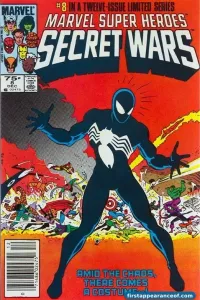
Tom DeFalco, Roger Stern, and Ron Frenz introduced the symbiote in The Amazing Spider-Man #252 (May 1984). The framing was visual: Spider-Man returns from the events of the Secret Wars limited series wearing a new black costume. The framing was not yet that the costume was alive. In ASM #252, the costume is a costume that happens to be black, white, and alien-in-origin. The in-universe origin (Spider-Man finding the costume on Battleworld during Secret Wars) is told in Marvel Super Heroes Secret Wars #8 (December 1984), which was published seven months after ASM #252 because of Marvel’s out-of-sequence event-comic publishing schedule.
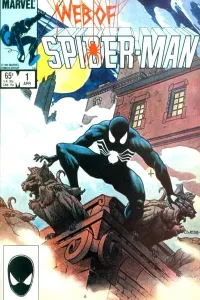
The symbiote’s true alive-and-sentient nature is revealed in Web of Spider-Man #1 (April 1985). Louise Simonson and Greg LaRocque write the issue. Spider-Man learns the costume is bonding to him permanently when he tries to take it off and it resists; Reed Richards confirms the alien biology when Spider-Man visits the Baxter Building. Spider-Man uses church bells to drive the symbiote off (high-frequency sound vibration is the symbiote’s first canonical weakness). The rejection is one of the most-cited single sequences in 1980s Marvel and is the load-bearing event for everything that follows.
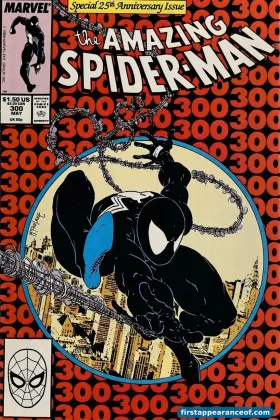
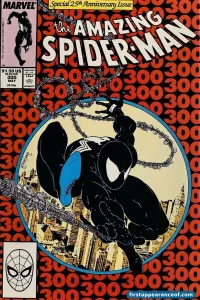
The symbiote, rejected by Spider-Man, finds a new host. Eddie Brock, a disgraced journalist who blames Spider-Man for his career destruction, is the host the symbiote bonds with. Their bonding produces Venom in The Amazing Spider-Man #300 (May 1988). The character debut is the load-bearing modern key for the symbiote concept and is one of the most-collected modern Marvel issues ever published.
Multiple hosts
The symbiote has had many hosts across forty years of Marvel publishing:
- Spider-Man (Peter Parker) — May 1984 to April 1985. The original host.
- Eddie Brock (Venom) — May 1988 to ongoing, with multiple breaks for separation arcs. The canonical Venom and the host most readers identify with the symbiote.
- Mac Gargan (Venom 2.0) — 2005 to 2011. Former Scorpion bonds with the symbiote when Eddie Brock has it removed during cancer treatment. The Mac Gargan period overlaps with Dark Avengers and Siege.
- Flash Thompson (Agent Venom) — 2011 to 2015. Government black-ops use of the symbiote, with Flash Thompson as the host. Rick Remender’s Venom run developed the framework.
- Lee Price — 2016. Brief antagonist period. Mike Costa’s run.
- Eddie Brock (returning) — 2017 onward. Donny Cates and Ram V have continued the run.
- Dylan Brock — Eddie’s son, partial host across some Cates-era arcs.
- Various alternate-reality and what-if hosts — Carnage’s symbiote (Cletus Kasady, the Venom-spawned offspring), the Spider-Verse symbiotes, the Old Man Logan-era symbiote, Knull’s symbiote army.
The structural feature that the symbiote can have multiple hosts is the engine that has kept the concept generative for forty years. Most superhero artifacts are tied to one character; the symbiote is structurally able to migrate, which gives Marvel writers a flexible recurring concept.
The Klyntar / Knull mythology
The post-2017 Klyntar designation expanded the symbiote concept from a single alien parasite into a full cosmic species. Mike Costa’s Venom #6 (Vol. 4, April 2017) canonized ‘Klyntar’ as the name for both the symbiote species and their homeworld. The framework gave Marvel a foundation for treating the symbiote as one entry in a much larger species story.
Donny Cates’s Venom run from 2018 onward built extensively on the Klyntar mythology. The 2018 to 2021 run introduced Knull, the cosmic progenitor god of the symbiote species, as a top-tier Marvel cosmic threat. The King in Black event (2020 to 2021) has Knull leading a Symbiote Imperium attack on Earth, with most of Marvel’s Earth-bound heroes ending up partially symbiote-infected during the conflict. The mythology recasts the symbiote as not just one alien parasite but as part of a primordial cosmic species with its own history predating most of the Marvel cosmology.
The Knull / Klyntar framework has been controversial. Some readers consider the cosmic-progenitor framing an over-extension of what was structurally a simple alien-parasite concept; others consider it the natural development of a forty-year-old idea into something with deeper mythology. Both readings have evidence. The framework has remained canonical since 2018.
Adaptations
The symbiote has appeared in nearly every major Spider-Man adaptation across film, television, animation, and video games:
- Spider-Man 3 (2007) — Sam Raimi’s third Spider-Man film. The symbiote bonds with Peter Parker (Tobey Maguire) and later with Eddie Brock (Topher Grace). Generally considered the weakest of the Raimi trilogy partly because of the symbiote handling.
- Venom (2018) — Sony Pictures’ first attempt at a standalone Venom film. Tom Hardy plays Eddie Brock. The film was commercially successful and established Hardy’s Venom as a recurring property.
- Venom: Let There Be Carnage (2021) — Sequel. Hardy returns. Andy Serkis directs.
- Venom: The Last Dance (2024) — Third Hardy film. Concludes the Sony Venom trilogy.
- Spider-Man: No Way Home (2021) — Hardy’s Eddie Brock briefly appears in a post-credits scene.
- Various animated series — Spider-Man: The Animated Series (1990s), Spectacular Spider-Man, Ultimate Spider-Man, multiple Disney XD series.
Collector context
The Amazing Spider-Man #252 is the canonical first-appearance key. CGC 9.8 trades in the high three to low four figures; 9.6 is in the high two to low three figures. The newsstand variant trades at premium-over-direct prices. The book is recognized as a foundational modern Marvel key and has held strong market position since the 2018 Venom film.
Marvel Super Heroes Secret Wars #8 (December 1984, the in-universe origin) trades at similar levels. Collectors often track both ASM #252 and Secret Wars #8 as paired keys. Web of Spider-Man #1 (April 1985, the symbiote sentience reveal) is the second-tier symbiote-specific key and trades in the high two to mid three figures at CGC 9.8.
The Amazing Spider-Man #300 (May 1988, first Venom) is the apex symbiote-related collector key and trades at significantly higher prices than any of the symbiote-concept-only keys above. The book’s collector market is built on Eddie Brock as Venom rather than on the symbiote concept itself; pricing follows the Venom character debut economy.