What Earth-2 is
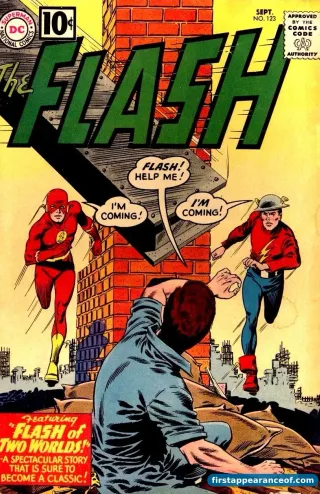
Gardner Fox introduced Earth-Two in The Flash #123 (September 1961). The “Flash of Two Worlds” issue is one of the most-cited Silver Age comics. Barry Allen, vibrating at superhuman speed during a stage performance, accidentally crosses into a parallel dimension. He meets Jay Garrick, the Flash from a different Earth. Fox’s framing is that the two Earths exist in parallel, with the same physical geography but different histories. Earth-One is Barry Allen’s home; Earth-Two is Jay Garrick’s. The designations enter DC continuity from this issue forward.
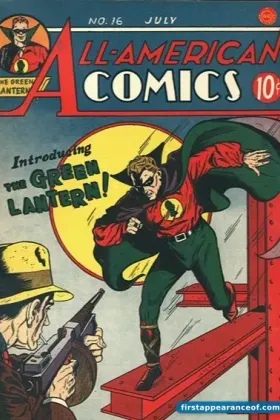
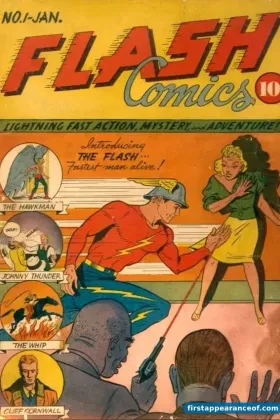
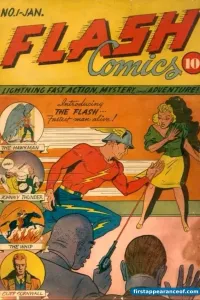
The multiverse framework let DC keep its Golden Age character history alive without contradicting the Silver Age relaunches. Jay Garrick had debuted in Flash Comics #1 (January 1940). Barry Allen debuted in Showcase #4 (October 1956). Both are the Flash. Without a multiverse, only one of them can be canonical. With a multiverse, both can exist on different Earths. Fox extended the framework to other Golden Age / Silver Age pairs: Alan Scott (Earth-Two Green Lantern) and Hal Jordan (Earth-One Green Lantern); the Earth-Two Atom (Al Pratt) and the Earth-One Atom (Ray Palmer); and so on across the DC roster.
The framework also let DC publish Justice Society of America stories alongside Justice League of America stories. The JSA, DC’s first superhero team (All Star Comics #3, Winter 1940), continued to exist as Earth-Two’s premier team. The JLA, DC’s Silver Age relaunched team (The Brave and the Bold #28, March 1960), was Earth-One’s premier team. Periodic crossover issues (the most famous being Justice League of America #21 and #22, 1963, “Crisis on Earth-One!” and “Crisis on Earth-Two!”) brought the two teams together for cosmic-scale events.
Crisis on Infinite Earths and the long retirement
The 1985-1986 Crisis on Infinite Earths event collapsed DC’s multiverse. Marv Wolfman wrote and George Pérez pencilled the twelve-issue limited series, which merged Earth-One, Earth-Two, Earth-S (Captain Marvel’s home), Earth-Four (the Charlton Comics characters), Earth-X (the Quality Comics characters), and various other parallel Earths into a single post-Crisis New Earth continuity.
The merger was structurally messy for Golden Age characters. Wonder Woman was pulled out of WWII history and reframed as a 1970s-era hero (Earth-Two Wonder Woman effectively ceased to exist). The Justice Society survived the merger but was repositioned as a single timeline of older heroes who had operated since the 1940s, rather than as the population of a separate Earth. The Earth-Two designation was effectively retired for two decades.
DC restored elements of the multiverse across Infinite Crisis (2005-2006) and 52 (2007), with the multiverse formally returning as a fifty-two-Earth structure. Earth-Two as a specific designation came back in stages. Geoff Johns’s late-2000s JSA work treated the Justice Society as a foundational Earth-Two team that had migrated to Earth-Zero / New Earth.
The New 52 reset (2012) introduced a new “Earth 2” (no hyphen) with younger versions of the JSA characters, reframed for modern continuity. James Robinson and Nicola Scott’s Earth 2 series ran through 2015 and was followed by Earth 2: Society. The New 52 Earth 2 was a substantial reframing rather than a continuation; Alan Scott was openly gay, Jay Garrick was younger and more bound to the Speed Force, and the political tone was significantly darker than pre-Crisis Earth-Two.
DC Rebirth (2016) partially restored pre-Flashpoint Earth-2 continuity. The current Earth-2 in DC publishing is a hybrid of pre-Crisis Earth-Two framing, New 52 Earth 2 reframing, and Rebirth-era restoration elements. The JSA’s place on Earth-2 in current continuity is the most stable iteration of the designation since the 1980s.
Why this matters
Earth-2 is structurally important to DC continuity in ways that Marvel’s equivalent designations are not. Marvel’s multiverse cataloging is mostly a 21st-century editorial overlay on a continuity that was originally built without it. DC’s multiverse has been load-bearing since 1961 and has survived multiple resets specifically because Earth-Two needed to exist for the Golden Age character history to continue having meaning. The Justice Society’s continuation into the present day is structurally dependent on the Earth-Two framework or its post-Rebirth equivalent.
Most casual readers think of “DC main universe” as a single entity that includes both Batman and the JSA. The reality is that DC’s primary continuity (currently Earth-0 / Prime Earth) is structurally separate from Earth-2 (where the Golden Age heroes live), and the two have always been parallel rather than the same. Conflating them is a common reader confusion that DC editorial has sometimes leaned into and sometimes fought against.
Collector context
The Flash #123 is the canonical Earth-Two first-appearance key. CGC 9.4 and above is in the high four to low five figures; 9.6 reaches into the five-figure range. The book is recognized as both a Silver Age Flash key and the foundational multiverse-framework introduction; collector pricing reflects both attributes.
Flash Comics #1 (January 1940) is the retroactive Earth-Two foundation but trades on its broader Golden Age key status (first Flash, first Hawkman, first Johnny Thunder) rather than as a specifically Earth-Two key.
Justice League of America #21 (August 1963, the first JLA / JSA crossover) is the second-tier multiverse-significance Silver Age key. CGC 9.4 trades in the four-figure range. The cover by Mike Sekowsky is one of the most-recognized Silver Age JLA covers and is a foundational image of the multiverse framework’s storytelling potential.