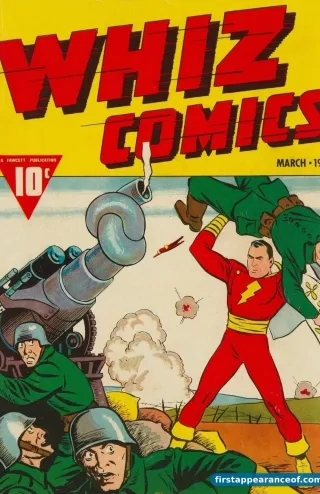
Whiz Comics #2 (1940). Captain Marvel (now Shazam) on the cover, his first appearance and first cover.

1st Appearance and 1st Cover

First Appearance of Shazam

Whiz Comics #2

February 1940 · DC · Golden Age

The 1940 Fawcett Captain Marvel that outsold Superman, sat dormant after a 1953 trademark lawsuit, and returned in 1972 as DC's Shazam. The Big Red Cheese.

Key Issue

Created by Bill Parker · C.C. Beck

By Atomm Updated

The first appearance (1st app) of Shazam is Whiz Comics #2 (February 1940), created by Bill Parker and C.C. Beck for Fawcett Comics. The character was originally named Captain Marvel and outsold Superman across the 1940s. A DC Comics 1953 trademark lawsuit ended Fawcett's publication of the character; DC acquired the rights in 1972 and renamed him Shazam in 1973 to avoid Marvel's separately-trademarked Captain Marvel character. Same issue: first appearance of Doctor Sivana, his defining antagonist.

Quick Facts

Debut
Whiz Comics #2 (February 1940, Fawcett Comics; DC has held the rights since 1972)
Real name
William Joseph Batson
Creators
Bill Parker (writer, character concept), C.C. Beck (artist, character design)
Publisher
Fawcett Comics (Golden Age original); DC Comics (1972 onward)
First enemy
Doctor Sivana (introduced in same issue, his recurring antagonist)
First ally
The Wizard Shazam (his mentor figure who grants him the power)
Team affiliations
Marvel Family (Mary Marvel, Captain Marvel Jr., other Marvels), Justice League (modern era)

Firsts Timeline

  1. Whiz Comics #2 cover
    First Appearance First Cover February 1940

    Whiz Comics #2

    By Bill Parker, C.C. Beck

    Bill Parker writes; C.C. Beck pencils and designs. Published by Fawcett Comics. The character was originally named Captain Marvel and outsold Superman across the 1940s. DC's 1953 trademark lawsuit forced Fawcett to stop publishing the character; DC acquired the rights in 1972 and renamed him Shazam (the magic word that triggers his transformation) to avoid Marvel's separately-trademarked Captain Marvel.

    Read the full breakdown
  2. First DC Continuity Appearance February 1973

    Shazam! #1

    By Denny O'Neil, C.C. Beck

    First DC-published Shazam. Denny O'Neil writes; C.C. Beck returns as artist after twenty years. The book reintroduces the Marvel Family to mainstream comics readership and begins the character's permanent DC residency.

    Read the full breakdown

Creation Story

Shazam is one of the most commercially significant Golden Age superhero characters and one of the most legally complicated. Whiz Comics #2 (February 1940) launched the character as Captain Marvel at Fawcett Comics, a competitor publisher to DC and Timely. Bill Parker wrote the debut and originated the concept; C.C. Beck pencilled and designed the visual character. The book’s framework: orphan Billy Batson is granted six gods’ worth of power by the Wizard Shazam and transforms into an adult superhero by speaking the magic word.

The character outsold Superman across the 1940s. Captain Marvel Adventures, the character’s self-titled ongoing launched in March 1941, ran 150 issues through 1953 and was at various points the best-selling comic book in the United States. Fawcett expanded the framework with the Marvel Family (Mary Marvel, Captain Marvel Jr., the Lieutenant Marvels), which gave the publisher a coherent superhero line that competed directly with DC and Timely.

The DC lawsuit

National Comics Publications, Inc. v. Fawcett Publications, Inc. (1953) is one of the most consequential lawsuits in American comics history. DC sued Fawcett for copyright infringement, alleging that Captain Marvel was too similar to Superman. The case dragged for years; Fawcett eventually settled rather than continue paying legal fees. Captain Marvel Adventures #150 (November 1953) was the final Fawcett-published issue, and the character entered a two-decade dormancy.

DC acquired the rights to the Fawcett superhero characters in 1972. By then, Marvel Comics had trademarked the Captain Marvel name for their own Mar-Vell character (Marvel Super-Heroes #12, 1967). DC could publish the original Fawcett character but only under a different name; they chose Shazam (the magic word that transforms Billy) for marketing purposes.

Shazam! #1 (February 1973) by Denny O’Neil and a returning C.C. Beck is the character’s first DC-published issue and the start of his permanent DC residency. The character has remained at DC ever since.

The Geoff Johns era

Justice Society of America #0 (2006) and subsequent Geoff Johns Shazam work reintroduced the character to mainstream DC continuity with expanded mythology. The 2011 New 52 renamed the character himself Shazam (rather than Captain Marvel), eliminating the need for the “DC’s Shazam who is actually called Captain Marvel within stories” framework that had been awkward for decades.

David F. Sandberg’s Shazam! (2019) with Zachary Levi brought the character to mainstream cinema for the first time. The film grossed $367 million worldwide and introduced Mark Strong as Doctor Sivana.

Collector context

Whiz Comics #2 is a foundational Golden Age key and one of the most valuable non-DC, non-Timely Golden Age books. High-grade CGC 9.0+ copies have crossed $300,000 at auction. Whiz Comics #1 was a never-distributed ashcan; #2 is effectively the first publicly available issue and the first Captain Marvel appearance.

Secondary keys: Captain Marvel Adventures #1 (1941, first self-titled). Shazam! #1 (1973, first DC-published). Power of Shazam #1 (1995). Justice Society of America #0 (2006).
Key subsequent appearances

After the debut, these are the issues collectors and historians reach for next.

  1. 1940

    Whiz Comics #2

    First appearance and first cover. Also first Doctor Sivana.

  2. 1941

    Captain Marvel Adventures #1

    First Self-Titled

    First Captain Marvel-headlined ongoing. Ran 150 issues through 1953 before the trademark lawsuit ended the run.

  3. 1973

    Shazam! #1 (DC)

    First DC-published Captain Marvel issue under the Shazam title. C.C. Beck returns.

  4. 1995

    Power of Shazam #1

    Modern Reboot

    Jerry Ordway writes and pencils a modern Shazam reintroduction. Fifty-issue run.

  5. 2006

    Justice Society of America #0

    JSA Era

    Geoff Johns writes Shazam back into the DC Universe with expanded mythology. Sets up the New 52 and Rebirth-era Shazam books.

In adaptations

Film, TV, animation, and game appearances.

  1. 1941

    Adventures of Captain Marvel

    TV

    Starring:Tom Tyler

    Republic Pictures twelve-chapter serial. First live-action Captain Marvel.

  2. 1974

    Shazam!

    TV

    Starring:Jackson Bostwick, John Davey

    CBS Saturday morning live-action series. Three seasons.

  3. 2019

    Shazam!

    Film

    Starring:Zachary Levi

    David F. Sandberg directs. Levi as the adult Shazam form, Asher Angel as Billy Batson. Grossed $367M worldwide.

  4. 2023

    Shazam! Fury of the Gods

    Film

    Starring:Zachary Levi

    Sandberg returns. Underperformed commercially.

Frequently asked questions

The questions readers and collectors ask most.

What is Shazam's first appearance?

Shazam's first appearance is Whiz Comics #2 (February 1940), created by Bill Parker and C.C. Beck for Fawcett Comics. The character was originally named Captain Marvel. The same issue contains the first appearance of Doctor Sivana, his defining antagonist.

Is Whiz Comics #2 valuable?

Yes, substantially. Whiz Comics #2 is a foundational Golden Age key and one of the most valuable non-DC, non-Timely Golden Age books. High-grade copies (CGC 9.0 and above) have crossed $300,000 at auction. Whiz Comics #1 was a never-published ashcan; Whiz Comics #2 is effectively the first publicly available issue of the title and the first Captain Marvel/Shazam appearance.

Why is Captain Marvel called Shazam now?

DC trademark situation. Fawcett's Captain Marvel outsold Superman across the 1940s. DC sued Fawcett for copyright infringement in 1953, claiming Captain Marvel was too similar to Superman. Fawcett settled and stopped publishing the character. DC acquired the rights to the Fawcett characters in 1972 but by then Marvel Comics had trademarked the name Captain Marvel for their own Mar-Vell character. DC could publish the original Fawcett Captain Marvel under the title Shazam (the magic word he says to transform) but not under the Captain Marvel name. The character has been called Shazam in DC marketing ever since, even though within stories he was originally still called Captain Marvel. Modern continuity (post-2011 New 52) renamed the character himself Shazam.

Who is Doctor Sivana?

Captain Marvel/Shazam's defining antagonist. Sivana debuts in the same issue as Shazam (Whiz Comics #2, February 1940) and has been the character's recurring villain across decades of comics. Sivana is a mad scientist whose schemes drive much of the Golden Age Captain Marvel storytelling. The 2019 film cast Mark Strong as Sivana.

What does Shazam stand for?

An acronym of the gods who grant Billy Batson his powers: Solomon (wisdom), Hercules (strength), Atlas (stamina), Zeus (power), Achilles (courage), and Mercury (speed). When Billy speaks the word, magical lightning transforms him from a young boy into the adult Shazam form. The acronym is the Wizard Shazam's framework; the Wizard chose Billy as his champion in Whiz Comics #2 and continues to feature in modern continuity.