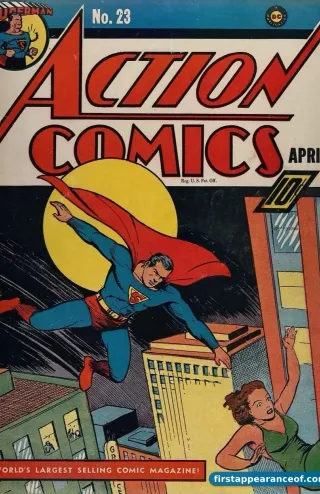
Action Comics #23 (1940). Superman on the cover; Lex Luthor debuts inside.

1st Appearance

First Appearance of Lex Luthor

Action Comics #23

April 1940 · DC · Golden Age

Superman's intellectual opposite. The bald-by-artistic-accident businessman-genius who has been DC's chief Superman antagonist for eighty-five years.

Key Issue

Created by Jerry Siegel · Joe Shuster

By Atomm Updated

The first appearance (1st app) of Lex Luthor is Action Comics #23 (April 1940), created by Jerry Siegel and Joe Shuster. Luthor debuts as a red-haired mad scientist manipulating world powers toward war. His first bald appearance is Superman #10 (May 1941), a result of an artistic error by Leo Nowak that DC retained because of reader response. The bald identity is now permanent. Luthor has been Superman's defining antagonist for over eighty-five years and remains one of DC's most recognizable villains.

Quick Facts

Debut
Action Comics #23 (April 1940)
Real name
Alexander Joseph Luthor
Creators
Jerry Siegel (script), Joe Shuster (art)
Publisher
DC Comics
First enemy
Superman (his defining antagonist across eighty-five years)
First ally
None long-term. LexCorp employees and occasional villain team-ups.
Team affiliations
Injustice Gang, Injustice League, Legion of Doom, Secret Society of Super-Villains

Firsts Timeline

  1. Action Comics #23 cover
    First Appearance April 1940

    Action Comics #23

    By Jerry Siegel, Joe Shuster

    Lex Luthor debuts as a red-haired mad scientist manipulating world powers toward war. Jerry Siegel writes; Joe Shuster pencils. The bald-headed visual identity is introduced by mistake in a later issue (Superman #10) and becomes canonical.

    Read the full breakdown
  2. First Bald Appearance May 1941

    Superman #10

    By Jerry Siegel, Leo Nowak

    Artist Leo Nowak mistakenly drew Luthor bald (mixing him up with a Luthor henchman). Readers responded strongly. DC editorial kept the bald design, which became permanent. One of the most consequential artistic errors in comics history.

    Read the full breakdown
  3. First Cover Appearance Spring 1940

    Superman #4

    By Jerry Siegel, Joe Shuster

    Luthor's first cover appearance (as the still-red-haired version). Predates the bald-identity adoption by roughly a year.

    Read the full breakdown

Creation Story

Lex Luthor is Jerry Siegel and Joe Shuster’s Superman antagonist. Action Comics #23 (April 1940) introduced Luthor as a red-haired mad scientist manipulating European powers toward war from a dirigible base. Siegel wrote; Shuster pencilled. The character was designed as Superman’s intellectual opposite: where Superman is physically overwhelming but ethically simple, Luthor is physically unremarkable but intellectually devastating.

The red hair was the original visual character. Superman #4 (Spring 1940) gave Luthor his first cover appearance in that form. One year later, Superman #10 (May 1941) changed everything. Artist Leo Nowak drew Luthor bald, apparently confusing him with one of his bald henchmen from a previous issue. DC did not correct the error in time, and reader response to the bald design was strong enough that editorial retained it. The bald Luthor has been canonical for over eighty years; it is one of the most consequential artistic errors in comics history.

The Golden Age Luthor ran through the late 1940s and 1950s as a recurring Superman antagonist across Action Comics, Superman, and related titles. He was one of the few Superman villains to persist consistently from the Golden Age through the Silver and Bronze ages without substantial reinvention.

The Byrne reboot

John Byrne’s Man of Steel #4 (October 1986) reimagined Luthor as a corporate-CEO villain. Post-Crisis, Luthor was no longer a mad scientist with domed-island lairs; he was the billionaire chairman of LexCorp, the most powerful corporation in Metropolis, operating legal and political schemes against Superman from public office and corporate boardrooms. The Byrne framing is the foundation for every subsequent Luthor portrayal, including Michael Rosenbaum’s Smallville performance and the modern comics continuity.

President Lex

Superman: Lex 2000 (January 2001) launched one of the most politically ambitious Superman storylines in DC’s history. Lex Luthor wins the 2000 U.S. presidential election in-continuity and serves as President for several years of publishing. The arc runs through multiple DC titles and concludes with Luthor’s impeachment during the Public Enemies arc (2003 to 2004). The President Lex era is a high-water mark for Luthor as a solo character: the storyline centers on his political competence rather than his villainy, forcing Superman to navigate a legal framework where Luthor holds official authority.

Collector context

Action Comics #23 is the Lex Luthor Golden Age key. High-grade CGC 9.0+ copies have crossed $150,000 at auction. The book sits in the second tier of Superman Golden Age keys behind Action Comics #1 and is a foundational Superman-rogue collectible.

Secondary keys: Superman #4 (first cover). Superman #10 (first bald appearance). The Man of Steel #4 (1986 Byrne reboot). Superman: Lex 2000 (2001 President Lex storyline launch).
Key subsequent appearances

After the debut, these are the issues collectors and historians reach for next.

  1. 1940

    Action Comics #23

    First appearance (red-haired).

  2. 1940

    Superman #4

    First cover appearance.

  3. 1941

    Superman #10

    First bald appearance (artistic error retained).

  4. 1986

    The Man of Steel #4

    Byrne Reboot

    John Byrne's post-Crisis reboot. Luthor reimagined as a corporate-CEO villain rather than a mad-scientist archetype. The Byrne framing informs every subsequent Luthor portrayal.

  5. 1989

    Lex Luthor: The Unauthorized Biography

    Character-Focus

    First extended solo-character Luthor examination. James D. Hudnall writes.

  6. 2000

    President Lex (multiple titles, 2000 to 2004)

    President Lex Era

    Luthor becomes President of the United States in a multi-book DC storyline starting with Superman: Lex 2000. The arc runs through 2004 and is one of the defining modern Luthor storylines.

In adaptations

Film, TV, animation, and game appearances.

  1. 1978

    Superman

    Film

    Starring:Gene Hackman

    Richard Donner directs. Hackman plays Luthor across three Christopher Reeve films. The Hackman-era Luthor is comedic and charismatic; widely regarded as a foundational screen villain performance.

  2. 1993

    Lois and Clark: The New Adventures of Superman

    TV

    Starring:John Shea

    ABC series. Shea's Luthor is the first modern-corporate-CEO television framing of the character.

  3. 2001

    Smallville

    TV

    Starring:Michael Rosenbaum

    The WB/CW series. Rosenbaum's Luthor across ten seasons (2001 to 2011) is widely regarded as the definitive television performance of the character.

  4. 2016

    Batman v Superman: Dawn of Justice

    Film

    Starring:Jesse Eisenberg

    Zack Snyder directs. Eisenberg's Luthor is a controversial reinvention.

Frequently asked questions

The questions readers and collectors ask most.

What is Lex Luthor's first appearance?

Lex Luthor's first appearance is Action Comics #23 (April 1940), created by Jerry Siegel and Joe Shuster. He debuts as a red-haired mad scientist. His first bald appearance is Superman #10 (May 1941), which was an artistic error by Leo Nowak that DC retained because of reader response.

Is Action Comics #23 valuable?

Yes. Action Comics #23 is a Golden Age DC key. High-grade copies (CGC 9.0 and above) have crossed $150,000 at auction. The book sits in the second tier behind Action Comics #1 (Superman) but ahead of most other early Action Comics issues. Low-grade reader copies trade in the low-five-figure range.

Why is Luthor bald?

Artistic error. Superman #10 (May 1941) was drawn by Leo Nowak, who apparently confused Luthor with one of his bald henchmen and drew the main villain without hair. Readers responded strongly to the bald version; DC editorial retained the design going forward. The bald Luthor is one of the most consequential artistic errors in comics history and has been canonical for over eighty years.

Is Luthor a scientist or a businessman?

Both, depending on the era. The original Golden Age Luthor (1940 to 1985) is a mad-scientist character with occasional schemes for world domination through technology. John Byrne's 1986 Man of Steel reboot reimagined Luthor as a corporate-CEO villain whose primary power is wealth, influence, and political access. Modern Luthor blends both framings: a brilliant scientist who runs LexCorp and uses corporate power as his weapon.

Did Luthor really become President?

Yes, in canon. The President Lex storyline began with Superman: Lex 2000 (January 2001) and ran through 2004 across multiple DC titles. Luthor wins the 2000 U.S. presidential election in-continuity and serves as President of the United States for several years before being impeached during the Public Enemies arc. The storyline produced some of the most politically ambitious Superman comics of the 2000s.