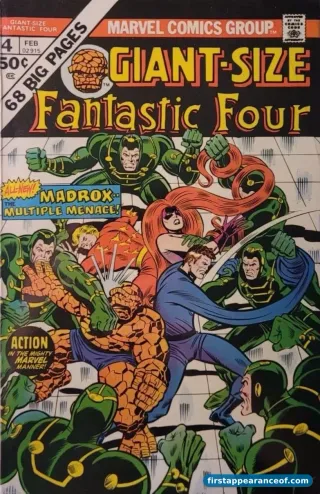
Giant-Size Fantastic Four #4 (1975). Multiple Man on the cover, his first appearance and first cover.

1st Appearance and 1st Cover

First Appearance of Multiple Man

Giant-Size Fantastic Four #4

February 1975 · Marvel · Bronze Age

Len Wein, Chris Claremont, and John Buscema's Bronze Age duplicator-mutant. The character whose Peter David X-Factor reframing turned a Fantastic Four guest-star into a noir detective with seventeen versions of himself.

Key Issue

Created by Len Wein · Chris Claremont · John Buscema

By Atomm Updated

The first appearance (1st app) of Multiple Man is Giant-Size Fantastic Four #4 (February 1975), created by Len Wein and Chris Claremont (co-writers) with John Buscema (artist). Jamie Madrox debuts wearing a containment suit that prevents accidental duplication; his suit malfunctions and the Fantastic Four meet him during the resulting incident. The issue is both his first appearance and first cover. His first solo title is Madrox #1 (November 2004) by Peter David and Pablo Raimondi, which set up the X-Factor Investigations relaunch.

Quick Facts

Debut
Giant-Size Fantastic Four #4 (February 1975)
Real name
James Arthur Madrox
Creators
Len Wein and Chris Claremont (writers), John Buscema (artist)
Publisher
Marvel Comics
First enemy
Antagonist himself in the debut. His complicated relationship with his own duplicates becomes the recurring narrative element.
First ally
Doctor Moira MacTaggert (his early mentor), the Muir Island X-Men auxiliary
Team affiliations
X-Factor (Peter David era), Muir Island X-Men, X-Factor Investigations

Firsts Timeline

  1. Giant-Size Fantastic Four #4 cover
    First Appearance First Cover February 1975

    Giant-Size Fantastic Four #4

    By Len Wein, Chris Claremont, John Buscema

    Len Wein and Chris Claremont co-write; John Buscema pencils. Jamie Madrox debuts wearing a containment suit that prevents him from accidentally creating duplicates. The Fantastic Four meet him after his suit malfunctions. The issue is both his first appearance and first cover. The Wein-Claremont co-script came in the same year both writers were laying groundwork for Giant-Size X-Men #1; Madrox would eventually become a fixture of the X-mythos rather than the FF universe.

    Read the full breakdown
  2. First Self-Titled Series November 2004

    Madrox #1

    By Peter David, Pablo Raimondi

    First Multiple Man self-titled limited series. Five-issue mini. Peter David writes; Pablo Raimondi pencils. Set up the X-Factor Investigations relaunch with Madrox as the lead protagonist.

    Read the full breakdown

Creation Story

Multiple Man is a Len Wein, Chris Claremont, and John Buscema Bronze Age creation. Giant-Size Fantastic Four #4 (February 1975) introduces Jamie Madrox in an unusual debut: he is already wearing a power-containment suit, designed by his late mentor Dr. Daniel Madrox to prevent accidental duplication. The suit malfunctions and Madrox creates dozens of duplicates that the Fantastic Four must contain. Wein and Claremont co-write; Buscema pencils. The cover billing is FF, but Madrox would eventually find his canonical home in the X-mythos rather than the FF universe.

The character’s power (creating autonomous duplicates of himself when subjected to physical impact) is the kind of high-concept mutant ability Bronze Age Marvel was experimenting with after the success of the Silver Age X-Men. The duplicate-as-narrative-engine framework would not be fully developed until Peter David’s X-Factor work three decades later, but the seed concept is in the 1975 debut.

Muir Island and X-Factor

After his FF debut, Madrox’s natural canonical home turned out to be Doctor Moira MacTaggert’s Muir Island research compound, where MacTaggert helped him stabilize his containment suit and his abilities. He appeared sporadically across Uncanny X-Men’s Muir Island arcs through the 1970s and 1980s.

X-Factor #71 (October 1991) brought Madrox to the foreground. Peter David’s X-Factor relaunch had Madrox on the government-sanctioned team alongside Havok, Polaris, Strong Guy, Wolfsbane, and Quicksilver. David’s writing developed Madrox’s potential as a character: the duplicate framework began to support real comedic and dramatic plotting.

The X-Factor Investigations era

Madrox #1 (November 2004), a five-issue Peter David and Pablo Raimondi limited series, set up the framework that would dominate Madrox’s character work for the rest of his publishing life. X-Factor #1 (January 2006) launched Peter David’s X-Factor Investigations ongoing with Madrox as lead detective of a private investigations firm in Mutant Town. The 50+ issue run is widely regarded as the definitive Multiple Man storytelling.

David’s signature move was using Madrox’s duplication as a noir-narrative engine. Each duplicate could pursue a separate lead. Each could develop personality drift if not reabsorbed in time. The accumulated memories on reabsorption let the prime body run multiple investigations in parallel and reach answers that single-investigator detective fiction couldn’t structurally support. The David run resolved long-standing questions about which Madrox is the “real” one and turned a Bronze Age curio into a credible noir protagonist.

Adaptations

Eric Dane’s Madrox in X-Men: The Last Stand (2006, Brett Ratner) is the character’s only major live-action portrayal to date. Dane’s Madrox is a member of Magneto’s Brotherhood; the film’s prison-escape duplication sequence is the most-cited visual representation of the character’s power on screen.

Collector context

Giant-Size Fantastic Four #4 is the Multiple Man Bronze Age key. High-grade CGC 9.6+ copies have crossed $1,000 at auction. The book’s value has tracked with Peter David’s extended X-Factor work and the character’s recurring X-Men appearances.

Secondary keys: X-Factor #71 (1991, Peter David X-Factor launch). Madrox #1 (2004, first solo). X-Factor #1 (2006, X-Factor Investigations launch). The Peter David runs are required reads for any Madrox-focused collection.
Key subsequent appearances

After the debut, these are the issues collectors and historians reach for next.

  1. 1975

    Giant-Size Fantastic Four #4

    First appearance and first cover.

  2. 1991

    X-Factor #71

    Peter David X-Factor

    Peter David X-Factor launch. Multiple Man on the team alongside Havok, Polaris, Strong Guy, Wolfsbane, and Quicksilver.

    Newsstand variant
  3. 2004

    Madrox #1

    First solo title. Peter David and Pablo Raimondi.

  4. 2006

    X-Factor #1 (2006)

    X-Factor Investigations

    Peter David X-Factor Investigations ongoing. Madrox as private detective. The David run on this title (50+ issues) is widely regarded as the definitive Madrox era.

In adaptations

Film, TV, animation, and game appearances.

  1. 2006

    X-Men: The Last Stand

    Film

    Starring:Eric Dane

    Brett Ratner directs. Dane plays Madrox as a member of Magneto's Brotherhood. The film's most notable Madrox visual is the prison-escape duplication sequence.

Frequently asked questions

The questions readers and collectors ask most.

What is Multiple Man's first appearance?

Multiple Man's first appearance is Giant-Size Fantastic Four #4 (February 1975), co-written by Len Wein and Chris Claremont with art by John Buscema. The issue is both his first appearance and first cover. Madrox debuts wearing a power-containment suit that prevents accidental duplication; the suit malfunctions and the Fantastic Four meet him during the resulting incident.

Is Giant-Size Fantastic Four #4 valuable?

Yes. Giant-Size Fantastic Four #4 is a Bronze Age key with X-Men-adjacent collector weight despite its FF cover billing. High-grade copies (CGC 9.6 and above) have crossed $1,000 at auction. The book has tracked with Peter David's extended X-Factor and X-Factor Investigations runs and Eric Dane's brief portrayal in X-Men: The Last Stand.

Why did Wein and Claremont co-write the debut?

Both writers were working on overlapping projects at Marvel in 1974 to 1975. Len Wein was the senior writer; Chris Claremont was a younger co-writer credited alongside him on Giant-Size Fantastic Four #4 (and the same year's Giant-Size X-Men #1). The co-credit reflects Marvel's editorial structure of the period rather than a specific creative decision. Madrox was a Wein-and-Claremont creation in equal measure.

What is X-Factor Investigations?

Peter David's X-Factor relaunch (X-Factor #1, January 2006) reframed Madrox as the lead detective of a private investigations firm in Mutant Town. The 50+ issue run reframed Multiple Man's power as a narrative engine: each duplicate could pursue a different lead, reabsorb the memories on return, and resolve the case through a single body operating in multiple parallel investigations. The X-Factor Investigations era is widely regarded as the definitive Madrox storytelling and resolved the character's long-running existential question of which Madrox is the 'real' one.

How does Multiple Man's power work?

Madrox creates duplicates of himself when subjected to physical impact. Each duplicate is a fully autonomous individual with the original's memories at the moment of duplication. Duplicates can be reabsorbed, transferring their accumulated experiences back to the prime body. Peter David's X-Factor era developed the canonical complication that the duplicates may have personality drift over time, raising questions about which version is the 'original' and what reabsorption ethically requires.