Creation Story
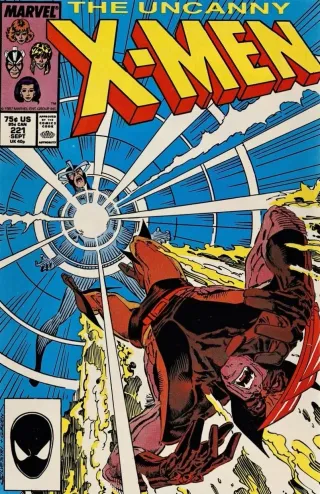
Mr. Sinister is Chris Claremont and Marc Silvestri’s Copper Age X-Men addition. Uncanny X-Men #221 (September 1987) introduces him as the geneticist behind the Marauders, the black-ops mutant unit responsible for the Mutant Massacre crossover (Uncanny X-Men #210 to #214 plus crossing-over titles, 1986). Claremont writes; Silvestri pencils. The issue is both his first full appearance and first cover.
The character had been mentioned in earlier issues without appearing on-panel; #221 is the canonical first appearance. Silvestri’s visual interpretation (sharp-featured, white-skinned, cape-wearing, with a distinctive diamond pattern on his forehead) became the canonical Sinister design that subsequent artists have preserved across decades.
The Inferno crossover
Uncanny X-Men #239 (December 1988) and X-Factor #39 (April 1989) developed Sinister’s role in the Inferno crossover (1989). Claremont and Silvestri on Uncanny; Louise Simonson and Walt Simonson on X-Factor. The crossover canonized much of the Sinister mythology: his obsession with the Summers-Grey bloodline, his involvement in the cloning of Madelyne Pryor (Cyclops’s first wife, a clone of Jean Grey created by Sinister), and his complicated relationship with Apocalypse as patron-and-rival.
The Victorian origin
The Further Adventures of Cyclops and Phoenix #1 (April 1996) by Peter Milligan and John Paul Leon canonized Sinister’s full backstory. Nathaniel Essex was a 19th-century geneticist whose unethical research on early mutation led him to seek out Apocalypse and bond with the cosmic Celestial-derived being. Essex was transformed into the immortal Mr. Sinister and has operated across centuries pursuing genetic-perfection research.
The Victorian-immortal framework gives the character substantial backstory weight that subsequent X-runs have developed extensively. Sinister’s obsession with the Summers-Grey bloodline, his involvement in mutant-genetics-driven crises across decades, and his complicated political position within the broader X-mythology all derive from the Essex-era origin.
The Krakoa era
House of X #1 (October 2019) by Jonathan Hickman and Pepe Larraz reframed Sinister’s role in modern X-Men continuity. The Krakoa-era framework positioned Sinister as a politically-corrupted ally rather than a pure antagonist; he’s part of the Quiet Council on Krakoa and is involved in the Resurrection Protocols. The framework gave Sinister his most extensive modern character work and is widely regarded as one of the strongest sustained Sinister-development arcs since the Inferno era.
Adaptations
X-Men: The Animated Series (1992 to 1997) featured Sinister as a recurring antagonist. Sinister was originally written into X-Men: The Last Stand (2006, Brett Ratner) but cut from the final production. X-Men ‘97 (Marvel Studios, 2024) features the character with substantially more screen time than the 1990s animated series provided.
Collector context
Uncanny X-Men #221 is the Mr. Sinister Copper Age first-appearance key. High-grade CGC 9.8 copies have crossed $400 at auction. Newsstand variants carry a meaningful premium. The book’s value tracks with X-Men adaptation cycles.
Secondary keys: The Further Adventures of Cyclops and Phoenix #1 (April 1996, Victorian origin canonization). House of X #1 (October 2019, Krakoa-era reframing).